Incidently, the stated twist distribution for the LAEV blades is very
strange, and I have not heard any response on the reason and logic
of that decision - Vance J
As a guess Vance what speed would you say it is twisted for.
I think Bill made some assumptions as to the actual direction of the in
flow
around the hub. I think he assumed a certain amount of external
diffusion
directly in front of the cowl as I recall. Is it the hub angles
of attack you are concerned with?

Paul Lamar
That's what I thought too Vance when I tried to figure out what the
"pitch" of the blade was at various tip angles. All I could figure was
Bill de-pitched it near the hub because he knew it was for a tractor.
But I haven't asked him (yet).

--
Perry Mick
Vance W Jaqua wrote:
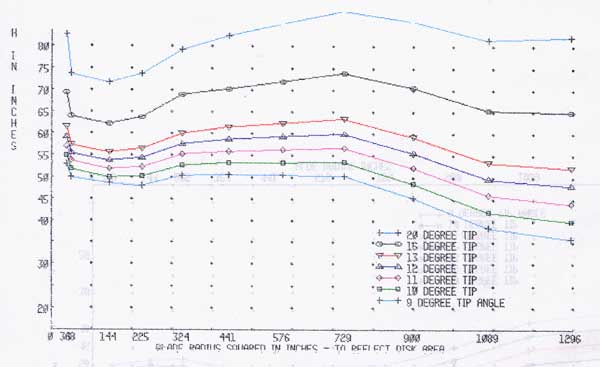
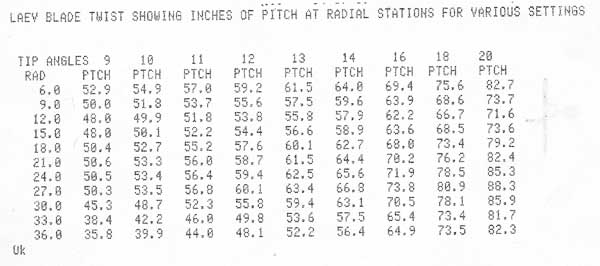
Here are a couple of plots of pitch distribution versus radial portions
of the blade versus a bunch of tip angle settings. The first is a simp;e
table, which I am sure a lot of the guys and gals have already
computed. The second is a graphic plotted against radius squared
which better shows the amount of disk area impacted by each radial
zone. The twist does not appear to be optimized for major areas of
true helical pitch. at any speed. In virtualy all settings, over 30 percent
of disk area
near the tip appears to be at least 20 percent under pitched ??
It will probably work reasonably well, since propellers are really
rather forgiving devices - but???
Vance J
Bill had some pretty good reasons for doing this at the time Vance.
As I recall we discussed this at length. If I get time I will look
up the pertinent messages.

>From memory I think the outer de pitching was to reduce the
transonic drag rise.

Paul Lamar


The AirCraft Rotary Engine NewsLetter.  Powered by Linux.
ACRE NL web site. http://home.earthlink.net/~rotaryeng/
Copyright 1998-2002 All world wide rights reserved.