Hi Butch,

 A thought occurred to me regarding the prop blade and hub and I can't seem
to get it out of my mind, so thought I would send it for your consideration.

    As you know there is an "coning" effect produced as the tips/ends of the
blades want to pull forward while spinning while the hub end of the blade is
anchored (by the hub).  My question regards the possibility of the coning
forces at the tip of the blade causing the hub end to bind.  It would seem
that to preclude the possibility of these forces causing the end of the prop
journal from being forced to the side and contacting the hub ( and possibly
binding) that the design would need two ball bearing races in the hub/prop
journal separated by a couple of inches.

    Now that I have that off my chest, I will await your illumination of my
befuddled brain {:>)

Ed Anderson

********************************************************************************

Hi Ed / Gang;

I must apologize for my tardiness in answering, seems I have caused a rather
tremendous ruckus-scramble after announcing my retirement, so I've been swamped
with FINAL project closings......I must be pretty good at what I do since they
refuse to "Let go" :)

Ed there's a short answer to your concern:   IF it could happen, it would just
prevent you from pitching the Blades further, and they would freeze/hold their
present pitch setting......The standard procedure would then be no different
than any of the previous failures we've discussed.

However, for the sake of "illumination", I'm taking the liberty of setting up
such a scenario....Ed you're right, there is a "Conning/Flexing" phenomena
which occurs that is most prevalent at the Blade tips.....and ends before the
Prop Hub, exactly where depends on the stiffness of the Blade.....The stiffer
the Blade the further outboard, and the softer being further inboard.
Regardless, the LAEV's Hub merely sees this as a perpendicular Force on the
Shank..........I agree with you, and it was previously discussed, that two (2)
Bearings spaced apart on the Shank would be a stronger approach, but in my
opinion way overkill.......The Bearing on the LAEV is quite capable of taking a
great deal more perpendicular loading than it could ever be exposed to. A
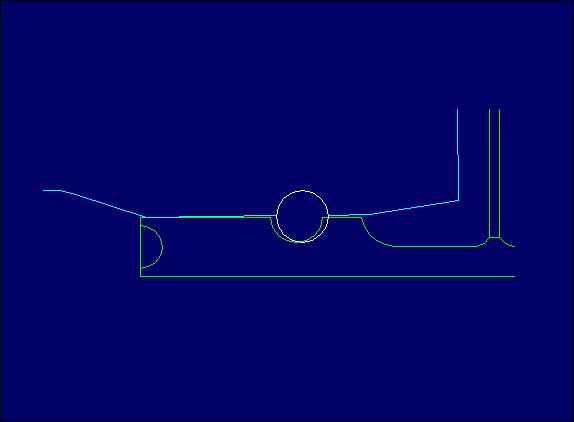
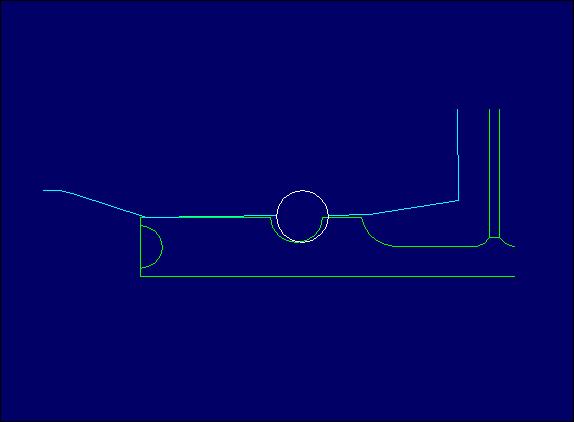
failure as shown in attachment NO 1 would take a TREMENDOUS amount of force
which is well beyond the actual Blade design parameters and would be considered
catastrophical.

Now for the kicker!!!!!.......The above is what's considered Static Loading.
However in actual usage (Dynamic Loading), this becomes a completely different
story since we gain an ally, Centrifugal Force.

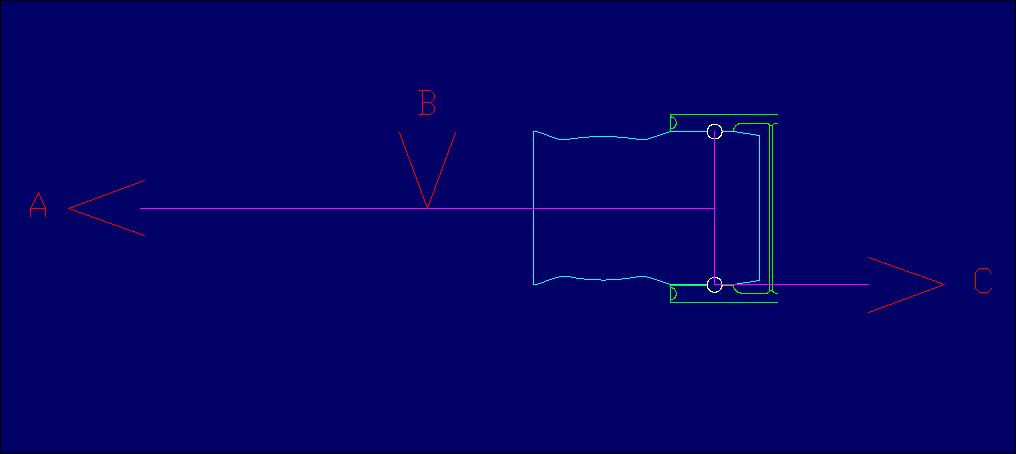
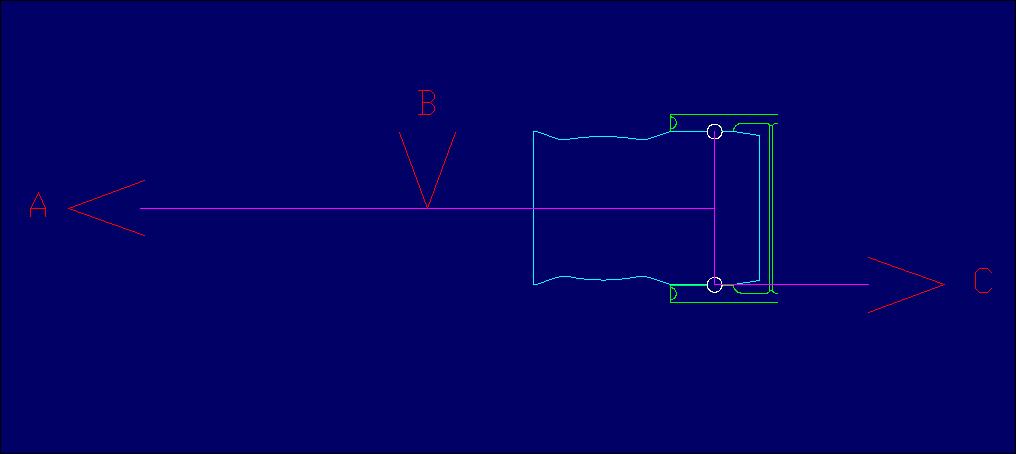
Reffering to attachment NO 2:

A= 31,800 lbs.........Centrifugal Force at 3000 rpm (Dynamic Loading)
B=  1,459  " .........Perpendicular Loading at Blade mid point (17.5"/1.612")
C= 15,839  " .........Load on Bearings (Static loading)

What this means is:
If you were to place Load B on the Blade, the Bearing will be loaded to 15,839#
at C static. As soon as you start to spin the Blade the dynamic loading at C
will star to shift to the front of the Bearing, as the rpm increases till you
get to 3000 rpm which unloads the perpendicular loading on the Shank to 0
(zero) lbs. This of course changes with Gyroscopic Forces......So you might say
this prop is designed for 2918 lbs of thrust at zero Perpendicular Shank
Loading ;)

I hope most of you made sense of my babbling, especially you Mr. Test Pilot:)

I'll be more than happy to clarify it further if necessary.

                                                            Butch
Well put Butch.

Paul Lamar

The AirCraft Rotary Engine NewsLetter.  Powered by Linux.
ACRE NL web site. http://home.earthlink.net/~rotaryeng/
Copyright 1998-2003 All world wide rights reserved.