james coffman wrote:
I'm at the stage where I need to make a plenum or
dynamic chamber for the manifold. In Tracys book he is
showing his made with separate chambers for inner and
outer runners to utilize reflected waves from the
closing intake ports.  My engine will be
turbo-normalized.   Easiest construction would be a
cylinder with throttle body on the end.  How about a
discussion on construction of the plenum?  Thanks Jim
Coffman
The dynamic chamber is not what we need. It gives more torque at
3000 RPM at the expense of less HP at 6000 RPM. In effect it doubles
the length of the runners and that is why Mazda uses it to enhance
the torque at 3000 RPM. Low speed torque is a real problem with
the rotary used in cars. The problem is the convoluted air passages
where the air enters the dynamic chamber. Best to use a simple
cylinder or square tube plenum with a simple three inch or larger
single butterfly throttle body facing forward picking up dynamic pressure
and cold air. Don't forget the bell mouths where the runners
enter the plenum.
Worth about 10 HP more around 190 to 200 HP.


Paul Lamar
Yes. I'd appreciate some input on building the intake too. I just got my
manifold. It looks good and its a great start, but the flange is too small
and two of the bolt holes miss it. ('93 13B REW). How do I get around that?
Weld a plate on the edge? Paul mentions "bell mouths", but the ends of the
runners are square and flat. Should we fabricate these bells or buy them -
any sources? Also, for those who've removed metal with a die grinder - any
tricks on measuring when to stop?
John Slade
Cozy IV 13B Turbo
Yes you will need to weld a bit of metal on (1/4 by 1/4 by .4 thick)
to accommodate the different engine bolt patterns. I screwed up slightly on that
version when I tried to save some weight. I will add a little more metal
the the flange on the next batch.
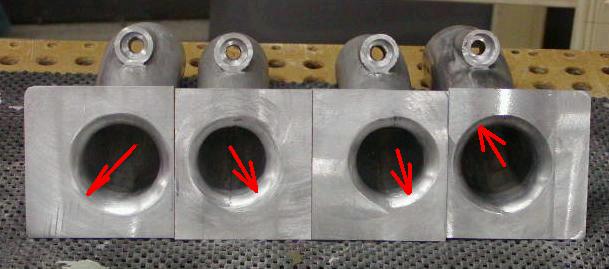
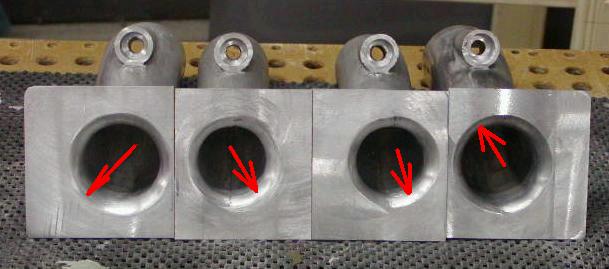
Adequate bell shapes are cast in. You will need to do a little additional radiusing
and polishing with a die grinder where the casting has been machined
flat to mate to a flat plenum wall. There is plenty of metal left to facilitate
that. Low cost sand casting is an imperfect science
and it has its limitations due to the absolute necessity of having draft
to pull the pattern from the mold. When the injector runners are machined
flat to fit a flat sheet metal plenum wall some of the cast in radius
is sacrificed.