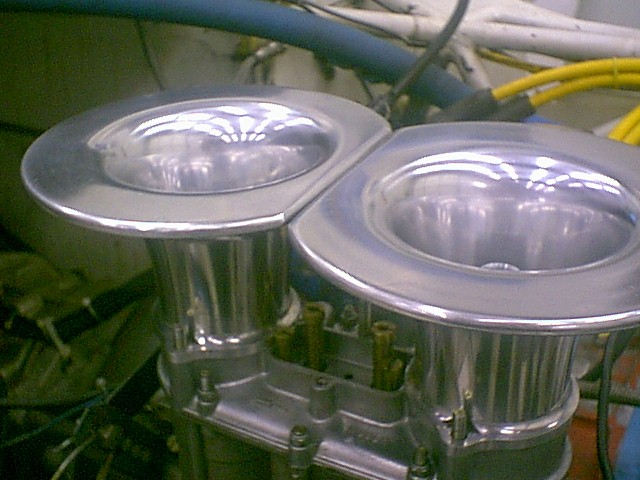
Don't forget the bell mouths where the runners enter the plenum.
Worth about 10 HP more around 190 to 200 HP.

Paul Lamar

You keep writing this. But one source tells me that the rounded
edges of
the bell mouths is the key here, not just the bell shape.

Finn

Possible I guess. Who is your source?
Does he have any comparison dyno data both ways?

I am just going on what Power Sport told me and what is common tuned
intake
manifold practice in the automotive industry. I think Mazda would
use it if it was noticeably better than just a simple bell mouth which
they do use along with Mercedes, Ford, GM, BMW, etc., etc.. In fact I
am
willing
to bet if that is really true the difference is immeasurably over a
simple
Bell mouth.

That feature would certainly greatly increase the cost of machining
the intake runners. In fact I see no way of machining it short of
an NC mill.

Paul Lamar

I don't understand the difference.

David Leonard
The Rotary Roster:
http://members.aol.com/_ht_a/rotaryroster/index.html

 Finn is referring to a feature with a 180 degree radius lip rather than
 a 90 degree radius lip.
Well then, everyone is right for the most part. The Flow bench likes all
kinds of shapes. It would seem obvious that some shapes just will not fly.
(Play on words) The worst case is a bare tube with some of the outside of the
tube exposed to the flow. This is where higher pressure flow can approach the
inlet from all directions including along the side walls of the tube. So some
of the flow is in the opposite direction of that desired. The flow around the
edge of the tube must perform a 180 degree direction change to enter the
tube. This direction change drops energy and the inertia chokes the actual
flow through the tube to half of the calculated flow for that size tube.

Better, is the tube to a wall 90 degree opening that prevents the 180
direction change. (Imagine a tube with a big washer welded at the very end of
it.) The worst case will now be a 90 degree direction change and that only
for flow along the wall.

Better is a tube with a trumpet shaped opening. The idea is to reduce the
velocity of the flow around the edges of the bell and then as the velocity
increases toward the center of the tube energy is not lost in a sudden
direction change, but the change is over a great distance so the speed is
reduced and the centrifugal force produced in the turn is reduced, and flow
near the surface of the opening remains attached so there is little or no
choking effect.

All of the is also affected by pulsed flow, reversion, how flow is entering
the inlet area, distance to the opposing wall, and so on. The ideal shape for
the inlet end of the tube won't fit in the plenum in most installations. The
point at which I cannot detect improved flow with my home built flow bench is
around three diameters of the test piece. At least one bell diameter to the
opposing wall.

You guys are using very large diameter intake runners for the displacement
involved, and most will not run over 6,500 RPM, so flow velocity will not be
all that high. So you can read close the barometric at full throttle. Anyway
a radius at the end of the runner is 10 times better than a sharp edge. Fire
up the vacuum cleaner, or the shop vac, and start experimenting. A piece of
string or thread held against the side of the tube back from the end. Now
make a funnel shape from card board and tape it on just as an inlet trumpet.
Notice the different sound of the motor as the revs drop off a bit because of
the improved flow (more work being done). Notice how the string acts along
the sides of the funnel and where it enters the hose end. More than twice the
flow with the funnel, no matter how poorly it is constructed

The bigger the radius of the shape the better, up to about three runner
diameters. Polished ID works better and looks better.  If it looks good it is
good.

Lynn E. Hanover
Carb horn shapes are far more critical than fuel injection horn shapes as you need the
flow velocity through the venturi to send  a strong signal to the main jet over a wide
RPM and air flow range in automotive use. In car racing applications where the
rules specify a max diameter or area restriction of the air intake the
exact shape of the horn is super super critical. It can make the difference
between first and last place.

Paul Lamar

The AirCraft Rotary Engine NewsLetter.  Powered by Linux.
ACRE NL web site. http://home.earthlink.net/~rotaryeng/
Copyright 1998-2003 All world wide rights reserved.