Tracy Crook wrote:
Previous msg
SNIP <<
I don't see any reason why at least 15 lbs can't be shaved off a gearbox
with the proper housing design.
While I applaud any efforts to reduce weight, I think we need a reality
check here.

The current RD-1B gearhousing weighs 9.75 pounds (total main & planet
carrier housing)
The current adapter plate weighs 7.75 pounds.
total  17.5 pounds

Reduce this by 15 pounds?

And Paul is right about messing with the E shaft.  Insane idea. Forget it.

Affordable light weight side housings are an ambitious undertaking and my
hats off to anyone who succeeds.  I'd certainly be in line for a set and
will volunteer to fly a set as soon as they are available.

Tracy Crook
tcrook@rotaryaviation.com
www.rotaryaviation.com
There is also the output and input shafts. I think where
the Ross scores is in the light weight of the hollow output shaft.
In theory lots of weight can be removed by making this shaft larger
in diameter and hollow. This also reduces the stress concentrations
where the shaft is connected to the planet carrier and to the prop
flange.

Also the Ross scores in the use of light weight needle bearings which
work fine at the low RPM's of the output shaft. Big ball or tapered roller
bearings are heavy. As far as I know nobody has complained
about the failure of the shaft needle bearings. The only complaint
we have on the Ross, other than defective machining from unit to unit,
is the lack of a helical sun gear thrust bearings. All other
bearings (needle bearings all) seem to be holding up fine.

The current load path is as follows. From the six planet
gear shafts down to the spline diameter... along the shaft and out
and up to the hollow prop dowel pin diameter.

Lets think outside the box. In theory the minimum
stresses and hence the lightest weight structure would occur if the
shaft diameter was the same or greater than the diameter of the
circle defining the planet gear shafts. Currently this diameter
is 3.5 inches for the 2.85:1 gear box. For the 3.15:1 gear box
it would be 3.25 inches. The diameter of the circle defining the
prop drive dowel pins is 5.5 inches as I recall.

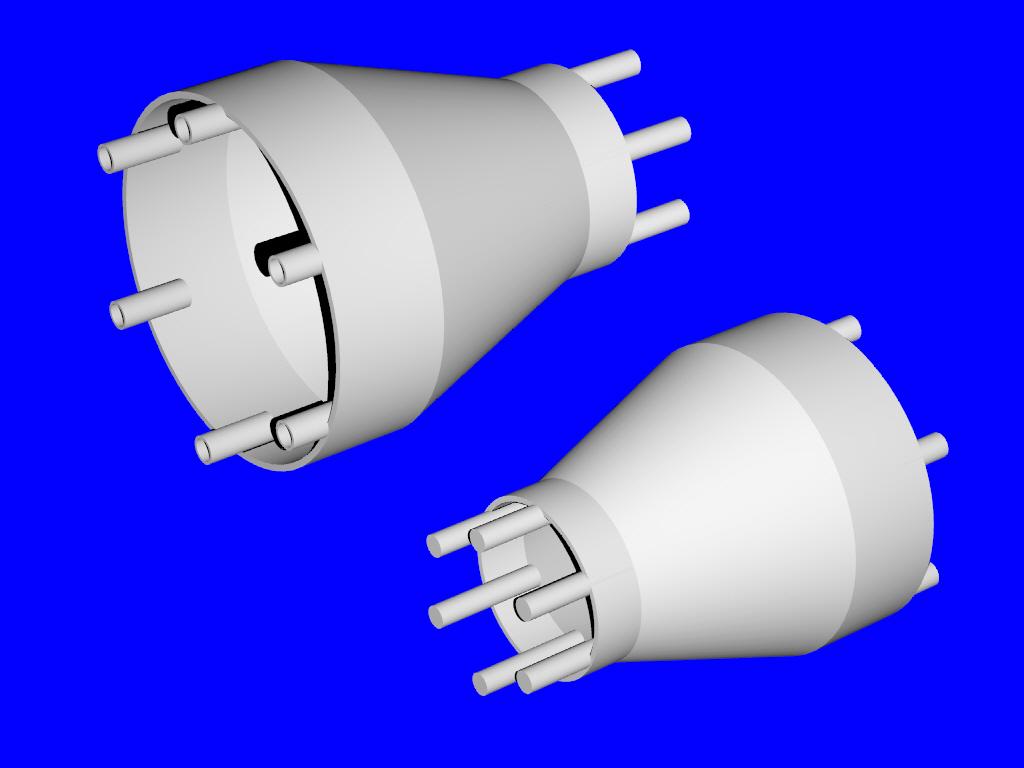
Here is a 3D of what I would consider to be an optimum output shaft.
The prop thrust bearing would be two 3.75 ID 4.6 OD needle thrust bearings
back to back directly abutting the planet carrier.

The shaft could be hydroformed at low cost and bits and pieces
welded to it.

The prop bearing would be 5.5 inch ID 6 inch OD  type WJ
needle bearing with a limiting speed of 3400 RPM and a max radial
load of 35,000 pounds

The planet end needle bearing would be 3.5 by 4 with a limiting
speed of 4800 RPM and a max radial load 18,800 pounds.


Here too is a rendering of the current Power Sport gear box
for background.

Paul Lamar

The AirCraft Rotary Engine NewsLetter.  Powered by Linux.
ACRE NL web site. http://home.earthlink.net/~rotaryeng/
Copyright 1998-2003 All world wide rights reserved.