Thanks for the flow data. Interesting about the thermostat. Good
argument
for not running one. Faster water.. more turbulence... better heat
transfer.

Paul Lamar
Not to mention better heat rejection from the radiator - better HT
coefficients, and lower delta T in to out giving higher average
rejection temp.

BTW; the intake plenum is made from fiberglass and painted silver.  It's
design was constrained by the cowling and other things in the way, or I
would have made it into a more effective dynamic chamber (DC).
Dynamic chambers rely on the fact the rotors are 180 degrees out of phase.
That is not the case in a 3 rotor and is why Mazda doses not use
them in the three rotor.
My
analysis of the optimum runner length for a 3-rotor where the ports
communicate via a DC is about 13" for 6000 RPM.  The effective length I
have is close to that, but I don't know that my plenum is very effective
in reflecting the pulses.

On a related note; one of the reasons that the hp continues upward at
the high RPM is the ability of the engine to "breath" reasonably easily.
Even in this case more power could likely be achieved at the higher RPMs
with larger throttle body bore.  I selected a 44mm (1.73") diameter bore
(each rotor) as adequate for up to 6000 or so, and still provide good
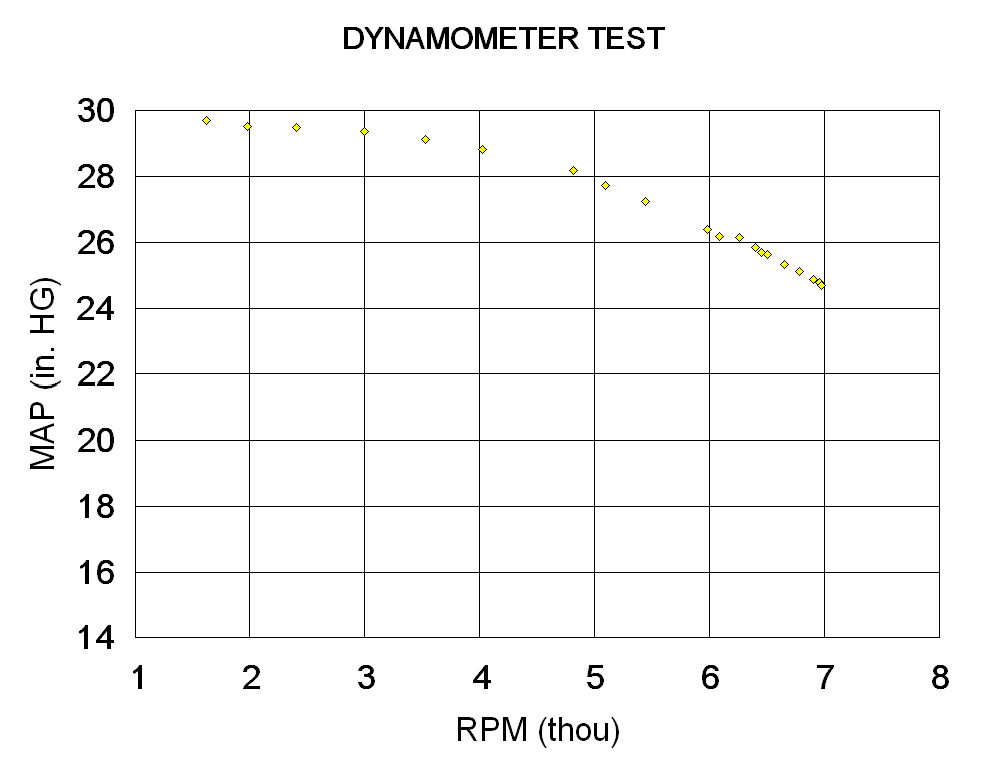
control at the low end.  The MAP pressure curve (attached) shows some
amount of drop up toward 7000; so if you want to run your normally
aspirated engine at this level or above, larger bore is better.  This
TWM 3003 series TB is available in 46 and 48 mm.  Low end control isn't
that much of an issue in aircraft.

And speaking of breathing; the engine has a tangential manifold/muffler
with the exit out the rear end (2 3/4"). Just a few inches downstream is
a secondary custom muffler that has an inner perforated tube (1/4"
holes) surrounded by an outer tube.  The inner tube has a slight
restricting orifice in the center to encourage some of the flow to go
through the holes.  The system was connected to the dyno exhaust system
which also contains a large muffler.

Power runs were made with the dyno muffler disconnected, and with both
the secondary muffler and dyno muffler diconnected.  There was
essentially no change in the power output from the baseline case.

Sound level measurements about 8 ft away at about a 45 degree angle from
the exhaust exit were taken with and without the secondary muffler.  The
readings at full power were 126 dB without the secondary muffler, and
120 with it on.  Both are high, but the good news is that the secondary
muffler provides a 6 dB reduction without affecting the power.  NO doubt
about it; it was a powerful sound.  We were not able to measure at a
point 23 meters perpendicular; or whatever the standard is.  At low
power low rpm, like taxiway operation, the sound was quite gentle; I'm
guessing little or no worse than a Lyc.

AL
Great manifold pressure data Al. Thanks a bunch. The manifold pressure
curve does indeed prove there is a lot more HP available from this engine at 4000
RPM and up. With a little more tuning work this proves the 20B is the most
powerful normally aspirated internal combustion aircraft engine
available short of a  985 radial.

Paul Lamar


The AirCraft Rotary Engine NewsLetter.  Powered by Linux.
ACRE NL web site. http://home.earthlink.net/~rotaryeng/
Copyright 1998-2003 All world wide rights reserved.