"Del Johnson, North Point Solutions, Inc" wrote:
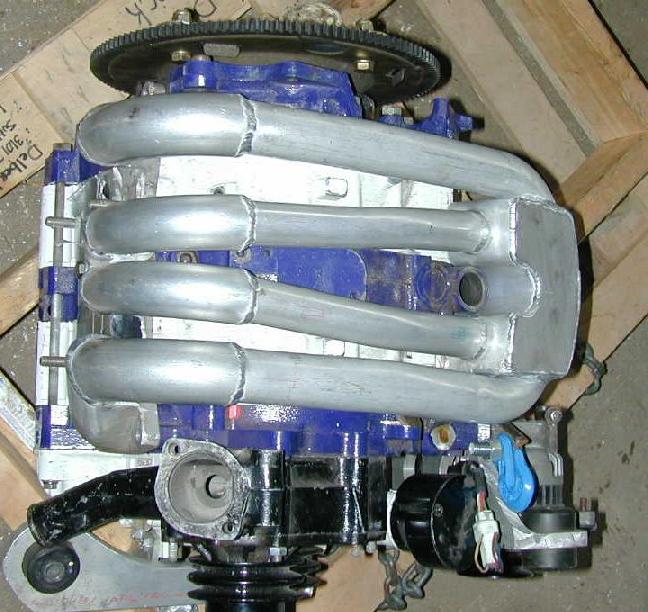
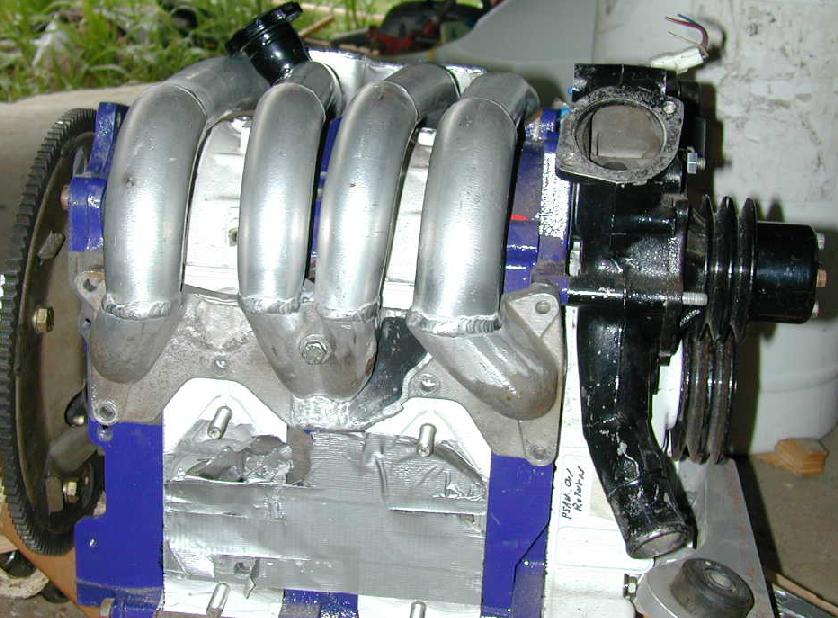
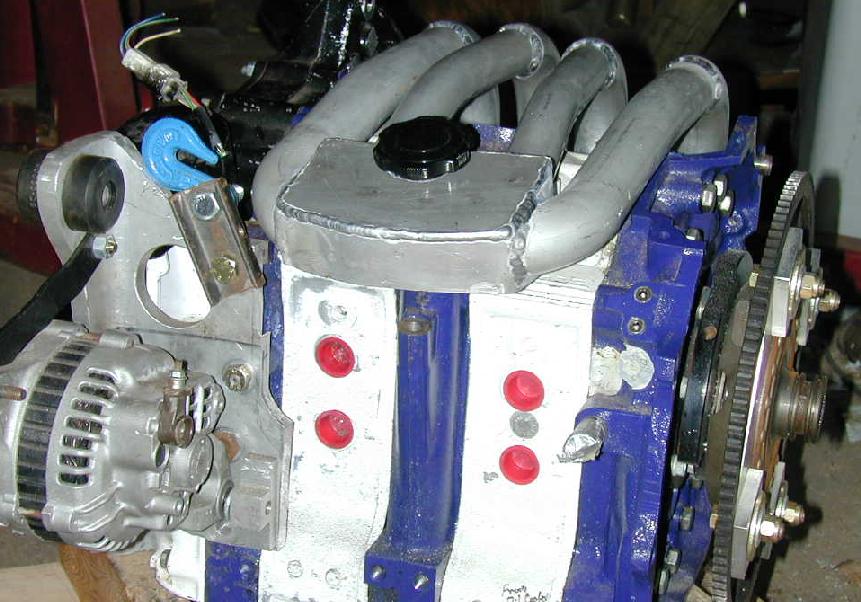
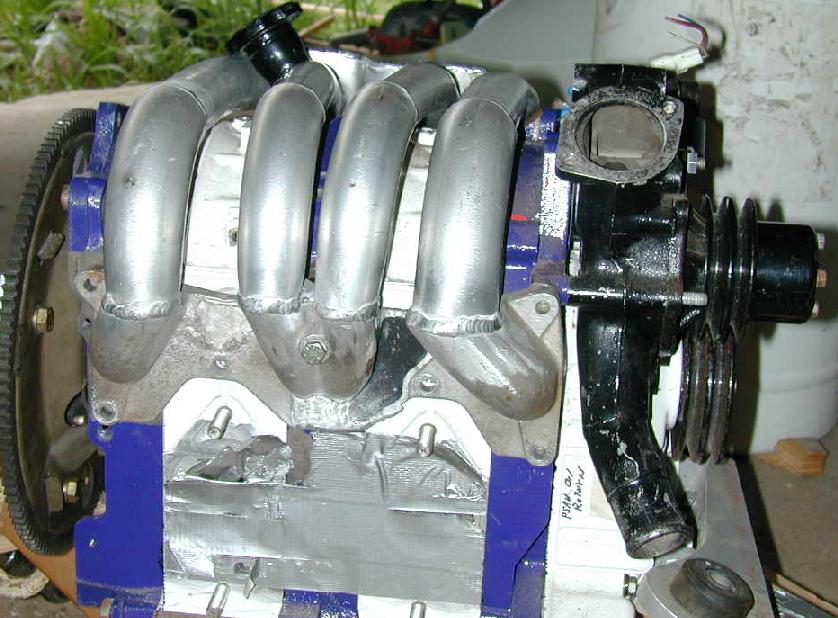
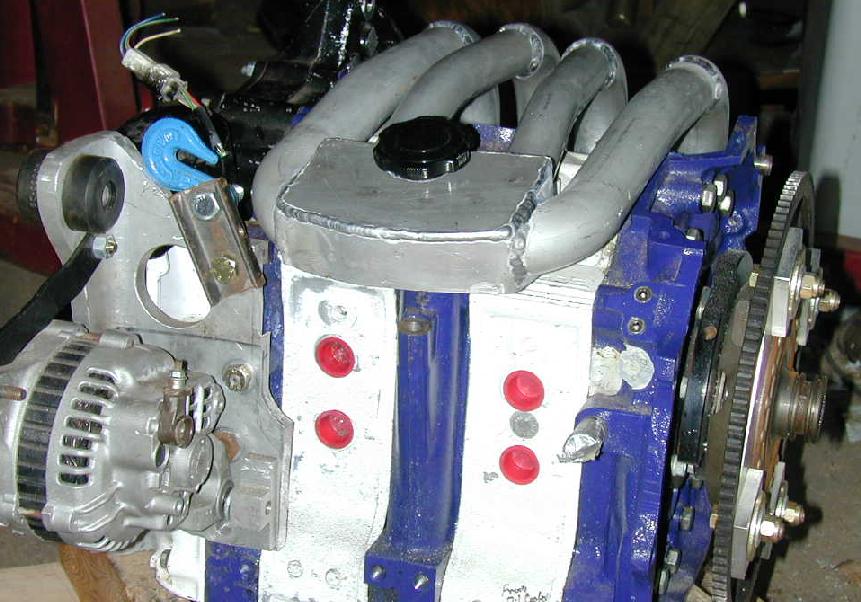
Attached are photos showing the intake manifold that was just completed
using the lower half of the stock manifold.  The air box was designed to
wrap around the oil fill area.  The tubing is 1-5/8 and 1-3/8 0.058
thickness.  I cut away the water jacket casting on the stock manifold and
Fritz Smydra, my master welder and Community College instructor/friend,
welded up the assembly including the water jacket ports on the intake
flange.  The whole assembly weighs 5 lbs. 5 oz without the plate on the
underside of the air box (still being fabricated).  There is a baffle inside
of the air box to achieve the dynamic chambering affect in the primary and
secondary intakes.

There is sufficient room under the intake runners to utilize the primary
injectors ports.  I will weld on injector bosses on the secondary injectors
near the top of the stock manifold where the 90 degree pipe bends are
attached.  The intake runners were bent slightly in a pipe bender to curve
over the engine and to provide clearance from the oil fill tube.

The oil dipstick tube was remove and the hole was taped.  I can position the
stock throttle body under the air box but might not use it in preference for
a larger throttle body.  If I go with the larger throttle body I will attach
an intake duct to the air box and move the throttle body forward.  I plan to
add supports to the air box that come up from the threaded holes just above
the top spark plugs which I think were used for attaching the knock sensors.

Paul, I didn't use your castings because I started on this long before they
were available.  I couldn't get access to my welder until after he was done
with teaching.  Now that he has his summer off I hope to work with him on
the cooling system.

Also, the college is sending him to be trained on the use of Unigraphics CAD
systems as well as the CNC equipment that mates with it.   I'm still
planning to use exhaust augmentation and spoke to him about building dies to
stamp out fishtails.  He was interested in doing it as a learning project
while he was taking these courses during the summer.  My thought was to take
Inconel sheet material and stamp out two symmetrical fishtail half pieces
and then weld them together.  I understand that the Mazda engine is hard on
restriction in the exhaust system but shouldn't Inconel work for this
purpose?  Any ideas on the general design of the fishtail.  Do you need
baffles in them to help spread the gases?  If he is able to make the dies
would anyone else be interested in the fishtails.
I would eliminate the dynamic chamber part if you still can.
Your runners are plenty long enough as is and you will only
lose a bit of power on the top end if you make it a dynamic chamber.
No point in enhancing the torque at 2500 RPM.

If you don't mind sawing off what you have and welding on a log
type plenum your runners would all be the same length which will
also enhance the power at the tuned length of the runners.
What you have now  broadens the HP curve because the outer runners
are longer than the inner runners. Consequently they are tuned for
different RPMs. Unlike cars aircraft engines don't need broad HP curves.

Make the plenum a rectangular box with at least 160 cubic inches
of volume 3 X 5 X 10 and place a hole in it right
over the oil filler pipe. Lengthen the oil filler pipe and run it
up through the hole in the plenum. Or weld a bent steel tube
to the side of the pan for an oil filler. The optimum length of the
runners should be around 17 inches total for a 2.17:1 gear box.
Shorter for a 2.85:1 gear box.

Don't forget the bell mouths where the runners enter
the plenum. Put the throttle body on the front side of the
plenum so there is a straight shot into the throttle body
from the air scoop to recover as much pressure from the forward
speed of the aircraft as possible.

I don't think you need Inconel that far away from the exhaust ports.
.065 stainless will probably last forever. You might need a doubler
at the edge of the fish mouth to beef it up and keep it from cracking.

Paul Lamar

The AirCraft Rotary Engine NewsLetter.  Powered by Linux.
ACRE NL web site. http://home.earthlink.net/~rotaryeng/
Copyright 1998-2003 All world wide rights reserved.