Dan Ruggirello wrote:

Ooops!  I meant:

"But, for me it all hinges on a decrease in BSFC, or I don't see the need
to tune
for cruise."
;-)
Dan
Dan there is a very simple way of looking at it.

Volumetric efficiency AKA pumping LOSSES.

When you pump air through a pipe, surface friction drag slows
the air and heats the pipe. That is where some of the energy in
the fuel goes and why the BSFC is higher.

I don't know why I did not think of this explanation a long time ago :)

Paul Lamar
Dan Ruggirello wrote:
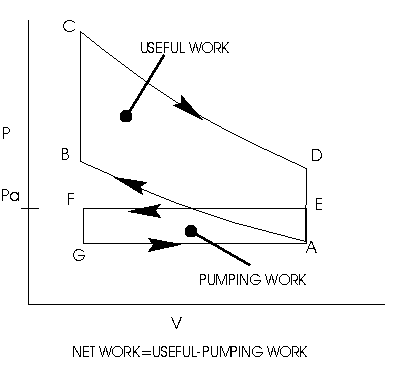
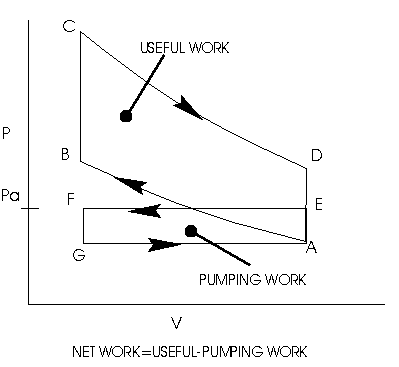
Thanks, that's a good way of looking at it.  I found a graph of the
throttled Otto cycle and it shows the pumping work required for intake and
exhaust.  This clearly shows that minimizing the rectangular area of the
intake/exhaust pumping work maximizes net work.  Also, according to Mark's,
intake pumping loss (area AXFGA) is typically about 60% and exhaust is 40%.

Hmm, it does seem very compelling.......

As far as your design, I am not too sure what happens with turbulence within
the plenum  when you extend the bell mouths into the plenum for the longer
lengths.   The trombone slide idea was an effort to minimize this effect.  I
concede it is more difficult to suspend.  It also may be OK at the higher
RPM's depending on realistic obtainable lengths.  It would probably lend
itself well to a ground adjustable type too.

Dan
It is a good question on what goes on inside the plenum. Mazda used a
very voluminous plenum on the Lemans car.

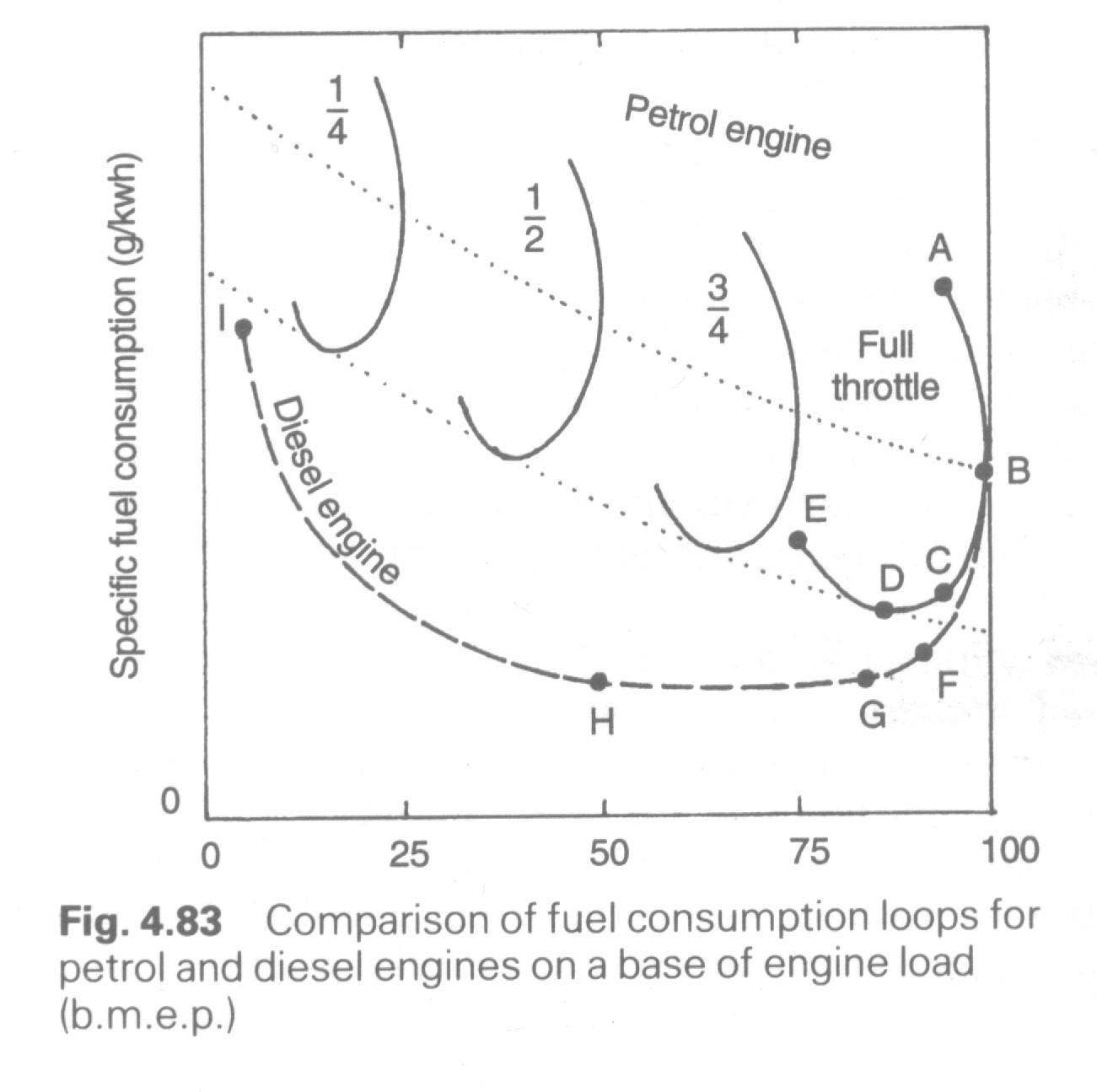
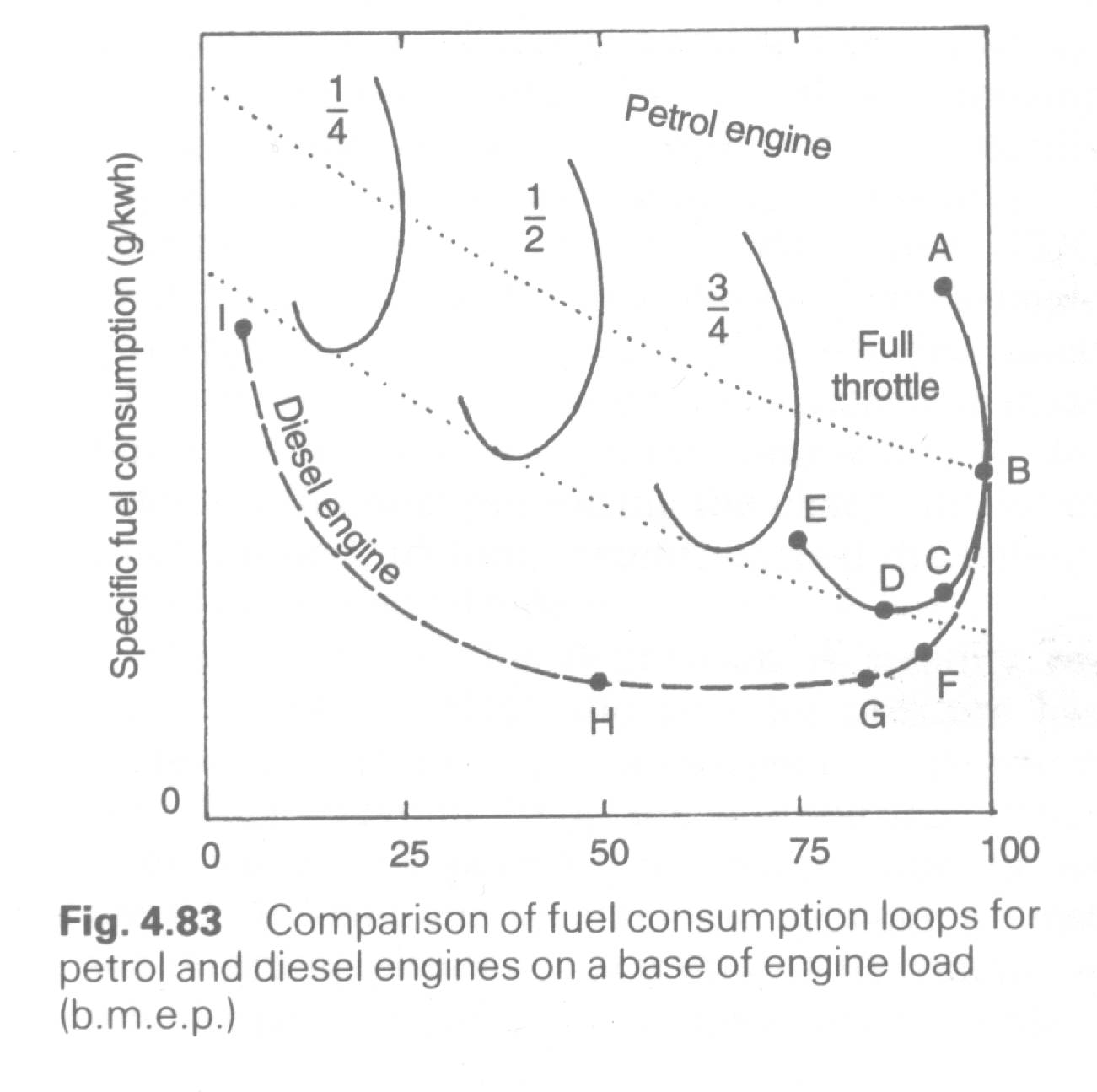
Here is very interesting chart from "Advance Engine Tech" by Heinz Heisler page 227.
The little hooked shaped curves are BSFC at different throttle openings/load/torque.

As you start at the tip of the WOT hook and move around the curve the
mixture changes from full rich to full lean.
Point E is excessively lean.
Point D max thermal eff.
Point C stoichiometric 14.7:1
Point B max bmep/HP
Point A is excessively rich.

"pumping losses from the diesel engine remain reasonably constant
from no load to full load" Because the throttle is always wide open
and only the amount of fuel injected is used to control power.

"pumping losses for a petrol engine progressively rises as the bmep
is reduced due to increased throttling" throttling in essence is
the same as VE. A 120% VE is like having a throttle 120% open :)

What is very interesting about this is the fact that the diesel
and the gas engine's BSFC converge at wide open throttle and explain
why diesel engines are not all that well suited to aircraft use.
Any advantage the diesel has at WOT is due solely to the increased
compression ratio bought at a drastic increase in structural weight.

As Peter Garrison said, in his recent Flying article, the 230 HP Renault diesel
is 100 pounds heavier but is only getting one or two gallons
an hour less fuel burn in the 10 to 15 GPH range.
The Renault is a four cycle diesel with intake and exhaust valves.
It would not surprise me if a loope scavenged piston ported 2 cycle diesel
like the Delta Hawk had a worse BSFC than a good aircraft engine.

Paul Lamar

The AirCraft Rotary Engine NewsLetter.  Powered by Linux.
ACRE NL web site. http://home.earthlink.net/~rotaryeng/
Copyright 1998-2003 All world wide rights reserved.