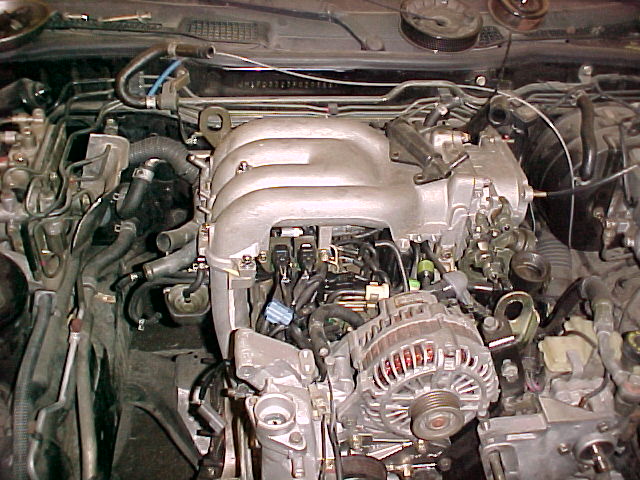
Ed, how is your intake manifold coming. I am intensely interested
in how you are going to configure the business end.

Here is a picture of Dave Lemons Production 2nd gen
convertible road racer. Now that is a serious air supply hose :)

Paul Lamar
Boy! that is one serious air intake.  However, I am working on one that
might rival it {:>).  I have completed the plenum casting mold and cores
and
was prepared to cast the plenum today - however, when I did my
calculation
of how much resin I needed,
SNIP
 So been busy, and close but no cigar yet. Thanks again for the casting,
made it all possible!

Ed
You do nice work Ed. This is a grand experiment in manufacturing intake
manifolds. What other types of resins are available for this kind of work.
Most of the production plastic manifolds are made from nylon as I recall.
Who is your source for these casting resins?

You will get the same power at 6000 RPM if you shorten the total
loop length to 17 inches. In other words from one outside port to
the other outside port. The distance from inside port to inside
port will be less which will tend to broaden the effect over a range
of RPM. That should save some weight. As your design is now it is tuned
for 3000 RPM and is working as a conventional tuned pipe manifold
at 6000 RPM. Rough numbers of course. The same as the Mazda stock
manifolds are designed to do.

The fact that most dynamic chamber designs we have seen so far
for four or six port engines have different loop lengths
for the primary and secondary ports tends to broaden the HP curve
at the expense of the peak power obtainable with a simple high Q system
with all runners the same length.

I will shortly up load a 3D design for a peripheral port dynamic chamber
that inherently solves this particular problem.


Paul Lamar
Thanks, Paul

    There are a number of casting resins - as you might imagine.  The ones
suitable for "Home workshop" (in other words won't poison you out right
{:>) - and even then you have to be careful and don't require injection
molding ) are more limited.  They appear to fall into three categories,
polyester resin, Polyutheran resin and epoxy resin. There are others - but
many are for injection molding.    These come in all sorts of varies with
different hardness, elasticity and other properties.  The two principal
categories are "filled" and "Unfilled" types.  The filled ones simply have
something (aluminum dust, glass mircospheres, fiberglass fiber) to give it
additional desired properties.  Some of the resins set in as little as 3
minutes, some take hours.  The hardness, elasticity, specific gravity vary
considerably giving you a large number of variables to consider.

   I am current using the products of a company called  Smooth-on (URL
http://www.smooth-on.com/proto.htm ).  I had intended to use their
resin/plastic called C-1520 but that turns out to weigh quite a bit, so have
decided on their product called Feather-Lite with a specific gravity of 0.67
(will float on water).  Won't really know how well it will turn out until I
get it done and installed.  I intend to let a piece of scrap casting soak in
100LL and 87 Auto fuel continuously to see if any detrimental effects show
up.

   Appreciate your comments on the tuning of the induction system.  The
tubes shown in the photo are longer than they will be - always save the
cutting to last {:>).  But, I am going to send you the data I used to
calculate the "dynamic length).  Apparently there is something I don't
understand about the dynamic chamber and want to send you the details of how
I did the calculation - so I can understand where I am going amiss.  It
appears the math I am using to determine length for the dynamic pulse effect
ends up right for 3000 rpm whereas I think it right for 6000 rpm. The 17-18"
length, you mention,  is what I get for  the runner distance from outside
port to throttle body to other outside port  rather than the total length of
port to port.   Appears I am confusing a "Tuned" lenght with that required
for the dynamic effect.  Details to follow.

In the meantime, I've order the additional resin I needed and hopefully will
have it poured by this time next week.
Ed Anderson
17 inch is right from port to dynamic chamber for both 3000 and 6000.
At 3000 RPM the pulse travels 34 inches from one
port over to the other while at 6000 RPM it looks like two simple
17 inch runners and a somewhat restricted plenum chamber.
This is about the stock 3rd gen configuration.
As I said low RPM torque is their biggest problem

If yours is 17 inches from side housing port to side housing port it is
primarily tuned broad band for about 6,000 and 12,000 as simple pipes.

Here are a couple of shots of the third gen dynamic chambers.
Mazda claims they are a large improvement over the 2nd gen versions.
The main improvement is putting the air feed pipe/throttle body in the same
plain as the runners more or less. The 2nd gen feed the air
in at 90 degrees. They could not quite pull it off on the
inner loop as you can see here. It goes in at about a 45 degree
angle. I noticed that Able Ibarra with his 800 HP turbo third
gen 13B engine uses this stock manifold that has been extensively
extrude honed.

This is a fascinating subject to me and I am sure Mazda spent millions
researching this stuff.

Paul Lamar

The AirCraft Rotary Engine NewsLetter.  Powered by Linux.
ACRE NL web site. http://home.earthlink.net/~rotaryeng/
Copyright 1998-2003 All world wide rights reserved.