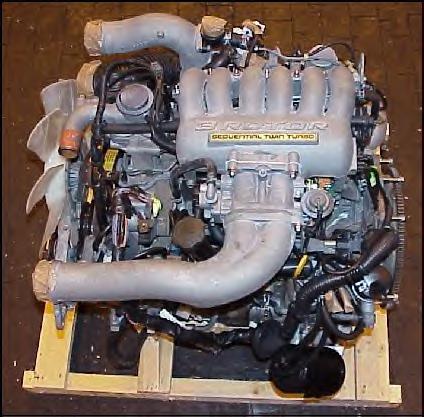
17 inch is right from port to dynamic chamber for both 3000 and
6000.
At 3000 RPM the pulse travels 34 inches from one
port over to the other while at 6000 RPM it looks like two
simple
17 inch runners and a somewhat restricted plenum chamber.
This is about the stock 3rd gen configuration.
As I said low RPM torque is their biggest problem

If yours is 17 inches from side housing port to side housing
port it
is
primarily tuned broad band for about 6,000 and 12,000 as simple
pipes.
Here are a couple of shots of the third gen dynamic chambers.
Mazda claims they are a large improvement over the 2nd gen
versions.
The main improvement is putting the air feed pipe/throttle body
in the
same
plain as the runners more or less. The 2nd gen feed the air
in at 90 degrees. They could not quite pull it off on the
inner loop as you can see here. It goes in at about a 45 degree
angle. I noticed that Able Ibarra with his 800 HP turbo third
gen 13B engine uses this stock manifold that has been
extensively
extrude honed.

This is a fascinating subject to me and I am sure Mazda spent
millions
researching this stuff.

Paul Lamar
I agree, fascinating indeed - Ok, looks like my 21" from port to
dynamiic
chamber vice 17" is a bit long for 6000 rpm which probably
explains why
my
peak torque appears closer to 5700 rpm than 6000. I will shorten
this
one
from the current 21" to around 18" just to see the effect. Can
always
shorten it another inch or so {:>).

Too bad we don' t have the resources to research/experiment/test
to
determine optimum for aircraft use, but considering what we get
its
fairly
close with the Renneses even closer to the perfect power plant.

Got a copy of Flying Magazine, Peter's article on the rotary
engine
referes
to you as the "Spider at the center of the web" {:>).

Ed
Yes I know :(

Can you shorten it to 8.5 inches? That would be optimum for
the manifold to actually work as a dynamic chamber. At 17 inches
and 6000 RPM it is working as four tuned pipes (two at one length
and two at another length) feeding off two piss poor plenums :)
At 17 inches it is working as an actual dynamic chamber only at 3000
RPM.
As far as the slightly different lengths are concerned an
electronic
analogy would be two series resonant circuits tuned
at slightly different frequencies in parallel. The impedance would
be lower if they were both tuned at the same frequencies
and the bandwidth narrower.

Hopefully Jerry Hey will have a p-port engine running soon
and it is easy to vary the runner length so we may have some dyno
data on this soon. The dyno is close to being done. All I need now
are some engines to run on it.
Okay, if one was to "tune" for 6K rpm using 8.5 inch runner lengths,
what
happens at a lower cruise rpm of say 4500 ? Will the power be
substantially
reduced and / or will fuel consumption be adversely affected?
Wendell
The fuel economy will suffer but that is an extremely low RPM for
an aircraft rotary. Stay tuned I am addressing that issue.

Paul Lamar
Paul,
If I am following this thread correctly, it only applies to the 13B, and not
the 20B?  Any idea what would be the optimum runner length for a 20B with
2.85:1 psru and six individual runners?

Mark S.
True Mark. The dynamic chamber is based on the fact the two rotor fires twice per rev
180 degrees out of phase. Mazda could not use it on the three rotor
and used a very nicely made, beautiful in fact, simple tuned manifold
on the three rotor. Probably tuned at a rather low RPM for a rotary. My guess
is down around 4500 to 5000 RPM from the looks of it. I have
never measured the runners on one.

Paul Lamar

The AirCraft Rotary Engine NewsLetter.  Powered by Linux.
ACRE NL web site. http://home.earthlink.net/~rotaryeng/
Copyright 1998-2003 All world wide rights reserved.