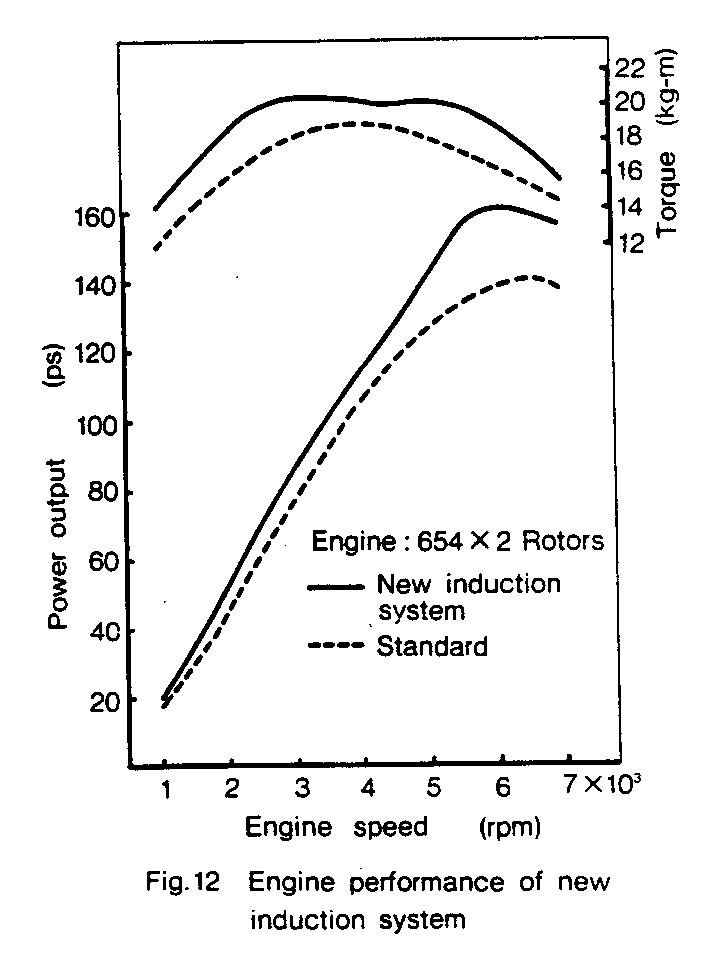
Paul;.........Being rather ignorant in all this Intake Tuning,
Dynamic
Chamber,
and Plenum Chamber etc. stuff, I find myself bouncing between
GETTING IT,
DUMBFOUNDED BY IT and NOT GETTING IT AT ALL :(
So I'm counting on the likes of YOU in the list on setting specific
guidelines
of all this so that the likes of ME on the list don't kill
themselves :)
That is..........Unless a miracle should happen in the interim, and
I
finally
GET IT ;-)
****************************************************************************
****
Well Paul,........The miracle has happened!!!....It was there all along
in my e-
mails and I just finished reading it, (5/26/03-"How Dynamic Chambers
Work").
Being behind on the reading of the newsletters I sort of jumped the gun.

Very, Very nice, an easy to comprehend explanation/demonstration on a
very,
very complex subject....It FINALLY clicked in......I FINALLY GOT IT!!!!!
:) -
Thank You.

                                                        Butch
PS:..........Great graphics ;)
Your welcome Butch. It took me a couple of years to figure it out as it
was never adequately explained by Mazda in all the SAE papers
they wrote and mentioned it in. In MUST work in that dual mode
or the torque curve would not look the way it does. A dual
hump camel. We could call it the rotary camel intake manifold.
or the rotary intake camel manifold.

The question remaining is; does Ed have it? :)

Paul Lamar
Well at least you have one bright pupil, Paul.{:>)

  No, Not willing to admit it I have it  yet.  But, still working on it
{:>).  Thought I had it figured out with a two port/stubbed port Helmholtz
resonator (which gave me two peaks for torque at around 3000 and 5000 rpm)
model of the intake.  I am using the dimensions off an 88 manifold.  Then I
screwed up,  I went out and actually examined the 13B "dynamic" chamber more
closely and measured it..

 Much to my surprise, I found it was not really a chamber as I had
invisioned it.  In that the primary and secondary apparently to not mix in
the chamber (they only interface on the intake side of the throttle body's
butterfly plates)  and the cross sectional  of the primary and secondary
pipes do not increase much , perhaps 1.5 the tube diameters,  although they
do go from a circular to an oval cross section as they entered the box.  The
secondary pathway is from a secondary manifold tube across the box in its
own chamber passing by the two throttle body ports (approx 6" across the
box).  The primary pathway is from a primary manifold tube pass the single
throttle body port and across to the other primary approx 2 1/2". No
connection inside the box that I could see.

Much like my current "plenum" the box appears to provide a conduct from one
pipe to other of the same type as well as access to the ports of the
throttle body.

But, in any case,  the volume I had estimate for the Helmholtz resonator
(base on external size of the dynamic box) went out the window and I am back
to examining another simpler model.
I'll get it one day, just takes a little longer for us old dogs.

Ed
Of course the inner and outer loops have separate
air intakes. I thought you knew that :) They both work the same
way but the inner loop is a bit shorter and that is why the torque
curve (band width) is broadened compared to the conventional system with
all tuned runners the same length. Again the  parallel series resonant
circuit with slightly different tuned frequencies comes to mind
as a good electronic analogy.

When you get it please try shortening the pipes to at least move the dynamic
chamber's lower torque hump up to around your cruise RPM and see if you can
do better than Tracy on the BSFC. IOW lower burn. You will be giving up a bit of power
on the top end as that will also move the upper hump further to the right
on the torque curve verses RPM. You might be able to get some of that
torque/power back by going to a 2.85:1 or 3.12:1 PSRU ratio and
run the engine up to 8000 RPM or more for take off.
4500/9000 tuned RPMs might be a good compromise with a high
ratio gear box even if you never get to 9000 RPM on takeoff.

Paul Lamar

The AirCraft Rotary Engine NewsLetter.  Powered by Linux.
ACRE NL web site. http://home.earthlink.net/~rotaryeng/
Copyright 1998-2003 All world wide rights reserved.