Ed Anderson wrote:
Hi Paul,

    As you know, the BurnsStainless bent aluminum tubing is annealed to
"O"
condition before bending - leaving it somewhat softer than desired for
our
applications.  See extract below, it appears that by sticking it into a
regular electric (not microwave) and baking it for 8 hours you can get
it
back to T-6 condition. (hate to think what the electicity cost would
be).
I think I may try that with my intake manifold just to see.

Ed Anderson
Jim Millett, president of U.S. Light Aircraft Corp., told us something
that
illustrates the peculiarities one can encounter in the field of heat
treating aluminum. He suggests taking a small piece of 6061-T6 sheet and
trying to bend it with your hands. You will find it to be very strong
and
springy. Then heat it to 950 degrees. This could be done in a pottery
kiln
or by using a propane torch to heat it evenly until the surface turns
gray.
Then immerse it in cold water. This is what is called "solution heat
treatment." The sample is now in the 6061-0 condition, the last "0"
meaning
that it has been annealed to dead soft and easily bent condition. Then
bake
it in a kitchen oven at 350 degrees for eight hours. This is called
"precipitation hardening" and the sample is now back to the 6061-T6
condition and just as strong as it originally was.

Ed Anderson
Matthews, NC
RV-6A N494BW
eanderson@carolina.rr.com
Funny you should mention that now. I am about to pick up about 120 bends
from the
bender and take them over to the heat treater.

How does it feel in the O condition. Can you easily bend or dent the .058
scrap?
BTW the legs on those bends look very long. What did Burns charge
you for those bends? I assume you are going to cut them off around
17 inches.

Paul Lamar
The O condition is soft, fairly easy to ding.  They have probably age
hardened a tad since I've had them a while.  I forget the exact price, but
it was somewhere around $27 each.  Yes, I am going to cut them off at around
8-9 inches up.  I am going to leave the length of the secondary about what I
have now as it gives me great torque around 5300 rpm (on cold mornings can
get 5800-5900 as I overpower and stall the prop).  However, the primary loop
will be shorter to try to get a little more power in the higher rpm range.

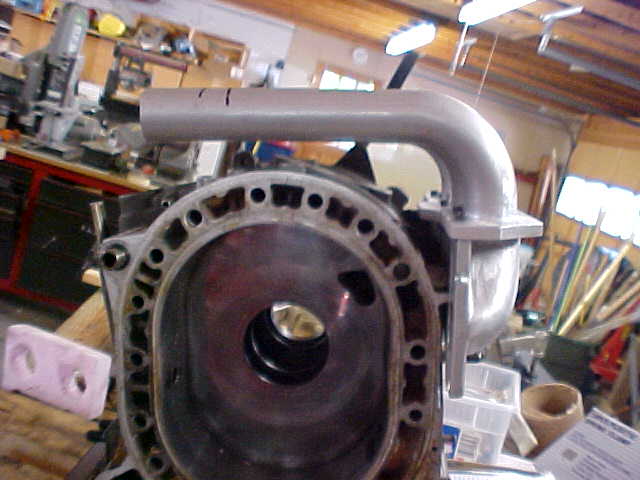
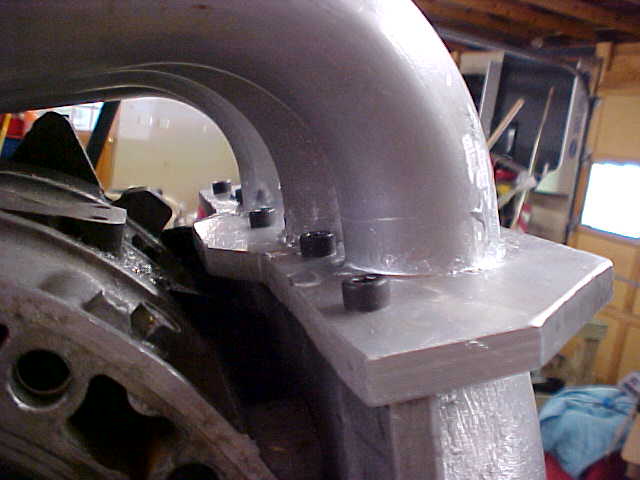
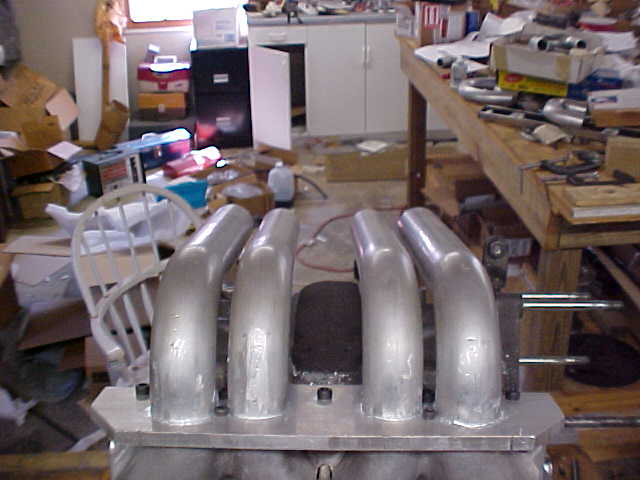
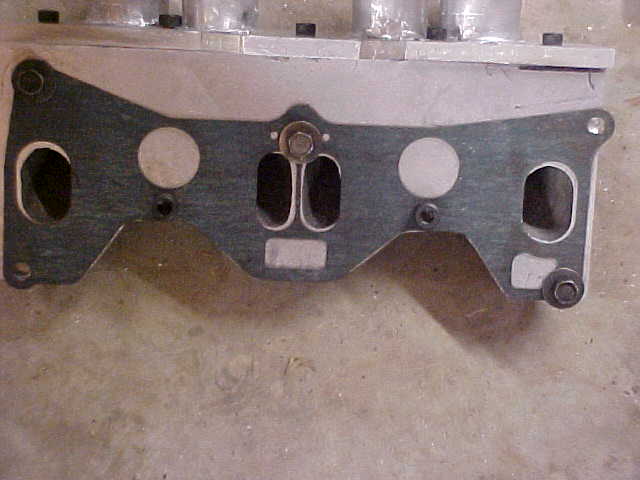
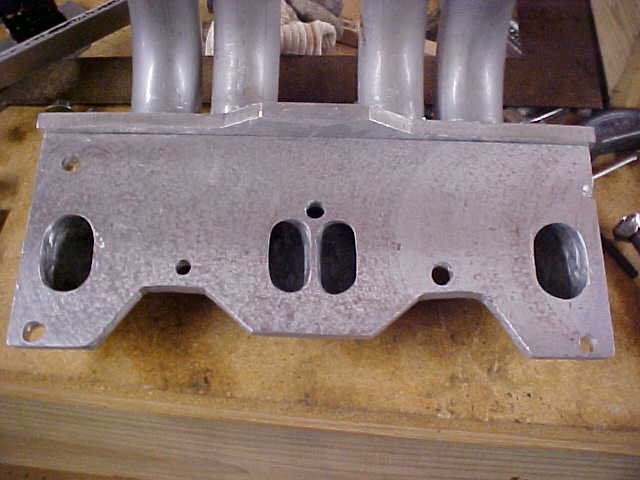
Attached are some photos of the tubes and flange as well as the ported
casting.  I need to see if that brazing rod will build out a flange around
the bolt hole along the edge.  Then cook it for 8 hours {:>)

Ed
"Loop"? Dynamic chamber? 5300-5900 static rpm? How long is your air strip?

Aren't those Sony Mavicas handy digital cameras? :)

Paul Lamar

The AirCraft Rotary Engine NewsLetter.  Powered by Linux.
ACRE NL web site. http://home.earthlink.net/~rotaryeng/
Copyright 1998-2003 All world wide rights reserved.