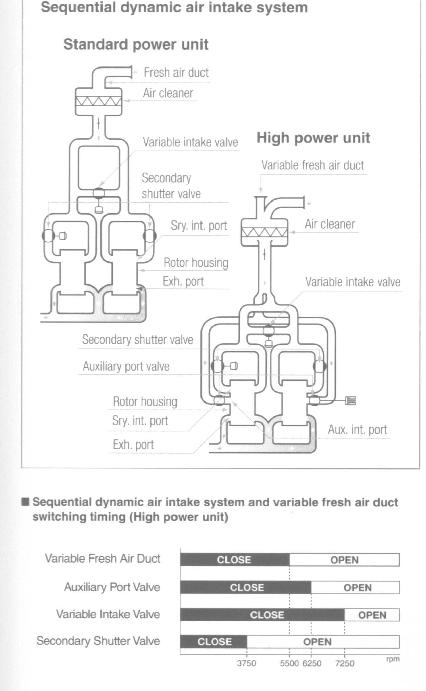
Its the longer intake runner Ed. Not the smaller tubes. People have been
talking
about this for years and every few years Mazda increases the port area and
reduces the velocity and the engine generates more power.
Tracy went into a state of shock and disbelief when I first told him the
RX8
engine had 30% more intake port area than even the big port 3rd gen engine
:)
If you want a good book get Taylor's "The Internal Combustion Engine
in Theory and Practice." Also H. Heisler "Advanced Engine Tech" a book
I have mentioned on here many times. Intake air velocities can approach
supersonic speeds. It is not as simple as it looks.
Wall friction in the runner plays a major role. The larger the runner the
lower the wall surface area to volume ratio becomes and the higher the flow.
The simple way of looking at it is the ratio of the circumference of
a circle to the area of a circle. The area is pi R squared while
the circumference is 2 R times pi.
Velocity cuts two ways. When the port opens the mass of air
must be accelerated. When the port closes the kinetic energy
in the air mass due to it velocity is converted to potential energy
in the form of a lump of high pressure air. See the rubber ball analogy in
an earlier post of mine. This then rebounds and comes back hopefully
just as the port opens again. Larger runner, larger ball,
lower wall friction losses relative to the size of the ball.
It's like getting hit with a Mac truck going 50 MPH verse a Honda
going 70 MPH. They both have the same energy but the Mac truck is seeing
less friction. One of the rationales for using plastic intake runners
is they have smoother walls than castings. One of the reasons
I designed the manifold in small sections was so the insides
could be polished. Extrude Hone is an expensive process but it
can be used and is used to polish the insides of production
cast aluminum manifolds.
The problem with going on what shade tree engine builders say is they
cannot possibly duplicate what Mazda can duplicate with dozens of dynos
running millions of combinations with computerized data acquisition.
Kenichi Yamamoto recognized this problem from the get go and invested in
a state of the art computerized test facility way back in the late sixties.
Imagine what he was confronted with. A brand new engine concept that
absolutely no one knew anything at all about. I digress.
Paul Lamar
Tracy Crook Wrote:
Shock & disbelief?   Oh come now : )
But seriously, port area has little to do with intake runner velocity (which
is the important factor).
And as I pointed out before, Mazda does not even open the secondary intake
ports until the RX-8 engine
reaches 6500 RPM.

Tracy
If not shock and disbelief what do you call it?
Should I have taken a picture of your face and recorded your response? :)
You vehemently disagreed with me until I sent you the data. I'll bet
the emails are on the CD :)

What do you mean by "port area has little to do with intake runner velocity"?
Assuming port area and runner area are the same with a given amount
of air flow the smaller the runner the higher the velocity. It has everything to
do with port/runner area.  Surely you agree with that. Making them
different sizes has no relevance.

The question is; does the RX8 engine generate more power at 6000 RPM
than the old six port engine? The answer is; it sure does.

6500? Not true. It is 6250 RPM :) I think that has more to do
with the low speed torque curve than anything else. Notice the long
length of the runners feeding the aux ports.
IMHO it is safe to say this engine would have more power at 6000 RPM with out all
the complication of this low speed torque optimized intake system.
So far Mazda has not shared all the data on all the combinations
they have tried with this engine.

The data we do have is on the Lemans engine with huge wide
open ports generating, in two rotor form, 240 HP at 6000 RPM.

Paul Lamar

The AirCraft Rotary Engine NewsLetter.  Powered by Linux.
ACRE NL web site. http://home.earthlink.net/~rotaryeng/
Copyright 1998-2003 All world wide rights reserved.