Paul, I think for Al's 3 rotor you would need to use something like
360
cubic inches and 9? cylinders.

Ed Andeson
Not true. Statements like this indicate a lack of fundamental
understanding of how the rotary really works. This is also
why you are confused on the intake manifold.

A three rotor is a three cylinder 2 cycle
or a six cylinder four cycle. Forget the three faces on the rotors.
The ONLY thing that counts is the intake, firing and exhaust events
per revolution of the e-shaft. Think of it as a mysterious black
box with air pulses going in and exhaust gas pulses and HP pulses
coming out.
Ok, Paul, given your statement above that a 3 rotor is characterized by
212
CID and six cylinder four cycle, then I would be interested in how a 2
rotor
is characterized? as a 2 cylinder 2 cycle or 3 cylinder four cycle?

Ed Anderson
"or 3 cylinder four cycle?"??????????

Where did that come from? I never said that. If I did it was a typo.

Don't you mean "or 4 cylinder four cycle?"?

Yes it is equivalent to a 2 cylinder two cycle or a 4 cylinder four cycle.

They both fire twice per rev with two intake and two exhaust events per
rev.
All racing organization around the world equate the 13B to a 2.6 liter
(160 cubic inches) four cycle engine.

One reason it generally generates more power than a 2.6L 4 cycle 4
cylinder
engine is the fact that the volumetric efficiency is much higher than a
piston
engine. It averages 120% over a wide RPM range. This is a direct outgrowth
of the slow rotor RPM keeping the ports open longer than would be the case
with a 2 cycle piston engine. This high volumetric efficiency also tends
to
insidiously convince people that the wankel is some how a larger engine
than 2.6L.
Another reason is the intrinsic high RPM capability.

The wankel is a very subtle and shrewdly designed engine.

In order to design an effective intake manifold one must thoroughly
understand exactly how the wankel works.

Paul Lamar
Vance W Jaqua wrote:
If you are designing a tuned tube, the Physics of the action could care less
what the
rotational speed of some mechanical part of the engine. It will be looking
at port
(or valve) open duration. and the flow during that period, and then the time
till
the next flow event. If you look at the relative durations, the actions
exactly
correspond to a 3 cylinder four stroke cycle 0perating at two thirds
eccentric
rpm or more meaningfully twice rotor speed because one turn of the rotor
takes
all three chambers through the four "strokes" of an Otto cycle. I believe
that
inlet resonance likes the longer off times between pulses, which is why they
generally do not pair up ports on piston engine resonance systems. In
resonant systems
the "Q" that we use for dynamic pressure is now a measure of efficiency of
the
resonant system, and you would like that high- However the higher the peak,
the narower the frequency range. The Wankel tunning is hampered by this
equivalent
pairing, but since there are no "Y"s  in the system, it is less damaging
than pairing
in piston engines, and it also shortens the pipes for easier packaging.
For aircraft use a two point system would be good for fixed props - static
and full power, I doubt that there would be any real gain at cruise in sfc.
Vance
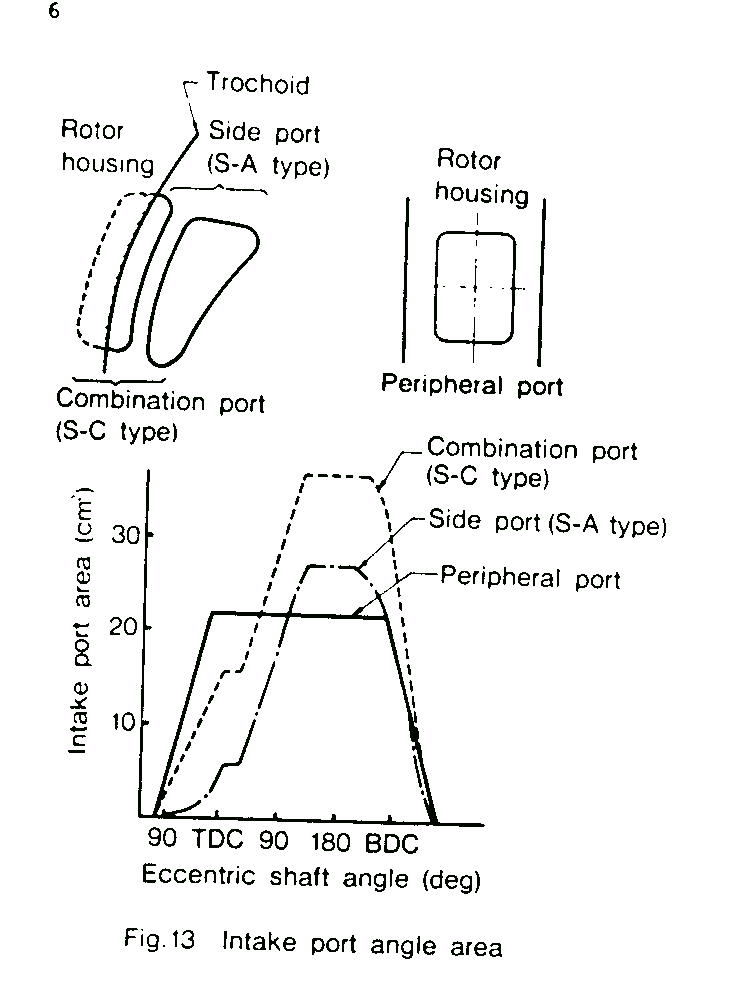
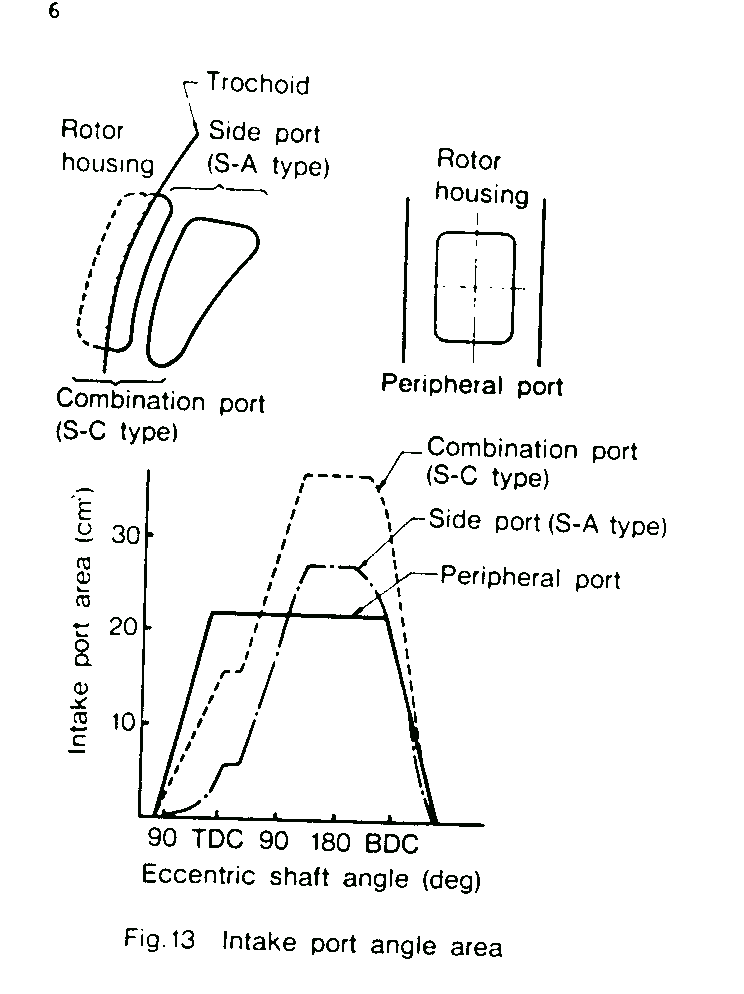
Hey if the open duration is only a little over 180 degrees of the e-shaft rotation
what then must be the closed duration? Think of the rotor as some sort of trick
valve. Forget that it has three faces. The rotor is moving very slowly.

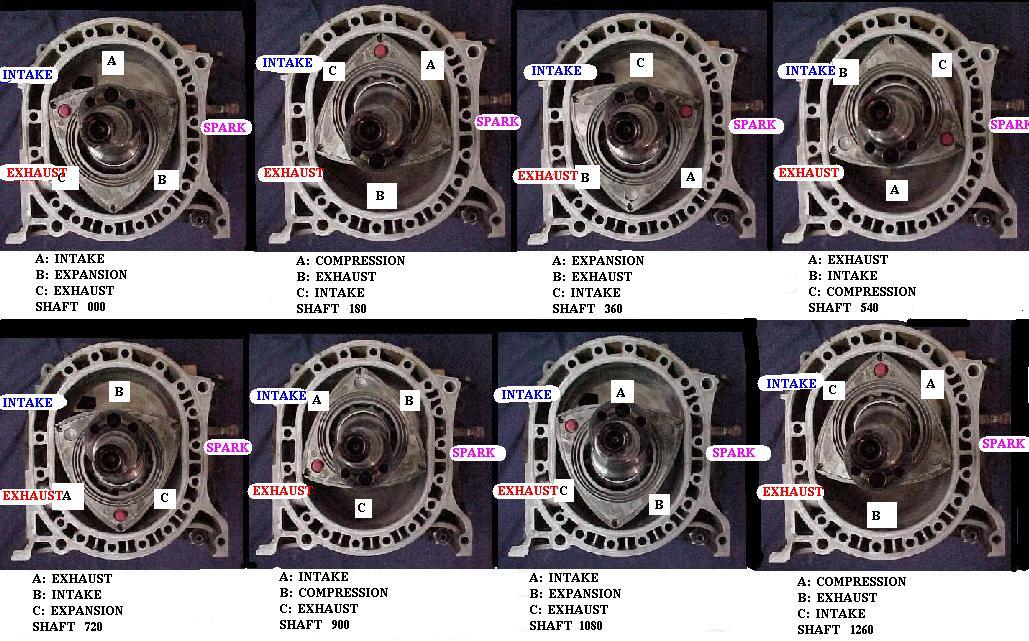
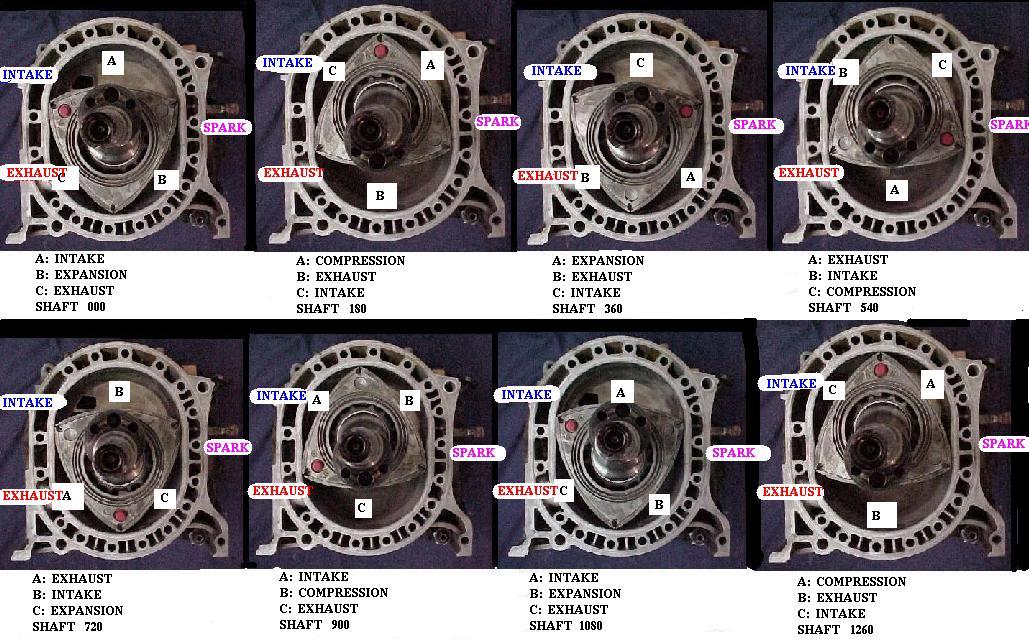
Start at 180 degrees shaft angle in this series of pictures. Note that the intake port is
just starting to open on chamber (C). 180 degrees later it is just closing at shaft angle
360 degrees. The next chamber (B) in line does not start to open until
180 degrees later at shaft angle 540 degrees. Just like a two cycle.

Tuning this is no problem. The port stays closed plenty long enough.

You are confused. The engine is equivalent to a two cylinder two cycle and a
four cylinder four cycle that has a trick valve system that stays open for
180 degrees of crank rotation rather than only a few degrees in the case of
the two cycle and and a little over 90 degrees in the case of a four cycle.
Simple as that. That is why it breaths so well and generates so much power
for its displacement.

Paul Lamar

The AirCraft Rotary Engine NewsLetter.  Powered by Linux.
ACRE NL web site. http://home.earthlink.net/~rotaryeng/
Copyright 1998-2003 All world wide rights reserved.