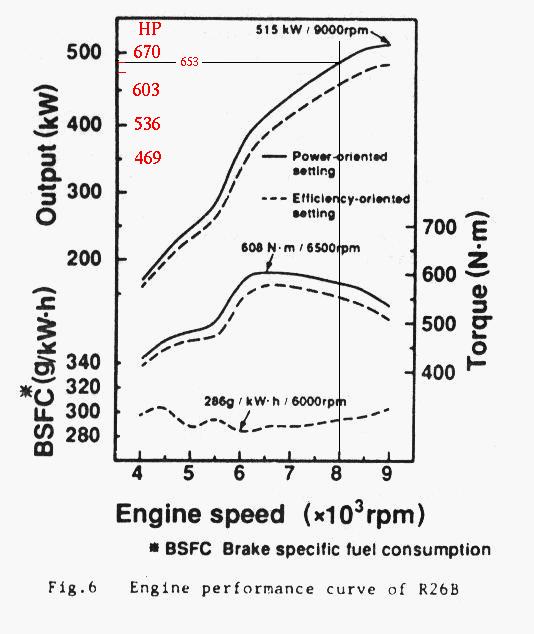
There is no such thing as a useless torque peak, and engines
only develop max hp at max torque if they are redlined at that rpm.
Any engine will deliver it's max hp at a higher rpm than the torque
peak = even the amazing Le Mans engine. They have probably
put the torque peak as high as practical for the engine design,
What is so useless about that?  see no "lack of understanding
by the engine designer -- his HP per lb of installed engine
weight is pretty good. - Vance
For an aircraft engine if the torque peak does not coincide with
the red line or shortly below it is a useless torque peak. All
direct drive aircraft engines like the opposed series have a
straight line function of HP verse RPM indicating the torque
peak is at or near the red line. These A/C engines have a 2700 RPM red
line or there abouts so the ratio of intake valve area to piston
area is not beginning to limit the breathing. In piston engines
used in cars the breathing starts to fall off around 4500 RPM and so too
does the torque. This cause the HP curve to start to flatten out.

The rotary on the other has no such breathing limitations and as proven
by this chart almost any torque peak at almost any RPM can be had by
merely
tuning the intake runners to the proper length.

So just like a large displacement direct drive aircraft engine
the rotary has a straight line HP curve more or less.

In the case of this 2 cyl horz. opposed  engine the intake valves are too
small
to achieve this end. If the engine is structurally designed to have
a red line at 6000 RPM an improvement in HP can be had by moving
the torque peak up closer to 6000 RPM by improving the intake valve area.
That may entail using two intake valves per cylinder but it will
never breathe as well as rotary and it may be impossible to get
the torque peak up to 6000 RPM :)

Paul Lamar
The only engines that generate max power at or near the torque peak are
direct drive aircaft engines such as Cont and Lyc , and that is forced
on them by desired prop rpm. Any engine designed for high specific
output (and almost all that aren't) will develop maximum power
significantly above the torque peak. Yes, as you show, you can move
the max torque up the rpm curve, but usually only at the expense of
the maximum torque value as shown in your curves. This is almost
always at an even greater loss at lower rpm resulting in a "race"
engine unsuitable for most other applications.
Still suitable for aircraft however as prop HP required is = to RPM^3 X Constant
Actually a road race engine requires a broader torque curve than an aircraft engine.
Your curves also dispute your claims that the Wankel is not
breathing limited. the torque curve of an imaginary engine that
is not breathing limited would proceed past the torque "peak"
at a constant level - which these obviously do not,
Not true. All you do is change the pipe length as a function of
RPM which is exactly what Mazda did.
 The fall off
of peak torque with the move up the rpm range does not indicate
improved breathing, but a reduced filling of the chambers at the
new peak in spite of the resonant amplification of the tuned
intake. BMEP numbers for the typical Wankel engine actually
suggest that Wankel port breathing is less effective than well
designed poppet valves and cam.
That is only true of you use your erroneous numbers for displacement.
You must be kidding about the archaic poppet valves.
Look at the pictures. Is there any silly poppet valves in the
way. Heck a person could put their fist into a Lemans engine
through the intake port.
The high volumetric efficiencies
quoted for Wankels are not supported by BMEP numbers
There is no data that suggests that a 13b is capable of 240
at 6000 rpm with normally aspiration and normal fuel.
Yes there is. Cut a four rotor in half and you have a 240 HP
two rotor at 6000 RPM.
The Lemans engine had to run on automotive pump fuel and not nitromethane,
alcohol or any other kind of racing fuel. Those are the rules.

Name another 2.6 L  N.A. street engine generating 250 HP like the RX8.
I do not think even the Le Mans engine makes 120bhp
per rotor at 6000 rpm, and 13B's are a lot further from that
engine than reworked ports.
Vance
It sure does make 120 HP per rotor at 6000 RPM. There is no fundamental difference
in the Lemans engine from your typical 13B engine that would limit
the power at 6000 RPM. Larger P ports are available from Racing Beat than even
the Lemans engine P ports. The main difference was rotor weight and
that would only affect top RPM. The RX8 probably has the same weight rotor
as the Lemans engine.


Paul Lamar


The AirCraft Rotary Engine NewsLetter.  Powered by Linux.
ACRE NL web site. http://home.earthlink.net/~rotaryeng/
Copyright 1998-2003 All world wide rights reserved.