You can add the pressure cap number to the block pressure number. So the
cap has to be in a location where block pressure cannot see it. Like on a
remote recovery bottle. Otherwise the block pressure will overpower the cap
and
dump coolant when you rev the engine.
I had to change this. Please note that you CANNOT expose the pressure cap to
block pressure because it will blow all of your water out. (I had "Can" in
there).
Sorry.

Lynn E. Hanover
Have you measured the pressure in the block and on the other side
of the restrictor?

Some of you people flying have water pressure gages.
Where are the gages tapped in and what are you seeing in the
way of pressures?


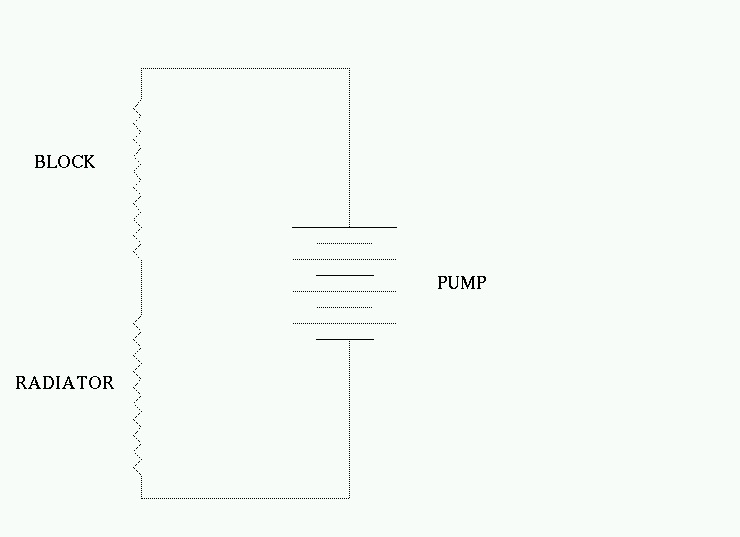
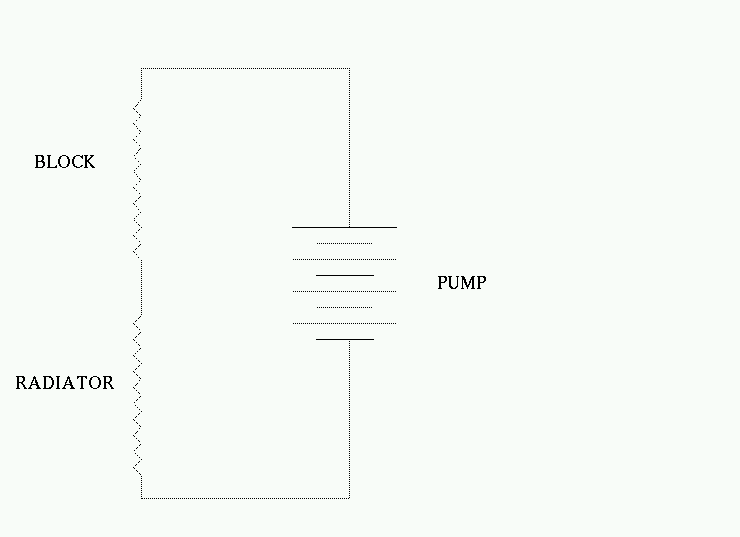
BTW there is a good analogy to fluid systems in a simple electrical
circuit. The block, radiator and restrictor are represented by
resistors and the pump is represented by a battery. The pressure
is the voltage and the flow of liquid is represented by the current (amps).

Just like a resistance circuit the liquid flow (current amps) is
the same everywhere.

The pressure (voltage) drops as you go around the system.
As far as the bottom of the pump is concerned it does not care
where in the system the restrictors are placed. All that matters,
as far as the flow is concerned, is that the total resistance
is as low as possible. Placing a restrictor in the circuit
reduces the flow.

A centrifugal pump acts just like a battery with finite internal
resistance. As you increase the total resistance in the system the
pressure (voltage) from the pump increases somewhat but
the flow (current) in the circuit is drastically reduced. On the other hand
if you reduce the the resistance in the system the pressure
the pump puts out is reduced but the flow is drastically increased.
Check your battery voltage the next time you hit the starter button.
A starter will suck up to 300 amps out of a battery.

One difference is the pump will cavitate if the resistance is too high.
It matters not where in the system this resistance is placed.

As you heat the water it expands to increase the average pressure
in the system. The relative pressure drops remain the same
through out the system. The pump does not care if the overall
pressure is increased. All it cares about is the pressure drop
across the pump remains below the point where it cavitates.

I have mentioned this before but there is a very good SAE paper
on this subject published by Continental on the liquid cooled
voyager engine.

* SAE Paper # 871042    0148-7191/87/0428-1042 $12.50 Design and
Development of the Voyager 200/300 Liquid Cooled Aircraft Engine by
R.E. Wilkinson. Twenty pages. Published in 1987. This paper is about
the engine used in the Rutan Voyager around-the-world un-refueled
record holder. If you never read anything else about any kind of
engine you must read this paper. It is by far the most informative
and up to date information on liquid cooled aircraft engines there is.

This paper emphasizes the importance of temperature measurements adjacent
to to combustion chamber. That is the bottom line regardless of
the coolant temperature.  In this regard we are still in the dark ages
Our main focus right at the moment is to keep the coolant
from boiling. Boiling fluid is a catastrophic event in a liquid
cooled aircraft engine.

Paul Lamar

The AirCraft Rotary Engine NewsLetter.  Powered by Linux.
ACRE NL web site. http://home.earthlink.net/~rotaryeng/
Copyright 1998-2003 All world wide rights reserved.