Paul wrote:
BTW there is a good analogy to fluid systems in a simple electrical
circuit. The block, radiator and restrictor are represented by
resistors and the pump is represented by a battery. The pressure
is the voltage and the flow of liquid is represented by the current
(amps).
Just like a resistance circuit the liquid flow (current amps) is
the same everywhere.

The pressure (voltage) drops as you go around the system.
As far as the bottom of the pump is concerned it does not care
where in the system the restrictors are placed. All that matters,
as far as the flow is concerned, is that the total resistance
is as low as possible. Placing a restrictor in the circuit
reduces the flow.

A centrifugal pump acts just like a battery with finite internal
resistance. As you increase the total resistance in the system the
pressure (voltage) from the pump increases somewhat but
the flow (current) in the circuit is drastically reduced. On the other
hand
if you reduce the the resistance in the system the pressure
the pump puts out is reduced but the flow is drastically increased.
Check your battery voltage the next time you hit the starter button.
A starter will suck up to 300 amps out of a battery.

One difference is the pump will cavitate if the resistance is too high.
It matters not where in the system this resistance is placed.

As you heat the water it expands to increase the average pressure
in the system. The relative pressure drops remain the same
through out the system. The pump does not care if the overall
pressure is increased. All it cares about is the pressure drop
across the pump remains below the point where it cavitates.
---------------------------
Paul,

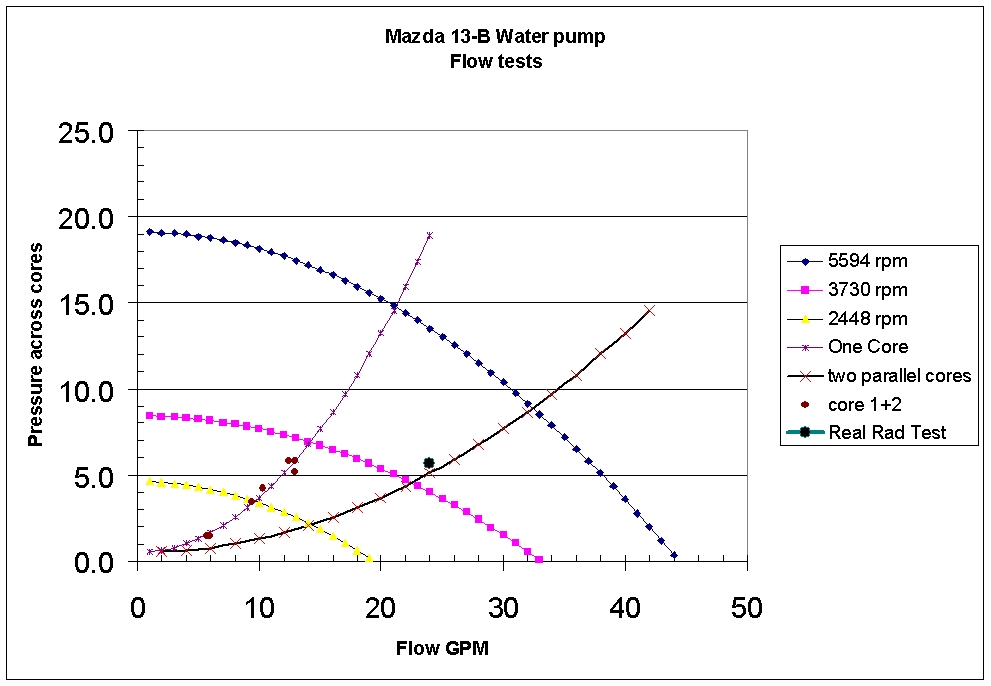
Your electrical analogy is very valid. With respect to the pump, we really
don't need to speculate, I *measured* the flow of a mazda 13-B pump, with
*no* restrictor or thermostat, all the way up to maximum restriction. I
think we are going to need all the free flow we need, and will use cowl
flaps (or a hidden varient thereof) to control "overcooling" which I could
get in the winter.

Bill Schertz
The AirCraft Rotary Engine NewsLetter.  Powered by Linux.
ACRE NL web site. http://home.earthlink.net/~rotaryeng/
Copyright 1998-2003 All world wide rights reserved.