Paul Lamar wrote:
Our main focus right at the moment is to keep the coolant
from boiling. Boiling fluid is a catastrophic event in a liquid
cooled aircraft engine.
Oh c'mon Paul, don't make me launch back into the differences between localized
nucleate vs. overall boiling.  Our main focus right now should be to prevent
overall boiling while still experiencing localized nucleate boiling.

Russell Kent
Overall boiling was what I was referring too of course Russell nit picker :)

Actually we really don't know what is going on because nobody has measured
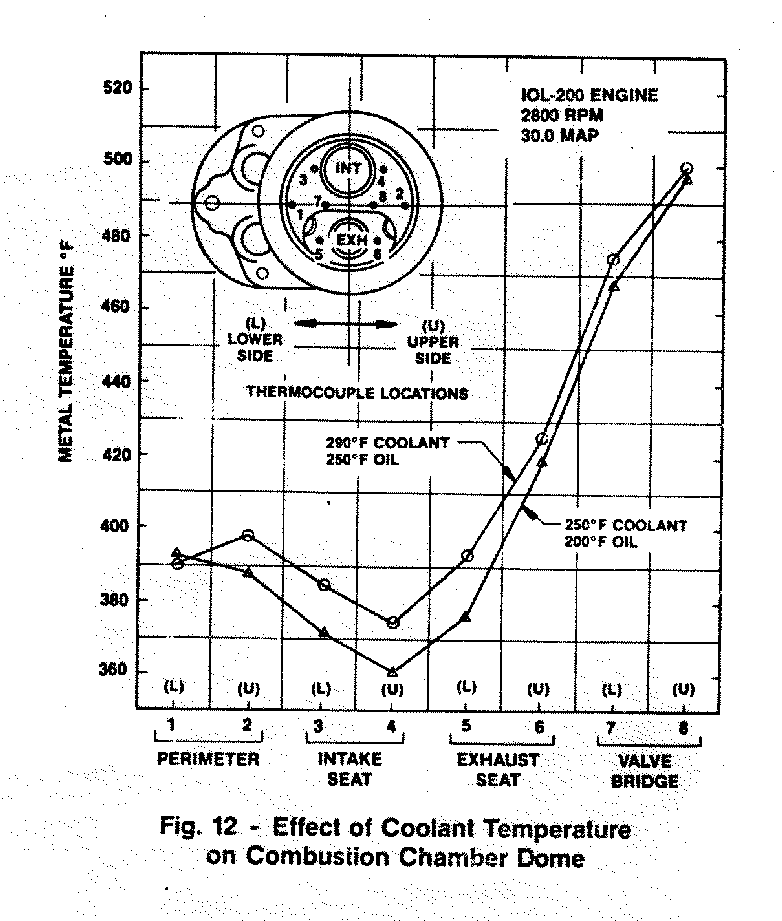
the temp within a mm of the combustion chamber except NASA and they did
it only in one place. There is absolutely no evidence of the type of cooling
damage one sees  in aluminum cylinder heads subject to high continuos HP.
I.E. pock marking. A common occurrence in early R3350's installed in B29's.
Also a common occurrence in Chevy big blocks in aircraft service.

I suspect there are two reasons for that. A: we have a rotating combustion chamber
engine so the heat is dissipated over a very large surface indeed. B: the rotor
housing is lined with chrome plated steel. If it were not for "overall boiling"
we might be able to run the rotary at 300 F. I think Ken Welter is still running propylene
glycol (Evan's coolant) which at atmospheric pressure has a boiling point of 300F.

Heat transfer between propylene glycol and metal is worse than 100% ethylene glycol
and metal which nobody runs anyway because of the fire hazard.  So the temp of the rotor
housing surface may be disproportional higher than even the higher temp of
the propylene glycol coolant would suggest. Ken is not running his engine
at 300 F unfortunately so we don't know if it is working. Ken, you need to
put a restrictor in there (a much smaller radiator), raise the temp  and
destructively test an engine for us if you don't mind :)

This has some far reaching implications. Number One the radiator could be made
much much smaller hence lower aerodynamic drag  and number Two the energy
lost to the cooling system from a pound of fuel could be reduced to perhaps
a lower level than even one of Vance's revered piston engines. We won't
know until we try it and see if we can damage the rotor housings. The
TES O-rings are good to 500 degrees F. Teflon O-rings with SS wire
springs inside are good to 800 F. Not only that they don't expand
as much as silicone.

BTW you want to insulate  or cool the intake manifold from the higher engine
temp or you will experience a HP loss running the engine at higher temps.
A phenolic spacer might help.

Paul Lamar

The AirCraft Rotary Engine NewsLetter.  Powered by Linux.
ACRE NL web site. http://home.earthlink.net/~rotaryeng/
Copyright 1998-2003 All world wide rights reserved.