Try a few streaks of dirty oil to see how the air is flowing.
Bill Schertz
Bill, there really isn't anyplace to put oil, the exit duct is just a
big hole now in front of the fan. To go from suction to pressure with
basically the same configuration, I can only come up with two
possibilities. Either my new exit duct isn't sealed correctly yet, which
is entirely possible, or the louvers that I removed have some effect.
Perry,
What about having two (in the tube set-up) similar to what has been shown on
here recently - would that do the trick or are you too limited on room.
George (down under)
That may be what I end up doing if all else fails. I'll probably try the
finned oil pan, then the '86 oil cooler, then the Fluidyne oil cooler,
which may have more volume and a better form factor. 4 years and 400
hours and still fighting this battle. I don't understand how anyone can
cool the oil operating over 5500 RPM. It must be the small coolant rad I
have isn't sufficient, but even when the coolant temp is normal the oil
temp can be elevated. Maybe the 210 degree F temp into the engine that
is held to be gospel, coming from Racing Beat, is just not realistic? I
measured the oil temp in the pan of my car a long time ago and it would
easily exceed 250 without even running the car very hard.

--
Perry Mick
Custom Composite Props
mick@bridgingworlds.com
http://www.ductedfan.com
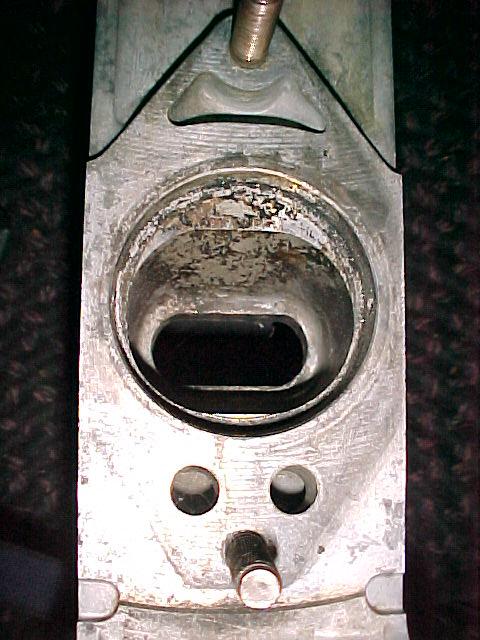
Since you are using the stock exhaust manifold there is some exhaust gases
that are circulating around inside the block. Most people use
a plain exhaust flange that blocks these passages. You might try a thin steel
plate sandwiched in such a way as to block these passages.
The passages are designed to heat the cool side of the block
so the engine does not go banana shaped. In car use the engine is generating
much less HP on average. From this chart at 3000 RPM the affect
on the temp of the block is severe. God knows what it is at 5000 RPM
and full power. Perhaps some of that heat is finding its way into
the oil.

I don't really think a square cooler is the answer. You will need
a lot of space above it to let the air flow freely. I then don't
see how you are going to get that air to flow down and out the
bottom. Perhaps a sketch would help me visualize what you have in mind.

An easy thing to try is that hole in the wing skin just behind
the oil cooler outlet. That will test my theory on the ducted fan
causing high pressure in that area. If you are not ready for that
just use one or two of those unused water manometer tubes to check
the pressure in that area. Put one tap on the top and one on the bottom.


Paul Lamar

The AirCraft Rotary Engine NewsLetter.  Powered by Linux.
ACRE NL web site. http://home.earthlink.net/~rotaryeng/
Copyright 1998-2003 All world wide rights reserved.