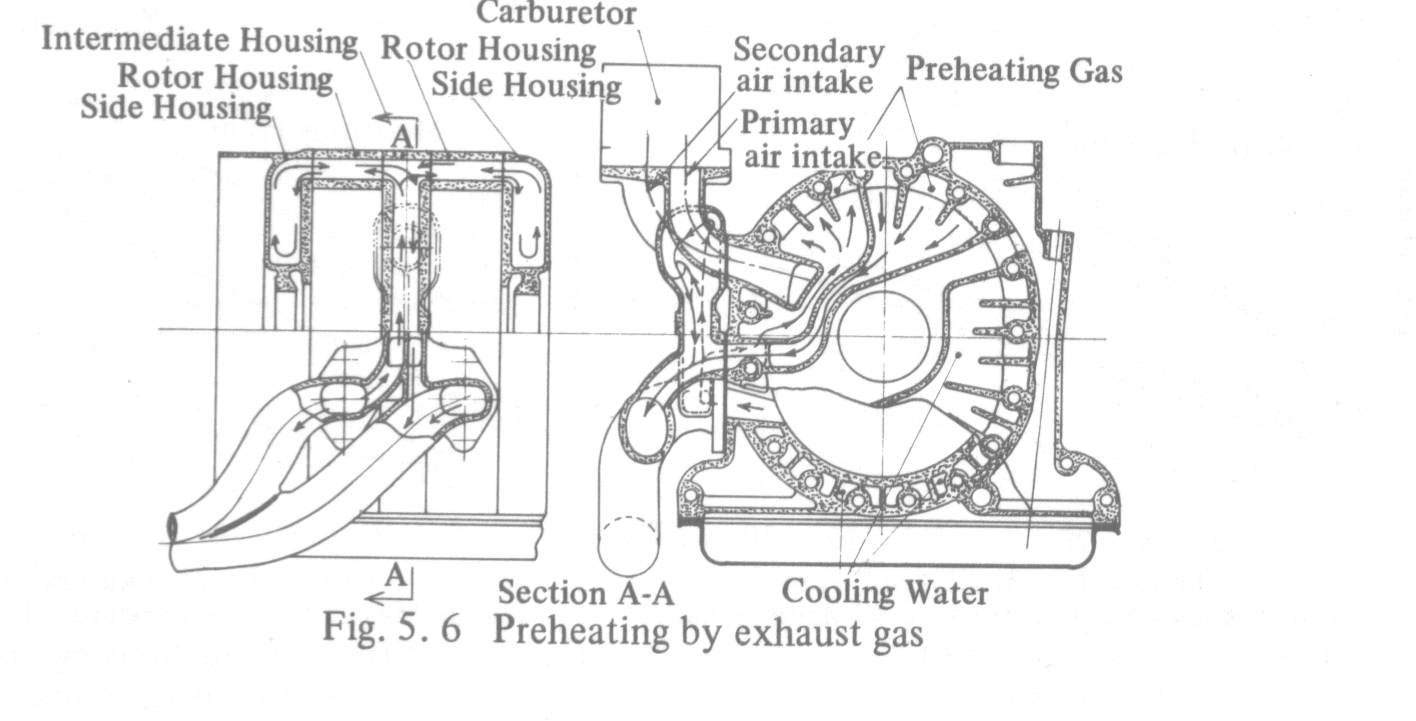
Since you are using the stock exhaust manifold there is some exhaust gases
that are circulating around inside the block. Most people use
a plain exhaust flange that blocks these passages. You might try a thin steel
plate sandwiched in such a way as to block these passages.
The passages are designed to heat the cool side of the block
so the engine does not go banana shaped. In car use the engine is generating
much less HP on average. From this chart at 3000 RPM the affect
on the temp of the block is severe. God knows what it is at 5000 RPM
and full power. Perhaps some of that heat is finding its way into
the oil.
Can you explain this a little further? The holes in the rotor housing
are below the exhaust ports, but somehow they communicate with the top
of the engine? They must vent somewhere, if you blow into a tube with
the end closed I don't think you are going to transfer much heat. I have
the EGR on the top of the engine blocked off so if that is where they
vent then that function is disabled.

--
Perry Mick
You got any rotor housings lying around? If you look closely at rotor
housing you will see they are not symmetrical. Exhaust gas flows
out of the rotor housing and up
the passage shown in the center housing and somehow makes its way
back to the other side of the rotor housing and into the exhaust
port around the insert. the two holes shown in the original picture
of the rotor housing are separated by a bulkhead.

I don't have a complete diagram yet. There may be one in
some of the SAE papers. There is one in the book Rotary Engine but it
does not appear to be current. I'll keep looking.


Paul Lamar
It is interesting that in this photo you sent, the exhaust gas passage
and the oil drain passage are next to each other, separated by a wall.
Could that be where heat is being transferred into the oil? My memory
may be faulty, but I think the exhaust manifold gasket has only one hole
in it other than the two exhaust port holes and the bolt holes. So it is
only using one rotor housing for this function?
Could be. I have the exhaust manifold and gasket up at the hangar
but since I have company this weekend it will be a few days before I
can look at them. In the mean time here is that old diagram from
Rotary Engine. Not necessarily exactly what you have in your engine.

Paul Lamar

The AirCraft Rotary Engine NewsLetter.  Powered by Linux.
ACRE NL web site. http://home.earthlink.net/~rotaryeng/
Copyright 1998-2003 All world wide rights reserved.