This is proving more costly than I thought. Very hard to machine
as it requires close tolerance to minimize the clearance
between impeller and housing. About three different lathe and mill sets
ups are required. No easy way to rapidly mount it and unmount on the
mill and lathe either.

I am building a test set using my CC mill as a power source. I will be able to
run the pump up to 7000 RPM and drive it with a 2 HP mill motor.
I don't think a single V belt will transmit that much HP so we shall
see. I have an eight inch die cast drive pulley and that might not
do the job so I am thinking of adding another one and use two
belts to drive the pump.

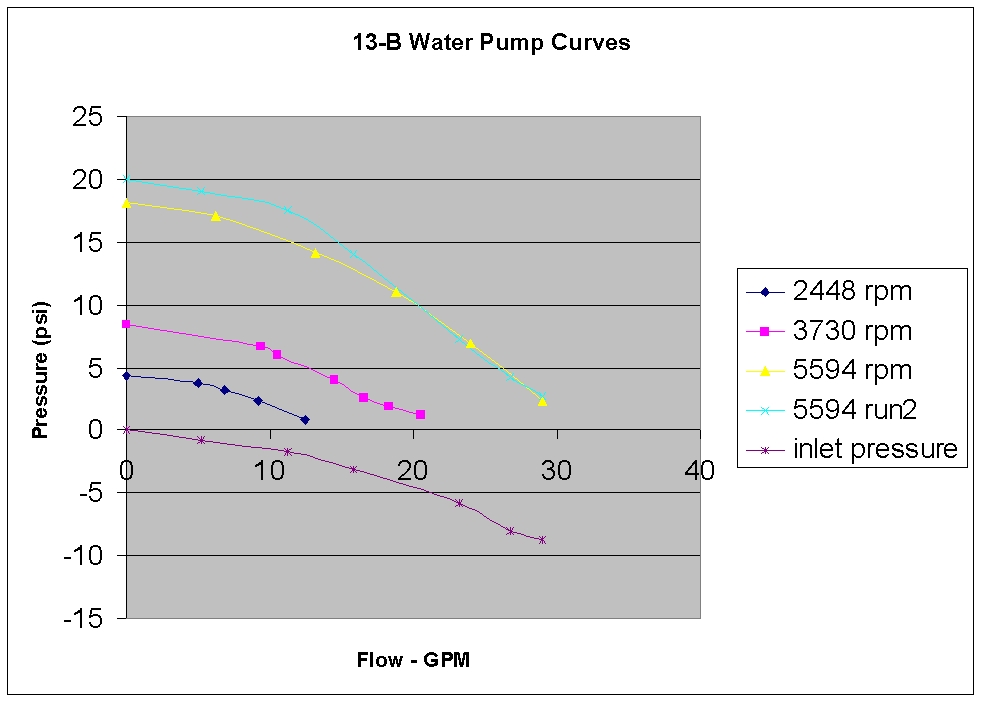
Bill Schertz ran the pump up to 5600 RPM and I am interested in seeing
what happens after that. I am also interested in seeing if the new
housing casting pumps more water at the same RPM as I think it will.

I also have an optical tach so I can check the pump RPM accurately.

Paul Lamar
BTW if anybody wants to do a little research on their own cooling system
McMaster Carr has a low cost ($65) flow meter that can be installed
in a working system. You drill a small hole in a 1.25 inch OD
water pipe and insert a small pito tube. The flow meter is then
clamped on the pipe with a gasket and hose clamps to seal the small hole.
This device measures the flow from 15 GPH to 75 GPH.  This low cost flow
meter is not too accurate at +/- 10% but could provide far more info on
a real working system  than we have now. If you plan on trying this please
measure the pressure in the block just before the exit, after the thermostat
and on the inlet side  of the pump to get a complete picture of what
is going on. The flow meter can go anywhere in the system as the
flow rate is the same throughout a closed loop system. If the passages
neck down the flow speeds up. If the passages open up the flow slows.

BTW Using a drum of water and a bucket to measure the flow does not really
simulate a real closed loop working cooling system. Never the less
Bill Schertz work using this method is greatly appreciated as it is way more info
than we had before. Here is the results Bill Schertz got with an
open loop system.

Paul Lamar

The AirCraft Rotary Engine NewsLetter.  Powered by Linux.
ACRE NL web site. http://home.earthlink.net/~rotaryeng/
Copyright 1998-2003 All world wide rights reserved.