I am willing to bet big bucks it won't make a significant difference to
the flow.
Anybody want to cover me on that bet I'll suck some water out and rerun
the test if you make it worth my while :)

Paul Lamar
It will make almost no difference in the flow, at least not enough to
measure.

It WILL make a difference in the pressure across the pump.  If you re-run
the test with a feed pipe on the suction side, you will be able to very the
flow rate with the valve and the pressure across the pump will very
inversely.

At any given rpm, you can make a flow rate verses pressure chart.  Somewhere
between full open and full closed is the real world system, but, as yet,
that point has not been established.

Bob Darrah

That's ok Paul, the Wright brothers didn't believe me, either, and you see
what happened to them.
What do you mean by a "feed pipe"?

That is a new device I have never heard of.

The pressure across the pump already varies slightly.

If you are talking about a stand pipe open on the
top that is not an option in a real system. In order for an open  stand pipe
to develop significant pressure on the inlet side of the pump it would
have to be ten feet tall. One foot head is .45 psi. Ten feet would be 4.5
psi.

If you are talking about a sealed pipe with air in it the system
will reach some sort of equilibrium with air bubbles mixed with the fluid
equaling the pressure in the closed pipe be it positive or negative.
My guess is it will be negative if it is on the suction side of the pump.

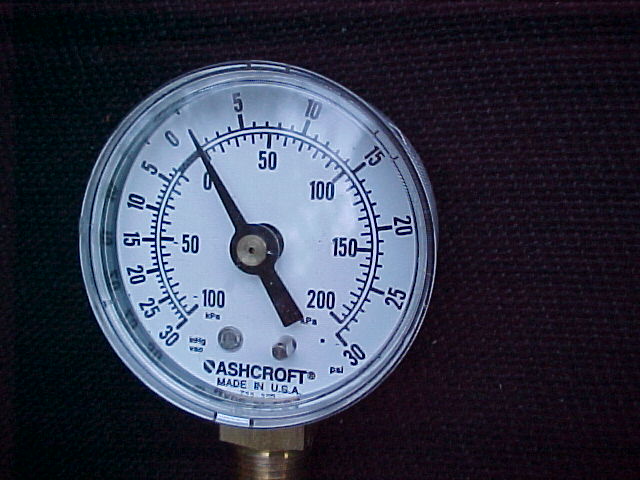
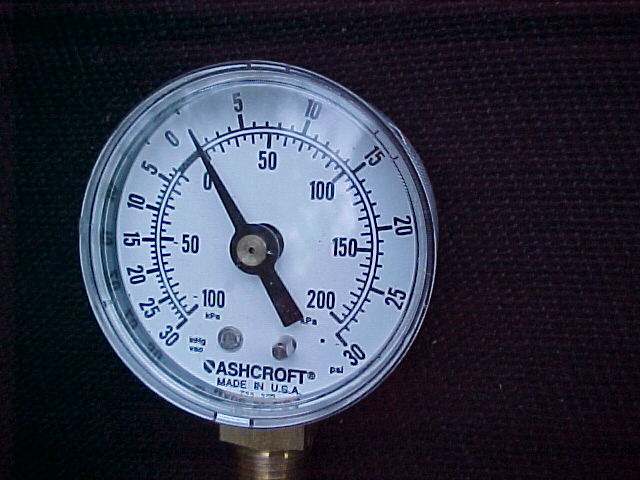
BTW I just got the trick pressure gage. Here is a picture. Ken uses something
like this on his system and you can see it go negative when the engine
cools.

Paul Lamar

The AirCraft Rotary Engine NewsLetter.  Powered by Linux.
ACRE NL web site. http://home.earthlink.net/~rotaryeng/
Copyright 1998-2003 All world wide rights reserved.