"In theory" and as I understand your system, ANY airspace,
capped or not
in
your stand pipe on the pressure side of the valve will distort
the
performance.

The standpipe should be on the suction side of the valve, with
no air at
all
in the pressure side.

Bob Darrah
Why?


Not that there is much airspace. My guess is its less than one
cubic inch.
Paul Lamar
In order to bring a cubic inch of captive air to, say for example,
to 15
psig, you have to compress it by 1/2 cubic inch. In your system,
in order
to do that, you have to get 1/2 cubic inch of water from
someplace. In your
test rig, the only place you can get it is from the intake side,
and that
would starve the intake side unless you put a stand pipe on that
side to
supply the necessary water. You will not get any useful pressure
readings
with your setup.

I done told Orville and I done told Wilber it would never get off
the
ground.

Bob Darrah
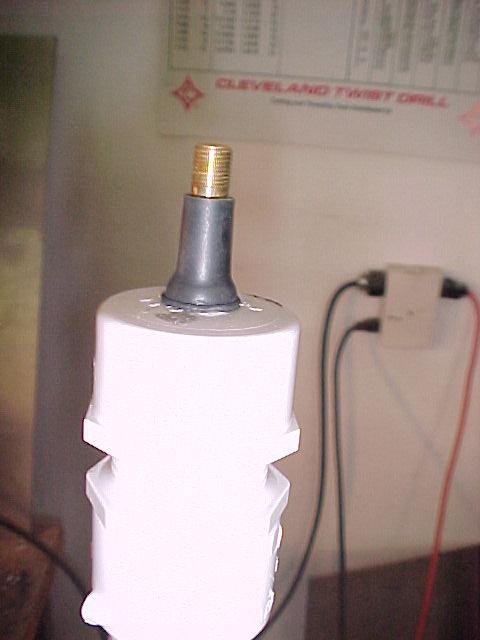
I totally disagree this is a closed loop system. THE STAND PIPE IS
SEALED.
The stand pipe does NOT add water. What ever water is in the system
is in the
system. Now the one cubic inch of air is probably mixed up with the
one
gallon of water that is in this test system.

Paul Lamar
I think part of the confusion is the stand pipe is not a stand pipe in
the true
definition of the term. Nor does it work like a true stand pipe. For a
stand pipe
to work as a stand pipe it must be vented to the atmosphere. In this
case it is
NOT vented. It is just a branch and a way of getting water in the
closed
loop system initially.

BTW if you would like to verify my results here is a good place to
locate
the pressure gages. Drill with a 11/16th drill and tap with a 1/4 NPT.

I used McMaster Carr 2" gage part 4004K4 0-30 psi +/- for the pump
inlet side
and 2" gage part number 3846K13 0-30 psi for the pump outlet and block
outlet.
Paul,

I see where Bob Darrah is coming from, and you are both right. However,
with your current setup, you can only get meaningful data when you
pressurize the system such that the inlet pressure guage never goes
negative. As long as the total system is pressurized, then you can read the
inlet and outlet pressure readings and get the delta-P. Alternatively, get a
negative reading pressure guage for the inlet.
If I recall your first run, (unpressurized), the pressure was very low,
for the reason that Bob stated, since the air column could compress, you
couldn't raise the pressure on thepump outlet. What was happening was the
inlet pressure was going to about -12 psi.  After you pressurized the
system, then you could read both gauges, and got a delta-P of 12 psi.
Several items to consider in any of these tests:
1. The pressure generated by the pump is a function of the RPM ( I
believe it is a function of the square of the RPM)
2. When dead-headed (zero flow) you get the maximum available pressure.
3. When you allow flow, the pump (at a given RPM) generates the same
pressure as at zero flow, MINUS internal losses -- the internal pressure
drop in the pump.  So with your tests, the flow goes to a high value because
there is little restriction, however the delta-P across the pump is
essentially the same (minus the internal losses).  That means that the
balance of the system requires ~75 GPM to get the offsetting pressure drop.
4. When you put other components in the system (engine block and
radiator), the delta-P across the pump will *remain the same* at a given
rpm, but the flow will drop off dramatically due to the pressure
restrictions of the flow through the balance of the system.
If you could measure several points of dead-head pressure as a function
of RPM, say 1000, 2000, 3000, 4000, 5000 that would be really useful
information.
Bill Schertz
KIS Cruiser # 4045
I filled that "stand pipe" to the top. There may have been a quarter inch
of air in there.
In fact the last time the pressure went up one or two psi as I screwed the
cap down.
There is no column of air. The gage will be here any minute. I won't get
to
test again until Wednesday as tomorrow is Robins birthday.

Lower RPM's are not of much interest to us but I will make another run
at a lower RPM.

Paul Lamar
John Gibbons wrote:
Is the air really an issue. If you are to use a pressurised overflow tank in
an a/c anyway what is the difference. I don't think the picture showed the
top of the "standpipe" but if that is just a cap with the schreader valve in
it, just cut it off , glue a ball valve in its place and then put it back on
top. This way you could fill the system with water, pressurise if wanted and
shut the flooded valve.
John
I just don't think it is an issue. If I really wanted to simulate the real
system I would empty the "stand pipe" of water and put a pressure cap on top.

I am willing to bet big bucks it won't make a significant difference to the flow.
Anybody want to cover me on that bet I'll suck some water out and rerun
the test if you make it worth my while :)

Paul Lamar

The AirCraft Rotary Engine NewsLetter.  Powered by Linux.
ACRE NL web site. http://home.earthlink.net/~rotaryeng/
Copyright 1998-2003 All world wide rights reserved.