Chuck wrote:

Well I did not make it to Arlington. I was over the Grand Canyon
at 12000 ft when the engine suddenly started shaking and RPM
dropped to 3900. Turn on the aux fuel pump, tried backup engine
controller, tried disabling trailing then leading ignition,
everything looked normal but RPM. GPS reported nearest airport was
Marble Canyon 21 miles away. Set up best glide, headed for Marble
Canyon, looked at EGT and rotor #1 (rear rotor in RV6, front rotor
in car) was showing <400F. 12 minutes later, Marble Canyon was 1
1/2 miles out but could not reach it so I set up approach on
Highway 89A. It was looking good until a truck pulling a travel
trailer appeared from around a curve, heading right for my
intended touchdown spot. He made no attemp to pull over, so I had
to stay above him. After he passed, I tried to set it down but did
not have enough speed to flare so it dropped in pretty hard. Got
it slowed down and off the road, luckily there was a nice wide
spot waiting for me. I got out and surveyed the situation, the
port wing had struck a highway marker post just inboard of the
wingtip and ripped a 2 foot gash in the lower wing surface. The
main and tail spring gear were all slightly bent from the impact.
Later after the engine and I had cooled off, I pulled the plugs
one rotor at a time, and sure enough there is no compression on
rotor #1. My friend flew up and picked me up, we flew home, loaded
up tools and trailer and made the 8 hour drive up there, removed
the wings loaded it up and headed back to Safford.  It has been an
interesting couple of days. It will take a bit longer than that to
repair the damage. I will report on the engine when I get it
apart.

Chuck Dunlap
Real sorry to hear that Chuck.

Thank heaven you made it OK. Congratulations on a saved-my-ass-job
well done. Also good job on the design of the motor mount as the
engine would have dropped out on the road if it had been weak.

Were those three piece apex seals?

For the new people. This is the very first failure of the basic
engine that I have heard about in the five year history of the news
letter. Apex seal failure is common on turbo engines that are
subject to detonation. Apex seal failure is rare on normally
aspirated engines like Chuck's but has been experienced in car
engines with the three piece design. They are less tolerant of high
wear. The new RX8 motor has gone back to the two piece design.

Paul Lamar
Hey Chuck,
I was looking for you at Arlington, since you were supposed to
arrive there before me. Really glad to hear there were no injuries.
Can you clarify something: did you have partial power at 3900 RPM on
the way down, extending your glide? If not, what were then
conditions when the engine quit running?

That sounds similar to an apex seal failure I had in a 1987 turbo
car. In that case it was the rear rotor. Suddenly the car lost power
big time. I could keep the engine running by keeping my foot on the
gas pedal. Managed to clutch and brake and keep the right foot on
the gas pedal for 30 miles to get me home, through stop lights and
everything. Once home and I turned off the engine, it would not
start again, as I suspected it would not.

--
Perry Mick
Custom Composite Props
mick@bridgingworlds.com
http://www.ductedfan.com
I highly recommend getting one or more  of these. Particularly if you
are running
a turbo. Also some indication of injector failure would be a nice thing
to have. Perhaps a failed injector could cause knock by the rotor
running too lean.

Paul Lamar
Has anyone verified that these will work on a rotary?
Chuck
Good question. I called MSD. I spoke to the PR department's Todd Wright and they
are going to send me one for testing. They did not freq when I said
"aircraft".

On the other hand you can build your own.
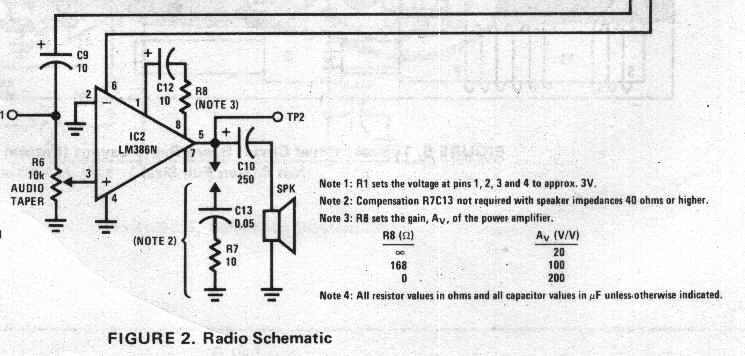
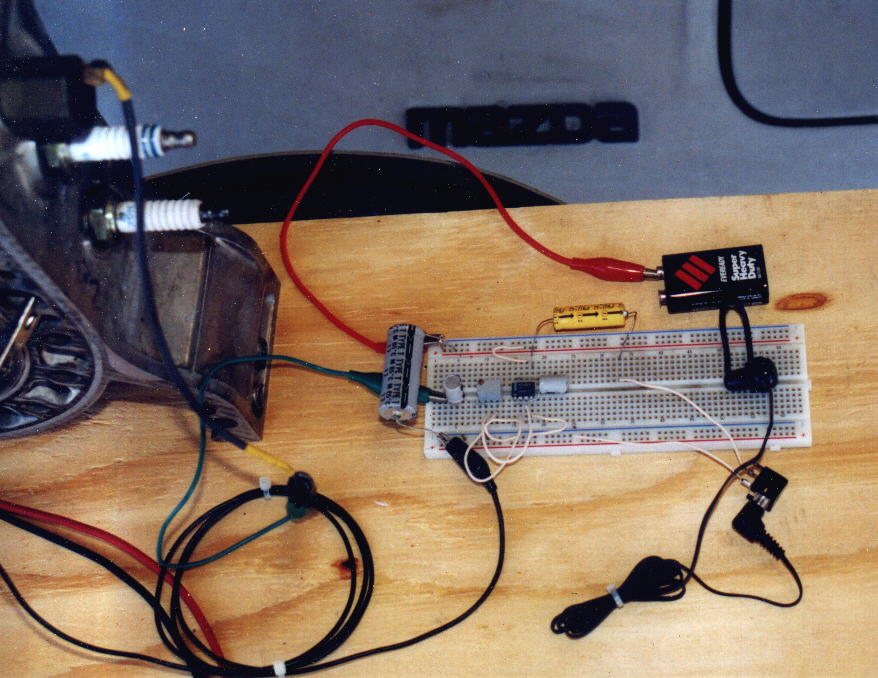
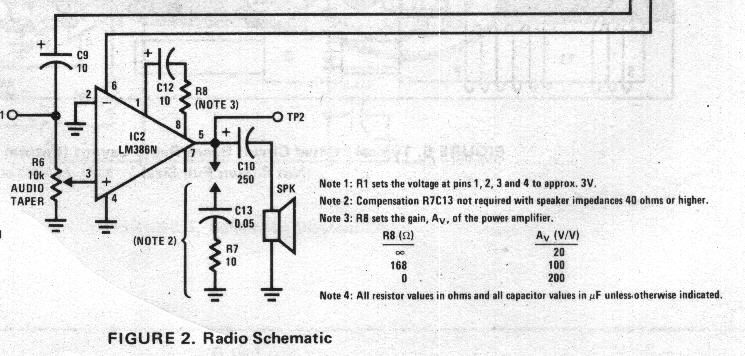
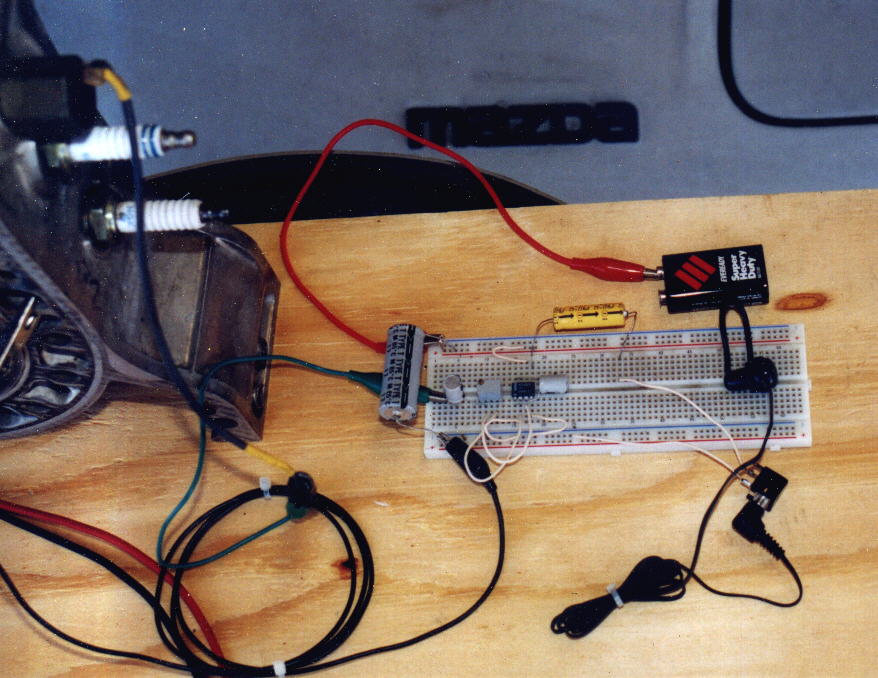
This schematic and photo will work. I tested it by tapping the rotor housing
with a hammer and listening to the ear phone.
Just a matter of finding the right audio filter band pass and rectifier
to light some LED's. The noise band is generated by the rotor housing vibrating
at it's natural frequency.

I notice the three rotor has three knock sensors. Most late rotor housings
have knock sensor mountings just above the spark plugs.

Paul Lamar

The AirCraft Rotary Engine NewsLetter.  Powered by Linux.
ACRE NL web site. http://home.earthlink.net/~rotaryeng/
Copyright 1998-2003 All world wide rights reserved.