I mentioned this to a few people at OSH and they were very
interested.
They felt Tracy rotary installation and PSRU looked a little
unprofessional.
Paul Lamar
Peter Cowan/Lexy Cameron wrote:
You shouldn't overlook the huge positive impact of a less than top of
the
line  somewhat imperfect installation that works.  It does far more to
convince us average guys without machine shops and unlimited funds that
we
can do it too. We wouldn't be where we are today without it.
Peter
That is the other side of the coin but I think that is far outweighed
by the bad cosmetics. I have spoken to many people about this and
the low cost side of the coin point of view is in a small minority.
Very few people are willing to risk their lives on some engine
installation that looks like it just came out of the junk yard.

One person was surprised and amused that Tracy, being in business
as he is, did not even have a cell phone. Yes I know it would
not be useful where Tracy lives but his daughter offered to
rent hers to Tracy for the air shows :)

BTW here is a picture of Tracy wearing a new T shirt and his daughter.
Where can we get one of those nifty T shirts Tracy? :)

Paul Lamar
Monty Roberts wrote:
People who do not have anything flying should not be so critical of Tracy's
installation. It is sound from an engineering standpoint. Every part of the
redrive installation is of known quality and is easy to analyze with hand
calculations. You don't need to do an FEA of the parts. It is "Real World".
He has flown over 1000 hrs with it. Have any of his detractors met this
goal? How many whiz bang, high buck, "professional" installations have been
successful? I can think of one company that has recently folded that had a
"professional" looking installation. The engineering behind it was dubious.
How many "professional" companies have taken deposits and left their
customers holding the bag? Tracy flies what he sells and delivers what he
promises. To me this is the definition of professional. His first aircraft
was a test bed and a very successful one. He has done more than any other
individual for making the rotary engine movement possible and I am certainly
not going to sling any mud. All the detractors are merely experiencing a
terminal case of sour grapes.

I for one would rather have a structural aluminum plate with known
properties holding my prop on than a thin low pressure sand cast bell
housing of unknown porosity and questionable strength that has been put on
purely for aesthetics. Have you done an FEA of the bell housing? Can you be
sure of the physical properties? My wife designs low pressure die cast
wheels for a living. The pressures they use are higher than a sand casting
by far and the thinnest section of most wheels is 5 mm in a non structural
area before machining. This is for flow reasons to prevent porosity in the
finished casting. They go to a lot of trouble to simulate the flow and
cooling in the die to insure there are minimal flow lines and inclusions.
Many, many FEAs of the part are done before any steel is cut. Then they test
the hell out of the finished product and still have problems from time to
time. They have metallurgists on hand to make sure the metal is mixed
properly. The castings are all heat treated and then machined to size. How
are you going to make 4 mm thick gravity fed sand cast parts of high
quality? You are going to a lot of trouble to build something of dubious
quality to put on your aircraft for purely aesthetic reasons. If this was
purely an aesthetic part I would remain silent, but it is a structural part
on which your life may depend. There is a proven, flying design that uses
structural aluminum plate of known quality and know properties available.
If you want to do this right you need a squeeze cast or high pressure die
cast part which would be prohibitively expensive. Otherwise you will have to
make the part too thick and heavy using gravity fed sand castings. You will
have to heat treat and machine the part to size. How much will this cost
compared to Tracy's solution? You would be better off using a spun aluminum
housing that is then heat treated with bolted connections on the front and
rear, or using the stock die cast automatic transmission bell housing. I
have tried to remain silent on this subject, but if you are going to sling
mud at a proven design while holding up some unproven design to the world as
ideal, you better be ready for some return fire.

If you don't like the way the plate looks, put the cowl on. Are we artists
or engineers? Form follows function, Period.

George, none of this is meant to disparage your efforts, and I wish you
luck. I  get a bit peeved at all the feather merchants who knock Tracy all
the time. We'll get the real poop after the first couple are cast. If they
do cast well, Just cut a few open and take a look at the metal, and test the
hell out of it before you fly with one. I have to call em like I see em.

Monty
Nobody is disparaging Tracy's engineering. The subject is the superficial cosmetics
of his installation. The people disparaging the cosmetics are precisely the
people whom have not completed a rotary installation and are precisely the people
you need to impress.

As far as the gravity cast bell housing is concerned that is all true Monty but there
are dozens if not hundreds of Ross gear boxes flying with gravity cast bell
housings including Tom Parkes's airplane. Ross gear boxes have been available
for at least 20 years. Several turbo three rotors have flown with Ross gear
boxes and many have flown as gyro's with hundreds of hours and many other
airplanes with 13 B's and Ross gear boxes have flown for hundreds of hours.
None have experienced cracks or failures in the bell housing. Ross gear
boxes have their problems but the problems are not cracked gravity castings.

If anything George's bell housing is way over designed at 5 mm or .2 inches
thick assuming his foundry can cast it that thin. Tracy's big flat plate is
12 mm thick just for perspective. Georges's reinforcing ribs are more prevalent and
double the depth of the Ross gear box ribs.  We will probably static test it
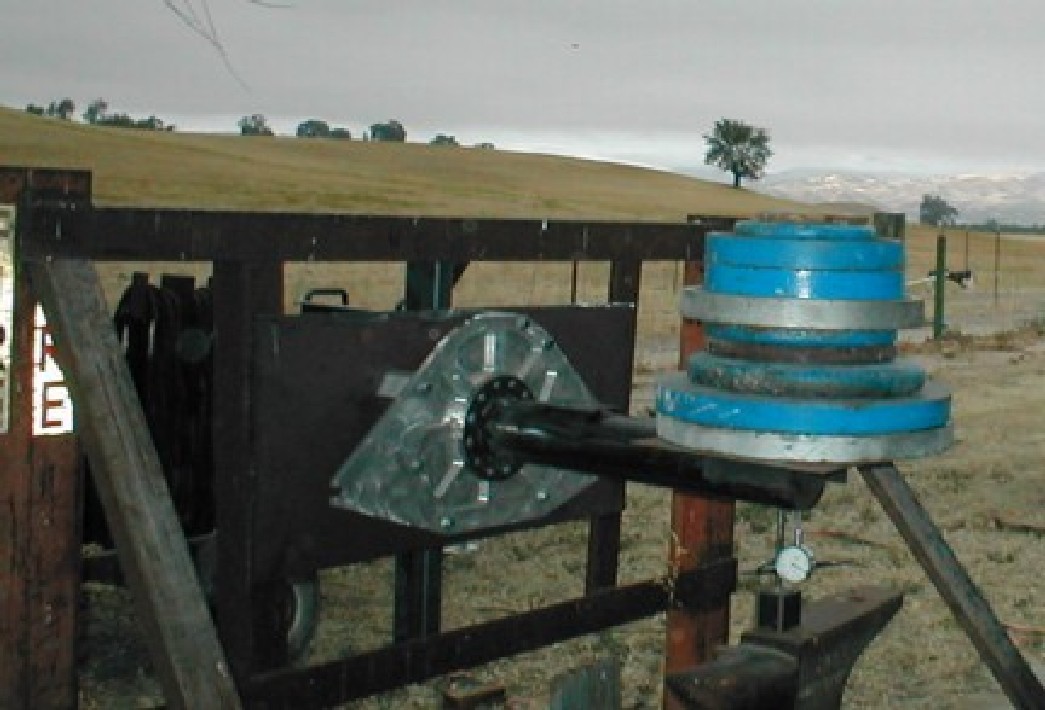
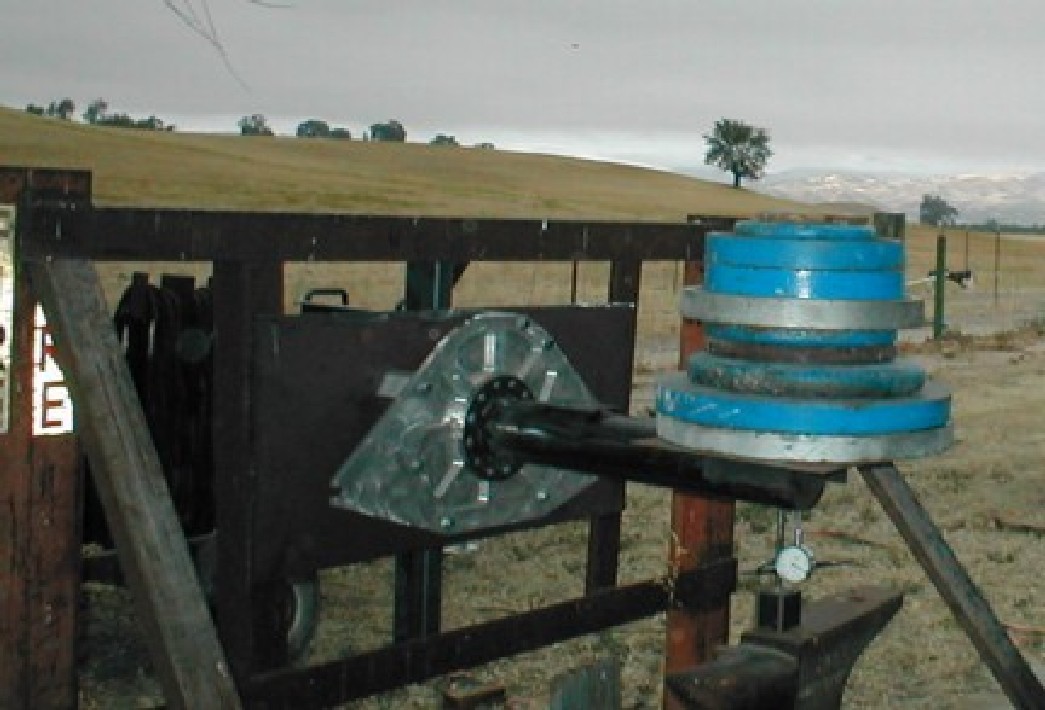
the same way we tested Tracy's motor plate. See the picture below.

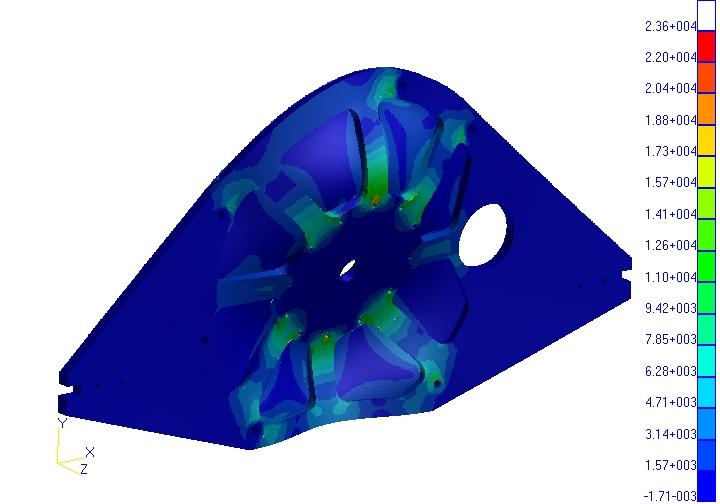
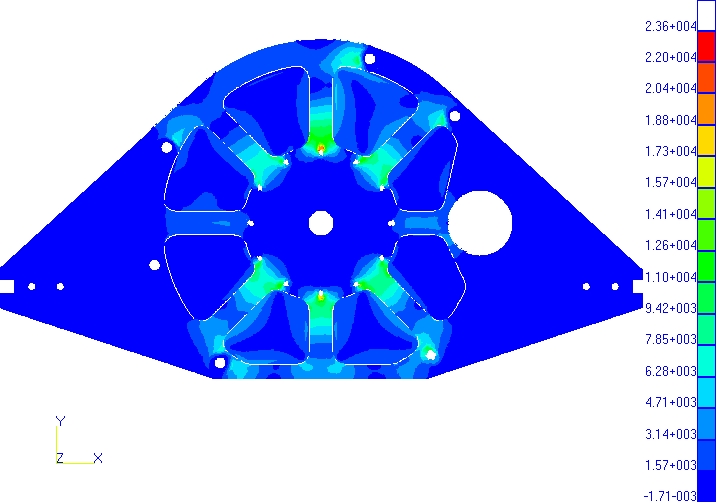
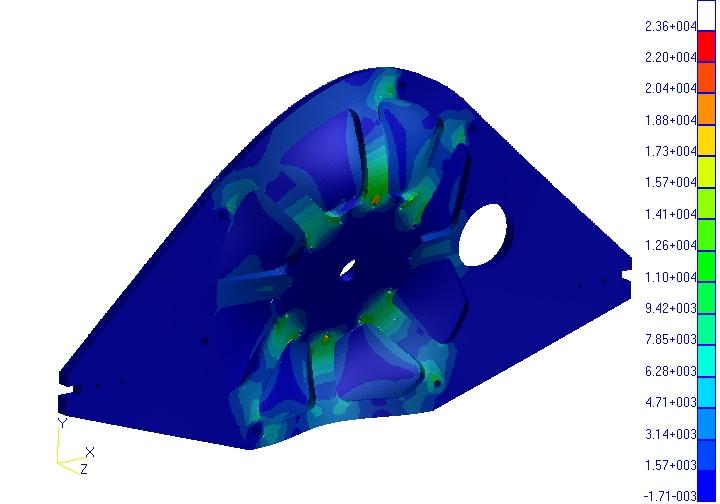
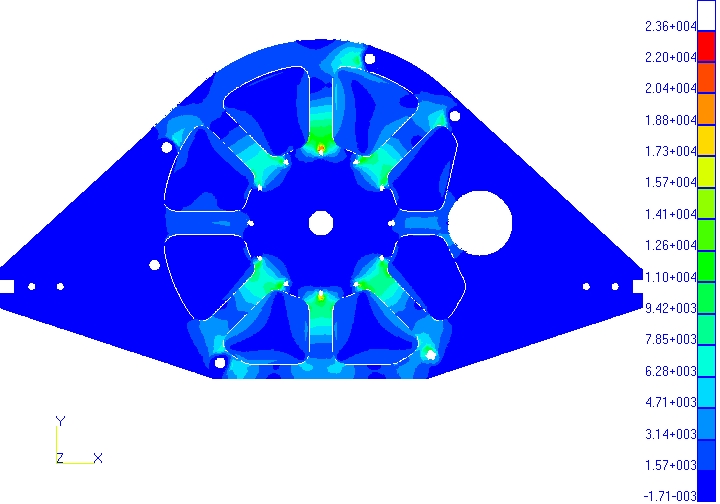
We do indeed have a few FEA's and the stress's are very low indeed.
For those not familiar with FEA's the deflections shown are greatly exaggerated.
The stress's at the point where Tracy's gear box would bolt on to the bell housing
are about 20,000 psi with a prop gyro torque load typical of a constant speed
metal prop pitching at one radian per second. I.E. 600 foot pounds bending. With
a wood prop or carbon fiber prop the loads would be half of this.

As far as the quality control of the gravity casting is concerned I have never
found any porosity in the castings I have received from the foundry after they have been
machined and we have not heard of any porosity from any of the dozens of people
that have received intake manifold and fuel injection holder castings from me.

The quality of the work from George's foundry supplier remains to be seen
but I am confident from what George has told me about it that it will
be adequate. I have no reason to believe otherwise.

Paul Lamar

The AirCraft Rotary Engine NewsLetter.  Powered by Linux.
ACRE NL web site. http://home.earthlink.net/~rotaryeng/
Copyright 1998-2003 All world wide rights reserved.