Perry Mick wrote:
I finally hooked up a voltmeter to my oxygen sensor. It read between
0.75 and 0.85 when it
was operating (warmed up). Looking on the web, this does not seem to be
a lean condition,
but rather a rich condition. From what I've been able to find, 0.45 is
the optimum, less than
that is lean, higher is rich. Is this correct?

--
Perry Mick
Custom Composite Props
mick@bridgingworlds.com
http://www.ductedfan.com
Hi Perry,

   Yes, the standard O2 sensor puts out a voltage between zero (or close to
it ) and 1 volt (lean to rich).  0.75-0.85 is in the power making range.
0.45-0.5 volts is the stoichiometric air:fuel ratio voltage, but not
necessarily the optimum (well. it is for emissions, but not much else) - it
depends.  If you want to make power then the air/fuel ratio needs to be
richer than 0.5  If you want leaner mixture, then less than 0.5 volts.
Supposedly 12.65 A/F is Best Power ratio.

Here's some information about lambda (O2) sensors... I found on the web

Lambda sensors come in two basic types, those with heating elements built in
and those without. They all work on some clever principle described by the
Nernst equation, and produce a voltage depending on the gas concentration
gradient across the device. Zirconium Oxide sensors need to be above about
300 C to work, and can be used to measure the Oxygen content in your
exhaust.

In practice you never burn all the available Oxygen, and the amount left
over will be related to the fuel/air mixture present, and the combustion
conditions. Basically, if you're running too weak, more oxygen is present in
the exhaust gas, and if you're running too rich, less oxygen is present.
Nearly all automotive lambda sensors give a 0.5V output for a stoichiometric
air:fuel ratio, and this appears to be 14.7:1.

The curve below may vary slightly from sensor to sensor but is fairly
representative
Ed Anderson
Thanks Ed. I got no reading on the ground taxiing, I first noticed a
reading as I was climbing out.
A very consistent 0.8 average throughout the flight. The ECU is not
actually using the O2 sensor
during any RPM setting I use for flight. It only goes closed loop below
3000 RPM or thereabouts.
I'm only at that power setting for base and final.

I can believe it is operating on the rich side, as I think my fuel
consumption is rather high, 7 to 8
gph operating at 5200 RPM. My fuel burn rate is higher than the O-235
LEZ I flew backseat
to Mojave, but of course that is a piston engine.

By having a free flowing exhaust system as compared to the car, would
that lead to richer
operation? If there is some logic behind exhaust system changes
affecting mixture maybe someone
can explain it to me. Less back-pressure of course, but I can't
immediately see how that would
affect mixture.

So I guess the white color of my exhaust ports does not indicate lean
operation.

All sensors used by the ECU should be operating correctly. The ECU puts
out a code if any of the
required sensors are not operating correctly, and I have 2 LEDs on my
instrument panel to
monitor this output.

The next step is to put a fake water temperature signal into the ECU to
see if I can affect mixture.

--
Perry Mick
Custom Composite Props
mick@bridgingworlds.com
http://www.ductedfan.com
Perry,

7 GPH 42 PPH .5 bsfc = 85 HP
7 GPH 42 PPH .6 bsfc = 70 HP

8 GPH 48 PPH .5 bsfc = 96 HP
8 GPH 48 PPH .6 bsfc = 80 HP

That is not a lot of HP out of your stock engine at 5200 RPM.
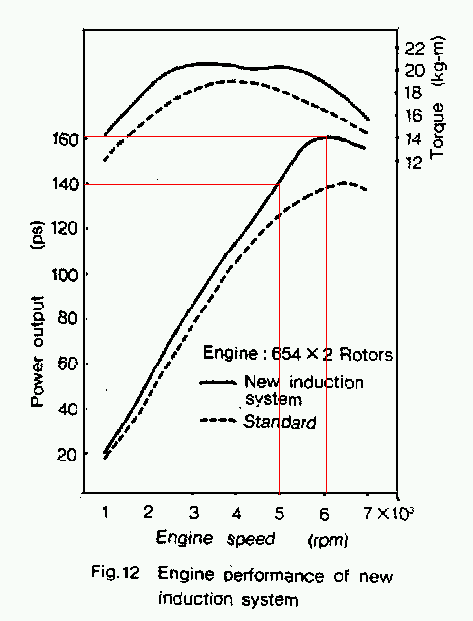
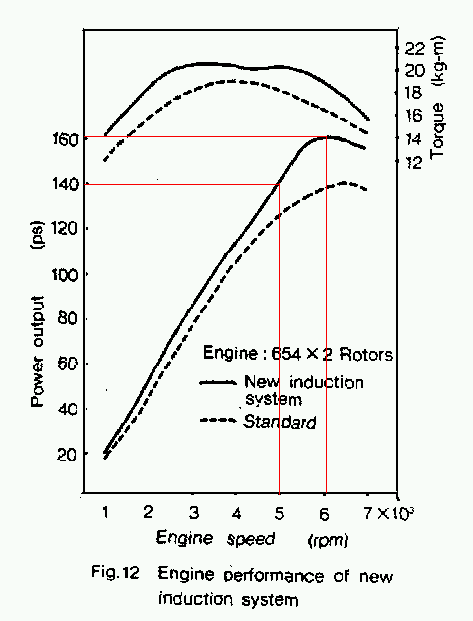
if the peak HP is around 6000 and is about 160 HP that
should be around 140 HP or so. See the stock dyno chart
below.

The color of your exhaust and these numbers are a strong
indication you are running lean. Is the O2 sensor fresh
or has some 100 LL been run through it lately?

What was the cruising speed of the O-235 Long EZ?
70% power on the 115 HP O-235 is 80 HP. At .45 bsfc that is
36 pounds per hour or 6 GPH. At an unlikely low .4 bsfc that
is 5.3 GPH.

Are you simulating any sensor inputs to the CPU?
Have you measured the intake manifold pressure?
Perhaps your tach is off.

Paul Lamar

The AirCraft Rotary Engine NewsLetter.  Powered by Linux.
ACRE NL web site. http://home.earthlink.net/~rotaryeng/
Copyright 1998-2003 All world wide rights reserved.