The Russians are very serious about selling  this airplane in the US.
http://www.airventure.org/2003/news/antonov.html

Robin and I are working on organizing a trip (very soon before it
gets cold over there) to the factory for a ride in the Vaz/Lada
rotary powered version. Preliminary itinerary: We will fly into Moscow,
take the Siberian Express train to the factory in central Russia
and come back by way of  Beijing. Anybody want to come along.

Paul Lamar
Here is a picture of the airplane in the water.

Paul Lamar
Jack Beale wrote:

P,

    How can they expect this aircraft to operate on ANYTHING but a DEAD-FLAT sea...?

    From looking at the picture, I'd think that even a light swell would tear the wings off...

Jack Beale
jack.beale@att.net
Beriev is no  Johnny come lately in the amphibian business.
I am sure the wings are strong enough to withstand anything a Sea State 2
(two foot waves) can do to it.

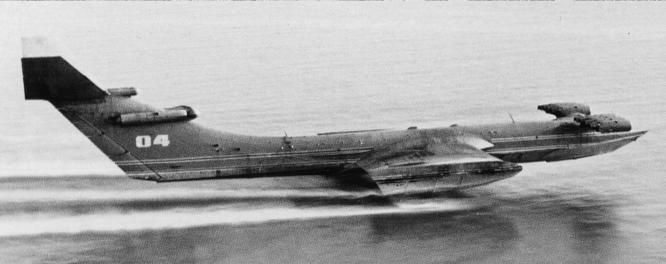
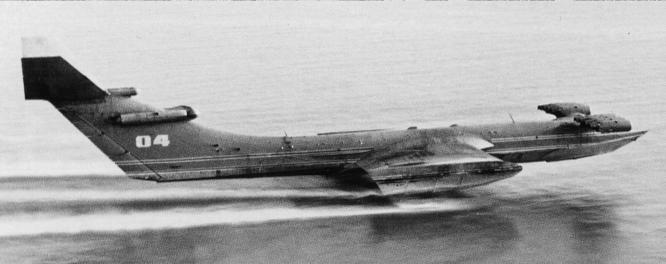
The Russians built huge Ekranoplans that could carry hundreds of tons
and fly a few feet over the water at over 100 MPH more efficiently than
airplanes.

The Be103 could efficiently fly in this mode using an accurate altitude hold
auto pilot controlled by a radar or sonar altimeter.

Paul Lamar

----------------------------------------------------------------
http://www.se-technology.com/wig/index.php
This largest ever built ground effect vehicle was designed in 1963-1964,
construction was completed in 1965. The KM's
maiden flight was on 18 October 1966, at that time
it had manual controls! The KM provided lots of useful data on large
scale WIG vehicles. Although only one KM has been built,
there are many photo's of the KM with different tail numbers (1
to 8). The numbers indicate the different test phases, some of the
changes to the craft were quite big, like wing span
(32-40m) and length (92-106m) variations. The max weight varied
from 495 to 540 ton.
The KM (Russian abbreviation for prototype ship) has a large T-tail
 with dihedral and surprisingly a mid wing. Eight large
turbojets are mounted at the front of the fuselage, the exhausts
of these engines could be deflected in order to create an
air cushion under the wing (PAR). Two extra turbojets were mounted
 on the fin in order to provide extra thrust for
accelleration. These engines are equipped with spray deflectors.
These engines were relocated from the fin to the top of
the flight deck in 1979 in order to reduce sprach ingestion.
All of the engines are Dobryin VD-7 turbojets. The maximum
wave height at take-off was 3.5 metres.
In December 1980 the KM crashed in the Caspian Sea during
take off. The pilot tried to lift-off without having 100% take-off
power. They tried to recover the KM, but it broke during lift
operations. The KM weighed 540 ton (at that time twice the
heaviest aircraft). The Americans who saw the secret KM on
sattelite photo's named it the Caspian Sea Monster (or
Casp A).
---------------------------------------------------------


The AirCraft Rotary Engine NewsLetter.  Powered by Linux.
ACRE NL web site. http://home.earthlink.net/~rotaryeng/
Copyright 1998-2003 All world wide rights reserved.