WOT 5500 RPM at 4500' manifold pressure is 26.5 in. hg.
5200 RPM at 4500' manifold pressure is 23.5 in. hg.
5200 RPM at 6500' manifold pressure is 22.0 in. hg.

I don't know what the white exhaust means but it is not lean. Maybe
in a car with a catalytic
converter and muffler white means lean. My O2 sensor is working
perfectly as far as I can tell. It reads 0.8 average anytime
in flight with RPM over 4000. That is when the ECU is
operating on internal maps. It read 0.45 when I was at 3000 RPM on
base leg. That is when it is closed loop using the O2 sensor.

--
Perry Mick
Make a low pass and tell me what it is nearer sea level,
Sounds a bit low at 4500'
Or just during takeoff. What is the field elevation there?

Paul Lamar
MMV is only 160 MSL. If I climb out full throttle at 80 knots RPM is
5150, if I climb at 90 knots it is 5200, manifold will read 30.0
near the ground. I will have to fly again to see what the manifold
pressure is 5200 RPM level flight near SL.

I'm guessing Mazda purposely runs the engine at 0.8V O2 sensor
best power mixture when the engine is at high RPM and high load,
because in the car you are generally only operating there when
you are accelerating and want the power. But like Tracy says,
for airplanes you want to lean it back in cruise. I just need
to see if I can trick the ECU somehow to do that.

--
Perry
Things are not adding up Perry. You are burning 100 HP worth of fuel
max (7 GPH) and your RPM is 5200 at 30" Hg manifold pressure you should
be developing about 140 HP.

Paul Lamar
5200 RPM and 30" Hg is climbing out. I may be burning 10 or 12 gph
during climb out, I just don't know. My gross weight would be
approximately 1400 lbs. and climb rate is maybe 800 fpm. The only
fuel burn numbers I have are from long trips. I used to burn 6.5 gph
cruising at 4800 RPM, now I burn 7 to 8 gph cruising at 5200 RPM.

I guess I could cruise around WOT for awhile and try to determine what
my fuel burn is, probably over 10 gph and closer to 140 HP like you say.

BTW, what is the source of that chart? It has plots for "old" and
"improved" manifolds. I'm guessing the "old" manifold is the 1986
and the "improved" is 1989. In that case you will get results comparable
to mine by using the "old" curve, which does show a peak close to
146 HP at 6500 RPM. I think the 1989 engine was rated more like
160 HP at 6000 or 7000 RPM.

--
Perry
8 GPH is 96 HP at BSFC of 0.5 and 80 HP at a BSFC of 0.6.
10 GPH is 120 HP at BSFC of 0.5 and 100 HP at BSFC of 0.6.
12 GPH is 144 HP at BSFC of 0.5 and 120 HP at BSFC of 0.6.

That dyno curve is from a Mazda SAE 841017 technical paper published
in 1984. The old is the non dynamic chamber version pre about
1985-1986. Note the lack of the torque peak at 2000 to 3000 RPM in the old
140 HP chart. The dynamic chamber was developed and used post 1986
to enhance the torque at 2000 to 3000 at the expense of peak power.
The 160 HP engine shows that torque hump at 2000 to 4000 RPM.
You are using the stock dynamic chamber and EFI so your engine is 160 HP
at 6500 RPM or so. BTW took me a long time to convince Ed of this fact:)

The 140 HP comparison engine was probably the early 4 barrel, 4 port
short intake manifold, carb version of the 13B used from 1974 in the
RX4 and 13B Cosmo. This is the engine I had in my Cosmo. All EFI systems
have been dynamic chambers from about 1985-1986 through 1991. In 1992 the
dynamic chamber was refined and improved and used only with the
turbo RX7 in the states.

BTW Tracy built a flow meter using the injector pulse width.
Tracy what is the status of that device? Can you loan it to Perry?

Paul Lamar
I just think if I really had 140 to 160 HP available on climbout, I would be
climbing at 2000 fpm instead of 800 fpm. My climb rate is more comparable
to an O-235 powered LEZ instead of O-320 or O-360. Of course my ducted
fan is inefficient :-)

I do know the 86 engine was rated 146 HP NA and the 89 was rated 160
HP NA. But it could be for reasons other than intake manifold differences.

That injector pulse width averaging circuit is simple enough, I will
probably
build one (eventually).

--
Perry
I just found a chronology chart in the 2003 Rotary Engine book.
Here is the chronology of the NA 13B in the US market.
1974 135 HP  128 ft lb 4000
1983 135 HP  133 ft lb 2750 dyn chamber EFI 6 port 1st gen RX7 (rare)
1985 146 HP  138 ft lb 3500 new dyn chamber EFI 6 port 2nd gen RX7
1988 160 HP  140 ft lb 4000 variable dyn chamber EFI 6 port 2nd gen RX7
1991 discontinued.

What does your airplane gross when it is climbing at 800 FPM?

800 FPM is 13.3 FPS X 1500 lb is 20,000 pound feet per second
or 36 net HP out of the ducted fan for climb alone not including
aero drag. Given a duct efficiency of 50% that is 72 HP out of
the engine.

At 2000 pounds gross it would be 48 HP or 96 HP out of the engine.

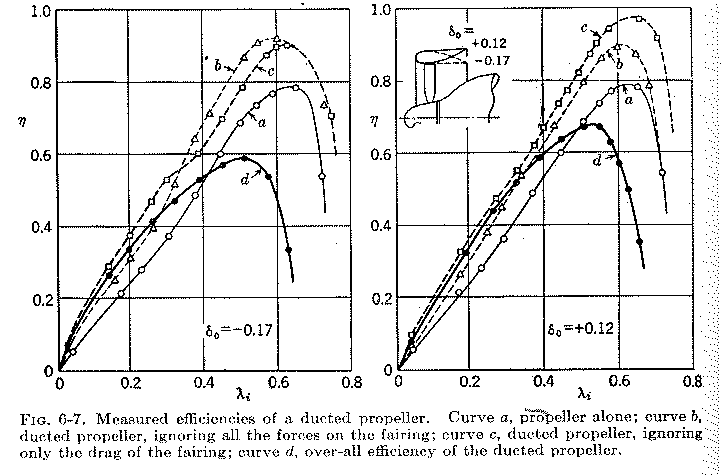
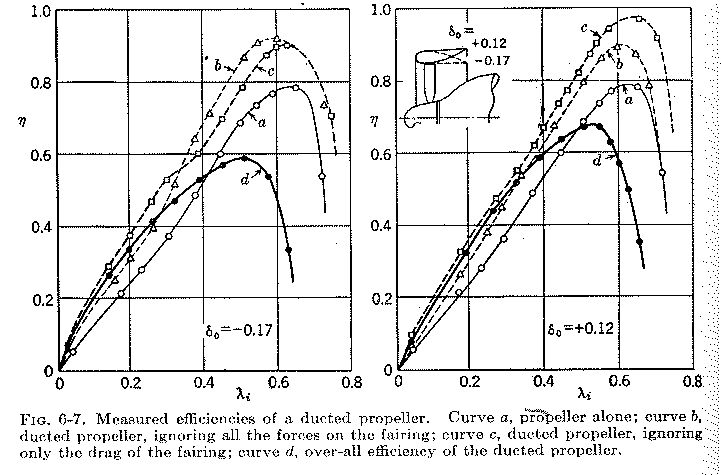
Here is a graph of ducted fans from K&M for the new guys.
Off design point (at lower speeds) the ducted fan is about
as efficient as a prop. Probably a prop of the same diameter.
That is because the additional aerodynamic drag on the duct becomes
less significant.

More evidence your engine is not generating the rated power.

The x axis is the advance ratio. Simplified that is the internal air
speed through the fan divided by the theoretical air speed
through the fan as if there were no slip. This is used for
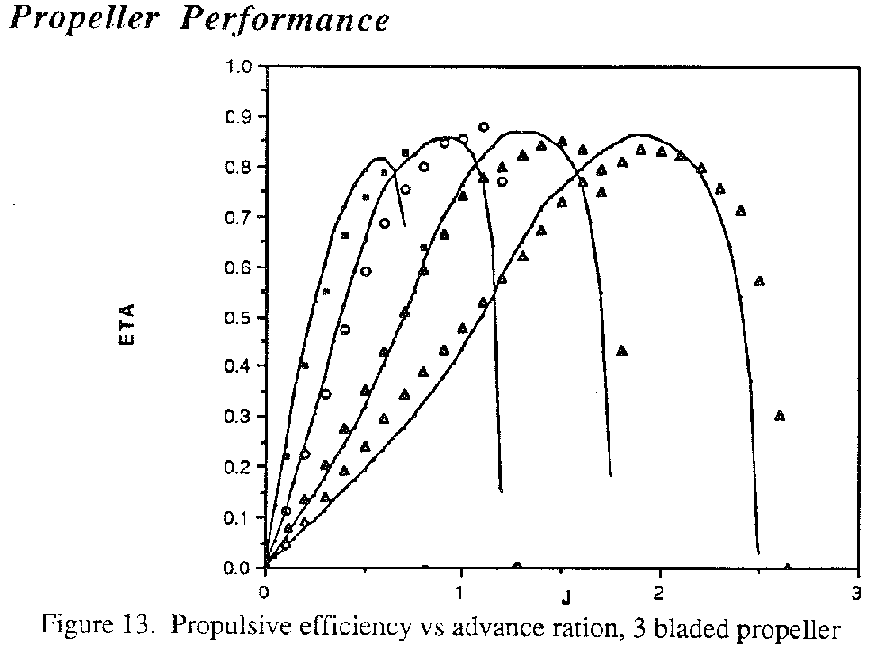
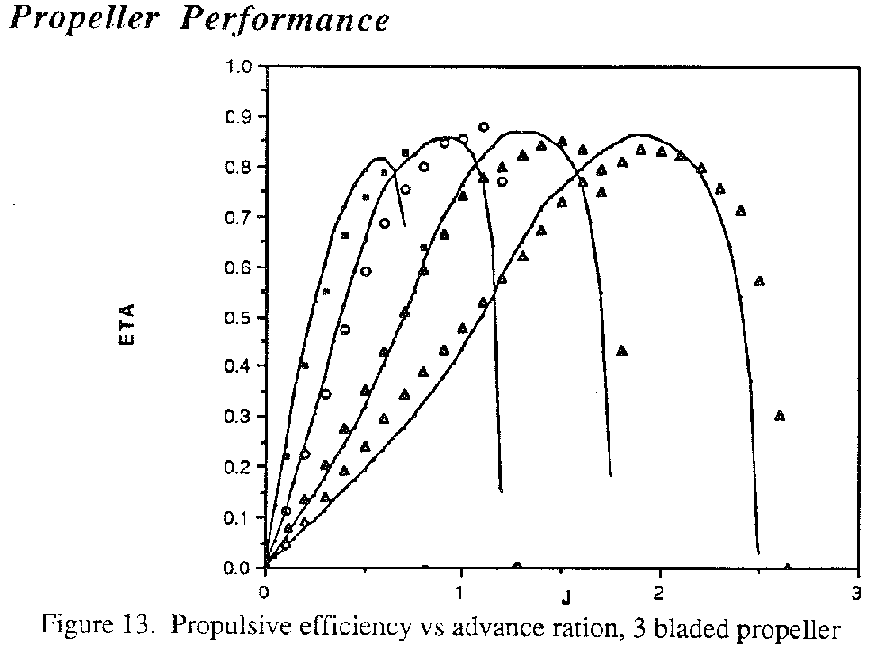
props as well. As you can see a fixed pitch prop reaches it's max
efficiency at only one speed. Roughly at .6 of the theoretical
air speed through the prop as if there were no slip.
However it takes a bit of slip to generate thrust.

Here also is a graph of a variable pitch prop for illustration
and clarification.

Paul Lamar

The AirCraft Rotary Engine NewsLetter.  Powered by Linux.
ACRE NL web site. http://home.earthlink.net/~rotaryeng/
Copyright 1998-2003 All world wide rights reserved.