Scott Gettings wrote:
Gentlemen,

I'm extremely interested in using a 13B in my Glass Goose, which is a
composite, pusher biplane amphibian.  The group may know
that there are already several of these planes with 13Bs in
various stages of installation.  None are yet flying to my
knowledge.  So far, at least 2 builders have installed a 13B
into a Goose within W&B and size limitations, so at least that part
of the project can be done.  However, overall weight and especially
aft weight are of concern.

I'm at the point of a decision on engine mounts and would appreciate
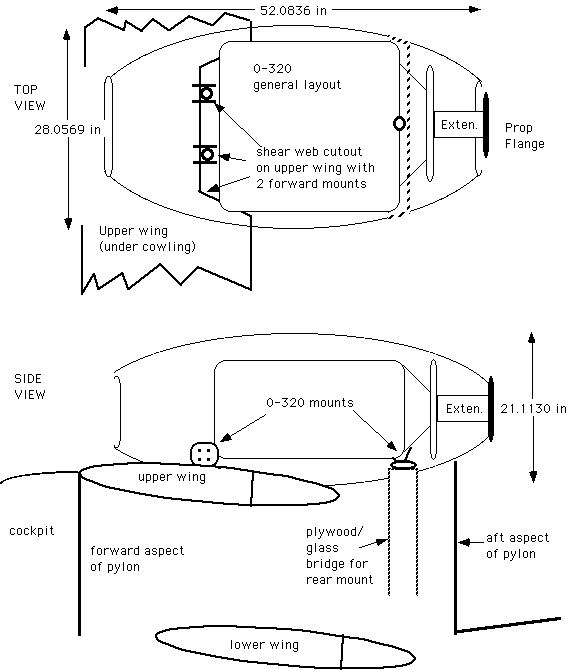
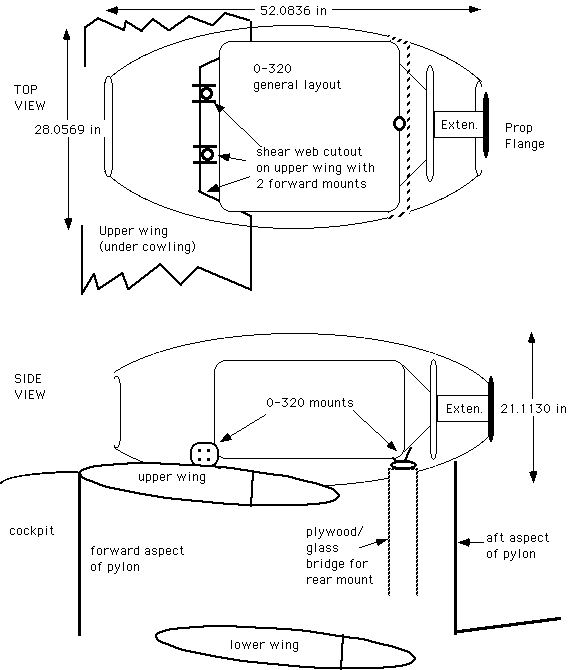
input from Paul and others.  The first of two (quite crude,
sorry) drawings attached shows the general layout and mounting
of the standard 0-320.  It uses 2 forward, Lord-type mounts that
attach to plywood/glass brackets on the shear web of the upper
wing.  These brackets are 1/4" plywood with 5 layers of 7725 BID
on each side.  It also uses a single rear engine mount that
attaches to a bridge built of 1/4" plywood arches that span between
the two walls of the inter-wing pylon (about an 18" span).
 This bridge has a 3/8" plywood top deck, and is covered/attached
with 3 layers of BID and 3 layers of UNI.  The bridge only
extends about 2/3 of the way down the pylon walls, which are 1/2"
foam covered with 2 x 45 degree UNI on each side.  It appears
 the rear mount supports between 1/3 and 1/2 of the engine weight.
This is interesting since the aft-most aspect of the pylon has
relatively little vertical support.

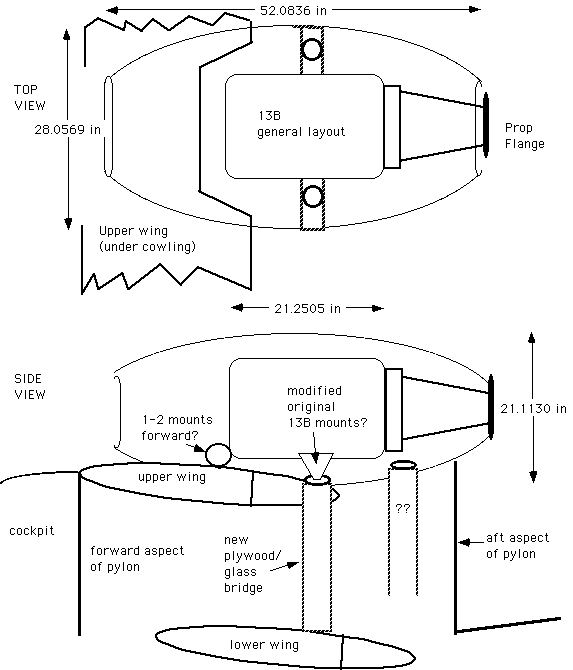
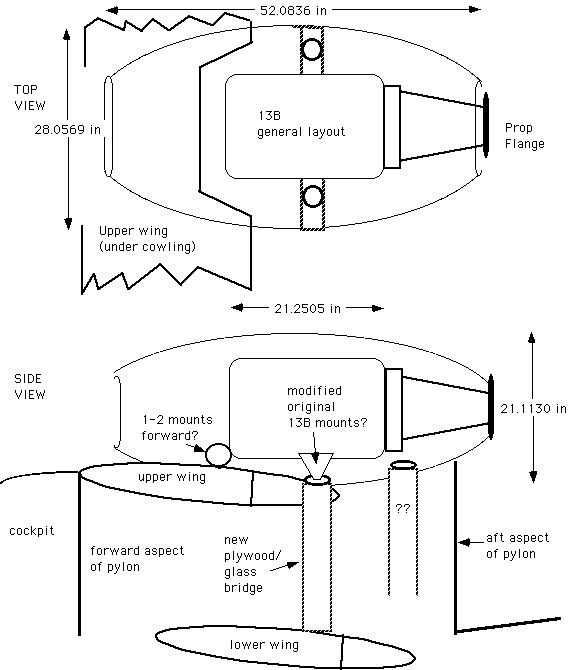
The second drawing shows an approximate layout of a 13B engine
in a Goose.  Although it appears there is plenty of room around
the engine, using a full, oil pan/plate mount as so many RV's
have done would most likely cause interference problems,
especially at the aft end.  One Goose builder used auto-type
center mounts and kept the existing aft bridge, using it for a rear
engine mount appx. at the location of the starter on a RD-1
redrive. The location of the original 13B auto. mounts luckily end
up almost directly over the lower wing shear web, which is
a major structural element.  Installing a bridge at this location
would seem capable of handling engine mounts substantially
 similar to stock auto mounts.  This new bridge could easily be
brought down to the lower wing structure, giving substantially
 more strength than the original, farther-aft bridge.  I can build
and load-test a sample of this bridge to 6-9 Gs without too much
effort.  Last, one or two front mounts could easily be attached
to the upper wing shear web, as with the 0-320 installation.

My questions are:
1.  Taking weight into consideration, does it make sense to
use auto-type center mounts plus Lord bushings on a new, center
bridge instead of the oil sump-plate mount or other scheme?
 I'm assuming the 2 std. auto mounts would be much lighter than an
entire sump-plate mount.
A sump plate is double the area to leak oil. Bad idea and heavy unless
you spend big bucks and mill it out. The stock Mazda mounts are too
heavy. Use the motor plate to attach the mounts as they will take
90% of the load because that is where the CG of engine/psru/prop
is located.
2.  The big question is then:  if two center mounts are present
in the middle of the engine, should there be one mount in front
and one aft, or would two (or one) in front suffice?  The distance
 between one or more front mounts and the engine center mounts
would be about 13", while the distance between the center mounts
and an aft mount would be about 9".  Having the mounts in front
would be better from a CG, weight and complexity as the
aft bridge would not be needed.

All comments and suggestions, including recommendations for Lord/Barry
 mounts, etc., are both welcome and appreciated.

Scott Gettings
One mount aft is all you need. Forward in the case of the Goose.

We got a guy in Florida almost ready to fly a 13B Glass Goose.
Harold but I can't remember his last name. Every year we get invited over
to his house for dinner but I keep forgetting to take my camera.

Paul Lamar

The AirCraft Rotary Engine NewsLetter.  Powered by Linux.
ACRE NL web site. http://home.earthlink.net/~rotaryeng/
Copyright 1998-2003 All world wide rights reserved.