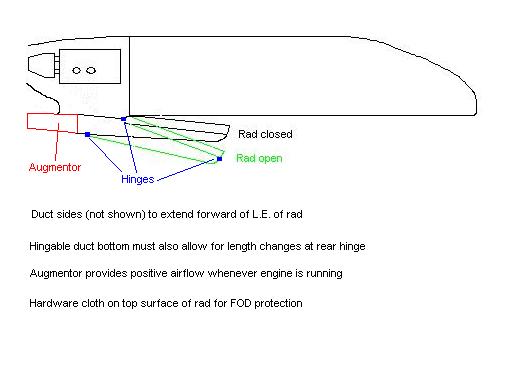
> > > IMHO this is a major breakthrough in cutting the work required
     > > > to install a liquid cooled engine. This has far reaching
     > > > implications for the acceptance of the rotary.
     > > >
     > > > A rad installation like this could take as little as two hours.
     > > > The stock oil cooler could be added along side the rad.
     > > >
     > > > The the interior of the cowl is opened up with far more room to
     > > > work on the engine and accommodate mufflers under the engine.
     > > >
     > > > All you need add to this illustration is side plates.
     > > >
     > > > The angle of the rad can be adjusted up and down to decrease
     > > > or increase the cooling effect.
     > > >
     > > > Will work for pusher and tractor.
     > > >
     > > >
     > > > This is a brilliant idea on whoever thought it up.
     > > > Good thinking outside of the box. Literally :)
     > > > Brilliant! brilliant! Brilliant!
     > > >
     > > > IMHO this will become the cooling system of choice.
     > > >
     > > > Paul Lamar
     >
     > > What happened to the concern about boundary layer thickness and splitting?
     > >
     > > Bill Schertz
     > > KIS Cruiser # 4045
     >
     > Good point. Might be needed in a pusher. On the other hand at climb out
     > angle of attack it might be fine as is. I am going to try it on
     > the KIS without as the boundary layer does not have much of a chance
     > to build up.
     >
     > On a pusher you could use a flat plate on top and space it down 2 inches.
     > That should handle the boundary layer.
     >
     > Paul Lamar

     > Another plus for this arrangement for the pushers is what happens
     > to CG. I was previously running 30lb of ballast in
     > the nose with the Lyc O320. I would like to eliminate as much of that as possible.
     >
     > I have two concerns relating to the pusher configuration.
     > One is the potential for damage from FOD kicked up by the
     > nosewheel. The other is cooling during taxi. I don't see any
     > way of using an augmentor or fan for low speed
     > assistance. Since hot air rises it will take some encouragement
     > to get the air to go down through the rad. Does
     > anyone know if an idling prop has enough suction to affect it from that far away?
     >
     > Dick Gregory

     I don't think so Dick. I think you will need a fan either blowing down
     from the top or sucking through from the bottom. Or use a water spray
     on the rad like Tracy uses.

     Hardware cloth can take care of the rocks.

     Paul Lamar
     The attached drawing may not be as simple as the original idea but
maybe it overcomes some of the drag and aesthetic
concerns that have been expressed. I wanted to use an augmentor
anyway and this isolates the turbulent air exiting
the rad from the outside airstream.

With the augmentor, the boundary layer may not be as much of
a problem. According to the ducted fan experts,
ingesting the boundary layer for purposes of accelerating
it provides better thrust because of the higher
 delta-velocity.

     Dick Gregory, LongEZ N613NC
I think that is a good idea Dick. With side plates of course.

The thrust augmentor might provide enough suction to defeat the
pressure  build up on the panel behind the rad.

Paul Lamar

The AirCraft Rotary Engine NewsLetter.  Powered by Linux.
ACRE NL web site. http://home.earthlink.net/~rotaryeng/
Copyright 1998-2003 All world wide rights reserved.