Bill, My two radiators are GM evaporator cores out of the junk yard
for $5.
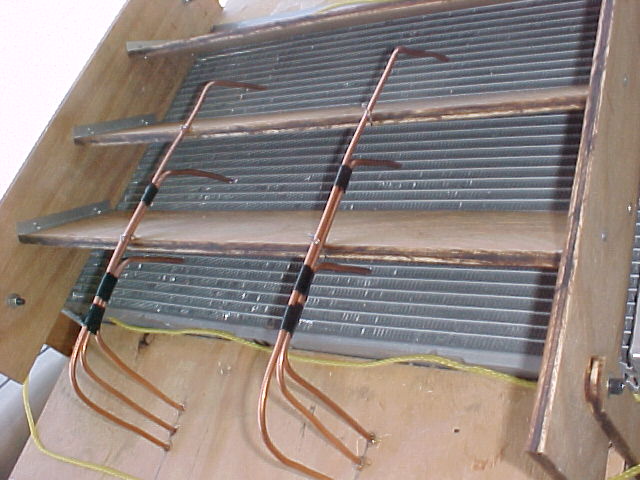
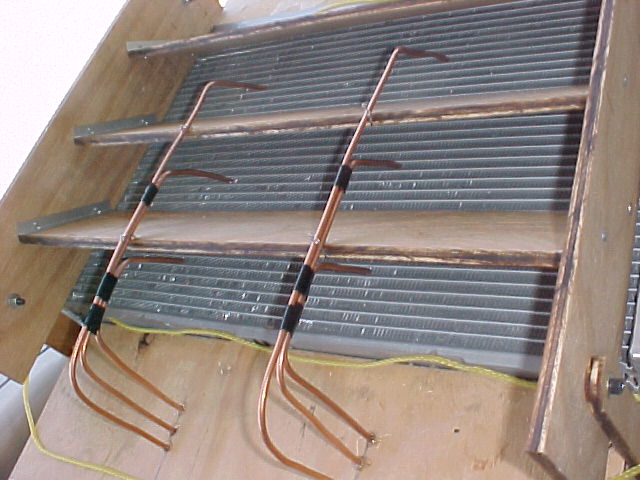
The fin area is 9x11x 3 3/8" plus the side tanks. I have a stock
Mazda RX-7
Oil cooler under the nose. Here is are some photo of the cooling
system
>from the front and the coolers and their mounts. As you can see in
the
older aircraft photo the ducts are generous in size.

My total radiator duct inlet area (before the reduction) was 48
square
inches, now down to 33 square inches
Ed, I ALWAYS listen to someone who is FLYING successfully. Let me
pass along some info you might find interesting. First:
depending on what you project your HP at you are using between
3 to 4 cubic inches per HP. The size of your rads indicates you
could probably do better with better ducts, good call on the mods.
One of the other things ignored by many is that Everett Hatch
used 2 rads IN PARALLEL. To successfully remove more heat one of
the best ways is to increase the mass flow of the water.
Everett understood that all things being equal more water
through meant better cooling. The only problem with the parallel
system is you must carefully balance the system so both rads pass
approximately the same amount of water. Paul is talking about
the e-shaft driven pump and this will help, IF it doesn't cavitate.
The other thing is that the standard pumps are real close to
cavitating to produce enough flow at high RPMS. Take another look
at the size of the water pump on the 900 HP Racing Beat
system. IT IS HUGE! Hang in there Ed.  The simple system
may get more aircraft in the air, which is good. After that we need to
look at efficiency and to paraphrase an old southern
standard, The ducts will rise again! Bill Jepson
The only place you will ever get perfect K&M ducts is in the aft
fuselage
like a P51. That is the only place with enough volume to do it right.
Most people are unwilling to cut large holes in the bottom of their
fuselages. We have been all over this years ago. You need to get one
of the NL CD's Bill and read all about how we got where we are
cooling wise.

For a canard forget it. There is not enough room anywhere.

Our best approach is to develop and have made a thin oblique rad.
There is a possibility something like that will work in a perfect K&M
duct
only four inches high and 16 inches wide and eight feet long :)
Three feet for the inlet duct two feet for the oblique rad and three
feet for the exit duct. Is it worth it? :)

Paul Lamar
Thanks for the comments and encouragement, Bill. I had considered
plumbing
my two radiators in parallel for the better efficiency, but after doing a
little research I decided that the odds of ensuring even coolant flow
through both were uncertain.  Several others who tried (including one
individual who tried a "gate" at the "Y" to balance the flow but found
that
what worked well at one rpm (coolant flow rate) did not work well at a
different rpm) did not find a satisfactory solution.  The only person I am
aware of successful using the parallel approach is Tracy Crook, but, there
may be others.  Besides the series approach was simpler to plumb in my
case.
I agree with Paul, that my new duct does not meet the K&M criteria (too
short - for one thing), however, perhaps not too surprising, the smoothing
of the inlet does seem to have improved the airflow into the radiator.  So
while not perfection, it provided encouraging results.  The new duct is
undoubtedly  a bit on the small size at 9 square inches, but it did reduce
total radiator inlet area from 48 sq in to 33 sq in.  So perhaps one
upsized
to 15-18 sq in for both might be the right combination.

With the smoothed ducts apparently providing better cooling, I then have
the
option of leaving them the original size inlet and having a "cooling
capacity reserve" perhaps for the hottest days (or "grin" perhaps more
power - turbocharger!) or reducing their inlet size in hopes of lowering
some cooling drag.

Whether K&M, the "Wedge duct", or the latest of hanging it under the
fuselage and having the radiator act as duct, what is important is that
your
installation provide adequate cooling - first and foremost.

 The research that Paul has done over the years on cooling has from time
to
time caused him to modify his view on the best approach. But then that
is
what you would hope additional knowledge would cause one to do - otherwise
why do any research at all. I understand Paul's "enthusiasm" with new
knowledge/understanding. However, at some point in working a project you
have to commit to one approach with hopefully the best knowledge you have
available at the time. If something better turns up then you have the
option
of sticking with what you started with (hopefully-good enough) or making
the
necessary effort/changes to adapt to a perhaps better approach.  No one is
forced to adopted any particular approach and while I may not always agree
with Paul, I  (for one) certainly appreciate the research, findings and
viewpoints that he shares with the group.

Keep it coming, Paul!

Ed Anderson
Thanks Ed.

Speaking of research Ed I think you and we would learn a lot if you set up five pito
tubes equally spaced behind your rad measuring the air flow distribution
exiting the rad. After all that is what the curved ducts are all about. Some static
pressure taps on the face of the rad would also help. Noting the
cooling ability is useful but measuring the pressures and velocities
is a far more direct way of developing duct shapes. This will also be a
reflection of any pressure build up on objects behind the rads.
Perry is currently using my water manometer but you can borrow it
when he is done with it.

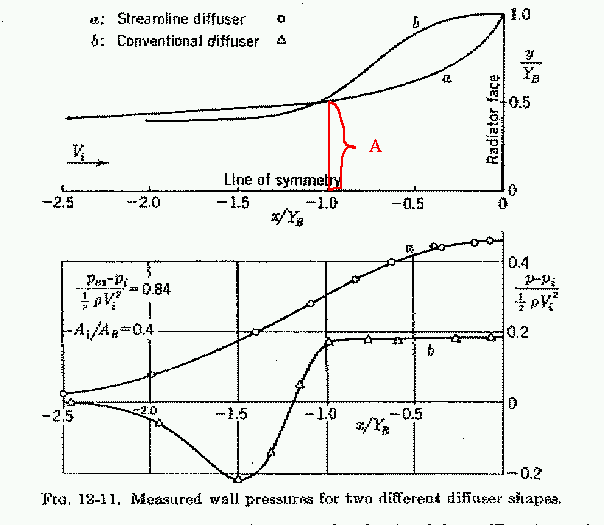
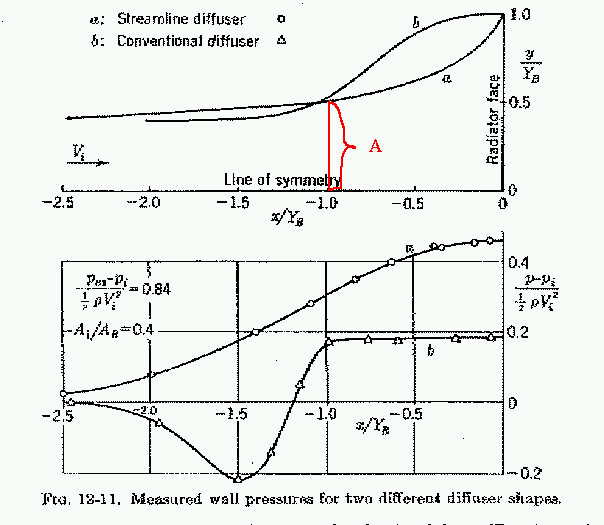
BTW Bill, notice the pressure recovery of the K&M duct. Although it is
up from 20% of dynamic pressure to 45% of dynamic pressure it is still
a far cry from full dynamic pressure. Right side lower chart. This is
because you are feeding a porous surface. With the simple wedge system
by definition you have full dynamic pressure across the opening at the
start of the core as there is no duct.

Paul Lamar

The AirCraft Rotary Engine NewsLetter.  Powered by Linux.
ACRE NL web site. http://home.earthlink.net/~rotaryeng/
Copyright 1998-2003 All world wide rights reserved.