Speaking of research Ed I think you and we would learn a lot if you
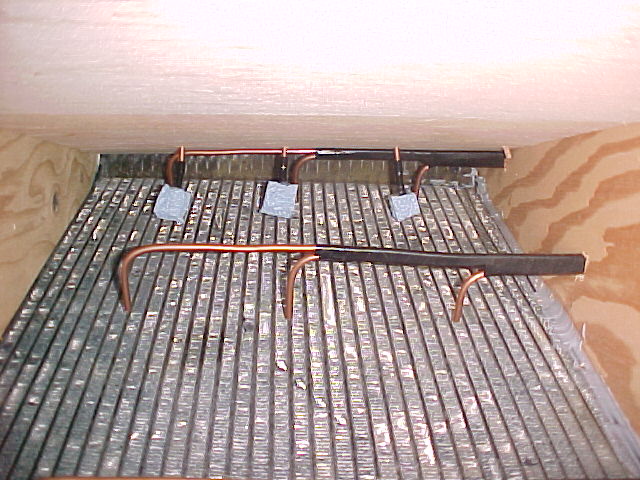
set up
five pito
tubes equally spaced behind your rad measuring the air flow
distribution
exiting the rad. After all that is what the curved ducts are all
about.
Some static
pressure taps on the face of the rad would also help. Noting the
cooling ability is useful but measuring the pressures and velocities
is a far more direct way of developing duct shapes. This will also be
a
reflection of any pressure build up on objects behind the rads.
Perry is currently using my water manometer but you can borrow it
when he is done with it.

BTW Bill, notice the pressure recovery of the K&M duct. Although it is
up from 20% of dynamic pressure to 45% of dynamic pressure it is still
a far cry from full dynamic pressure. Right side lower chart. This is
because you are feeding a porous surface. With the simple wedge system
by definition you have full dynamic pressure across the opening at the
start of the core as there is no duct.

Paul Lamar
Paul,  I agree with the value of your suggestion on instrumenting for
airflow/pressure.  However, since I have the PSRU with a mounting plate
that
blocks or greatly interferes with (it extends over my rear fins about 3"
from top to bottom of  each radiator and is a close as 2" to the fins)
approx 36 square inches of radiator area ( ouf of 180 in^2) or approx 20
%
of my cooling area, I'm not certain how much it would tell us about
cores
for cooling.

A better choice would be someone with the cores mounted without the
interference behind them.  One of the projects for the far future is a
new
cowl design to overcome some of the constraints of where I could mount
the
radiators under the stock RV cowling (and reduce some of the drag from
my
hugh bottom cowl opening (28x4.5"). I have not yet come to love
fiberglass
work, but after all the practice I think I can not do an adequate job
with a
cowl.

Best Regards

Ed Anderson

Ed
I think you have a rather typical installation other than the plugs up.
You would also know the velocity of the air going through the
rad and could then get a good estimate of the over all mass flow
through the rad. I would still be interested in those numbers.

I guess what this illustrates is it possible to
build an adequate cooling system if you have enough volume in the rads
regardless of the aerodynamic efficiency of the system.

Paul Lamar
Ok, Paul. But, when I had a bell housing I had no blockage of the back of
the radiator - well not within 6-7" {:>).  Have to think that makes some
difference.  I would like your suggestions as to what points and how many
pitot tubes I should place.  In front and behind of course, but any
particular position - like 1" from fins at inlet entrance, center of duct,
next to the walls, etc?

Ed Anderson
Divide the rad into four quadrants and put one pito tube (small copper pipe)
in the center of each quadrant and one in the very center of the rad.
Static pressure taps can be right up against the core using porous
foam on the ends of drip irrigation tubing.

Believe me you will be both amazed and dumbfounded at the same time.
So far this has happened to both Tracy and Perry :)

Paul Lamar

The AirCraft Rotary Engine NewsLetter.  Powered by Linux.
ACRE NL web site. http://home.earthlink.net/~rotaryeng/
Copyright 1998-2003 All world wide rights reserved.