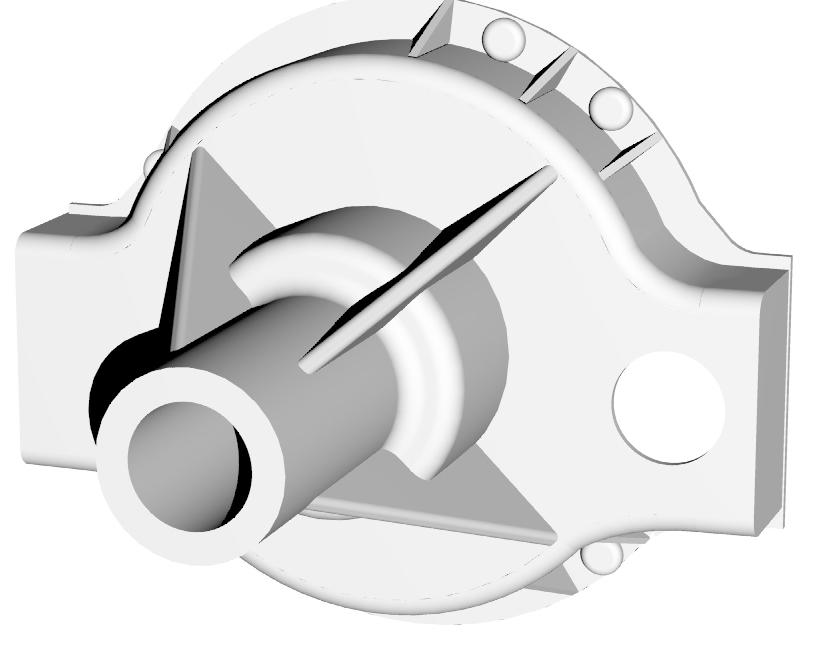
George you could always do this.

A: Machine it to take Tracy's parts. Load Tracy's parts
from the rear like a auto transmission.

B: Accept Tracy's gear box as a trade in and install the parts.
C: Sell the raw castings to me and let me doit.
D: Sell the machined castings to Tracy for new installations.
E: Sell the raw castings to Tracy and let him machine it.
F: Buy the parts yourself and sell the complete gear boxes.

Paul Lamar
Excellent idea Paul,

What concerns me is the distance the aluminium has to run and the
cooling
effect on that run distance- again injection casting is the answer to
all
our problems, especially in regard to thin walls.

I can't understand why it's so expensive for the moulds,
I'm wondering if some members would be interested in a group investment.
I'm
sure there would be a small profit in it at the end of the day. I would
be
happy to discuss it with anyone who's interested, but we would need
numbers
to spread the cost.

Paul, ever thought of starting up something like this?
George (down under)
Forget the investment casting George. I am sure if you talk to the
foundry about it and show them some of these 3D's they will come
up with a way of sand casting it. The overall weight can be drastically
reduced by this one piece approach.

Paul Lamar
Paul,
It looks very good but there would be other problems.

One would be that there would be no seal centre this would have to be an
add-on. To do it any other way would be to involve too much weight because
of the necessary taper (draft) required - the greater the height the thicker
the base.
The seal holder and back plate is a simple disk with a few holes. No problem
for my NC mill. Common in auto transmissions for cars.
That would go for the stiffening ribs as well - a nightmare to make.
Yes they are hard to make by hand but if you have a mill wood ribs are
easy as you shim up one end of the wood and cut the draft or AKA taper.
Then glue the ribs to the rest of the pattern.
You will notice that some other PSRU with bellhousings are done in flatter
sections - this overcomes the taper problem in adding unnecessary weight.
Perhaps we should be considering shallower sections rather than deeper 'all
in one' sections. I think we have a good depth in the housing section (this
is governed by the starter depth anyway) and Tracy has overcome this problem
(in the PSRU housing) by adding tube inset sections.
OK I will redraw it. Give me a day or so as I have a few things to do
in the next couple of days.
The Aussie design will have a bigger PSRU section foot print on the face of
the bellhousing - it will be approx 1.75 from the top edge and have a 1"
flange - that will spread the load as well as design so far suggested.

Perhaps (and this just a suggestion) the last section of Tracy's PSRU could
be replaced with  a section with a bigger footprint - in an effort to spread
the load wider over the face of the bellhousing.

No insult to Tracy, but I do see the base of the PSRU housing being the weak
link in a design, where we are trying to mount onto a housing with thinner
walls - it's probably fine for the 1/2" plate as this is what it was
designed around, but a wider base will spread the load better, as all of
your designs have indicated.

George (down under)
OK if you want to make two casting and bolt them together. It is more
machining work and slightly heavier. I also think it will cost more
for the foundry. It is the flexible way to go however. It will have
to have a large cutout for the starter.

Paul Lamar

The AirCraft Rotary Engine NewsLetter.  Powered by Linux.
ACRE NL web site. http://home.earthlink.net/~rotaryeng/
Copyright 1998-2003 All world wide rights reserved.