>      > > > > Ben Baltrusaitis wrote:
     >      > > > >
     >      > > > > Here is an excellent example of the plane I am building with an IO-540
     >      > installed.
     >      > > > > (I hope mine turns out half as pretty!) Do you
     >      > > > > think a Renesis, the new VAM exhaust, and Tracy's PSRU will improve
     >      > > > > the air on the nose and the weight under the cowl to have
     >      > > > > better performance than the Lycoming with 300hp?
     >      > > > >
     >      > > > > BTW, it seems every day I am amazed beyond belief at the engineering
     >      > knowledge available here!
     >      > > > > Thanks!
     >      > > > > Ben
     >
     >      > > > I think you will need a three rotor for something like that.
     >      > > > You might wind up with a bit less weight than the IO-540.
     >
     >      >     My Starduster performs fine with a 180 hp Lyc. Since weight is a major
     >      > consideration
     >      > in homebuilt aerobatic airplanes wouldn't a turbo 2 rotor provide
     >      > performance without the
     >      > extra weight? There is plenty of space available under the cowling to route
     >      > the exhaust
     >      > away from the engine.
     >      >                           -  Gordon Haggard
     >
     >      Aerobatic airplanes are real hard on turbos for oil drain back reasons.
     >      Plus you are on and off the power so engine response might be an issue.
     >
     >      Nobody that I know of has used a rotary for sustained inverted flight
     >      so you would be on the bleeding edge there.
     >
     >      Tracy's new gear box should be OK with a wood prop. Usually aerobatic
     >      airplanes use constant speed props for good vertical penetration.
     >      Unless you are willing to use an electric $10,000 Hoffman or MT you will
     >      have difficulty adapting a hydraulic constant speed prop.
     >
     >      Paul Lamar

     -> Ben Baltrusaitis wrote:
     >
     > My thinking was to go with the Renesis for the same reason
     > one opts for the 13B over a Lycoming-new technology. Tracy seems to
     > think 250hp is realistic from the Renesis. I'm figuring, with a
     > sleeker cowl and less weight than the IO-540 performance should
     > be very good, especially for a 50 yr.-old dude who just wants to
     > have a good time (no competition) and fly some cross country.
     > The Acroduster Too first flew with the 200hp IO-360.
     > And, yeah, Paul I do plan to go with the MT electric CS prop,
     > in fact, the MTV-18 rated to 260hp looks like the choice.
     > Do you see any problems flying a rotary inverted?
     > Thanks!
     > Ben

     With a 2.85 gear box and 7000 RPM max you are looking at about 215 HP.
     Assuming you install a dry sump system the big questions is how the
     drain back oil out of the rotors oil will behave. It might drain
     back better than a plugs up engine :) On the other hand the main bearing
     oil drain backs point straight down and they may be more of a problem.

     Paul Lamar
Ben Baltrusaitis wrote:

Paul,
Don't you think I would be able to turn almost 8,000 rpm with
the MT CS 3-blade prop and Tracy's 2.85? The prop is rated at 2800
max rpm. What hp is reachable at that rpm? Do I have to go to a 3.15 ratio?
Given that the main bearing drain back would be a problem, what do
you think would be the inverted flight time limit--assuming
no modification to the main bearing?
Thanks!
Ben
Yes of course. I did not know they ran that prop that high. I assumed
2700 which would be 7700. My guess at 8000 would be about 220 to 225 HP.
The new rating on the RX8 engine is 237 HP at 8500.

What is the prop diameter? You need a large
diameter for an aerobatics airplane to get good low speed thrust.

Like a helicopter :)

For a good aerobatics engine you might consider a supercharger
and a larger prop with the 2.85 psru. That will give you good
HP at the lower RPMs limited by the larger prop diameter. Don't
forget you will still need an intercooler.

Your guess is as good as mine on the main bearing oil drain
back. I don't know what will happen. You might want to build
a test stand with the engine mounted up side down.

Paul Lamar
Paul on the contrary. Most Aerbatic props are not big. they use 3 blade for low end thrust. My
neighbors Extra 300 is swinging a 70" 3- blade MT hydraulic on the IO-540. Of course a lower
top speed will also be achieved with the cruise pitch. They only problem I see is a greater
torsional load on the forward bearings of Tracy's redrive. Maybe accelerated wear?
Paul I have been working with Don over at Hayes Rotary about a set up he did for a customer on a
dry sump install on a car. He had done the modification work to the front housing but the
customer supplied the pump. Can you give me an idea on a suitable electric pump for this? Hayes
said he could do it for half of what Powersport was doing it for. That was approx $1,500. That
would be the solution to this inverted delemma!
Doug Mueller
RX-6 13BT
N900DM
Henderson,NV
There is no doubt that three blades help as well.
I think they are smaller so they can run the direct drive Lycoming engine faster
and get more HP.

Have you measured the diameter on a geared Russian radial engine prop on the Sukoi. Great
vertical penetration and IMHO why they dominated unlimited for so many years.
I tried to talk Gene Hackman into using a geared Lycoming a few years ago.
I did not know if the Lycoming gear box would take it as the regular
Lycoming aerobatics engine crank and prop shaft are beefed up.

This geared low speed prop advantage was over come when Extra went to
light weight carbon fiber construction.

There is no beating a helicopter for vertical penetration.
If Vance were here he would agree with me. The larger the diameter
the better the low speed thrust.

There are a bunch of after market dry sump pump systems.
Summit racing should have several  in their catalog.
Barnes here in So Cal are a big supplier.
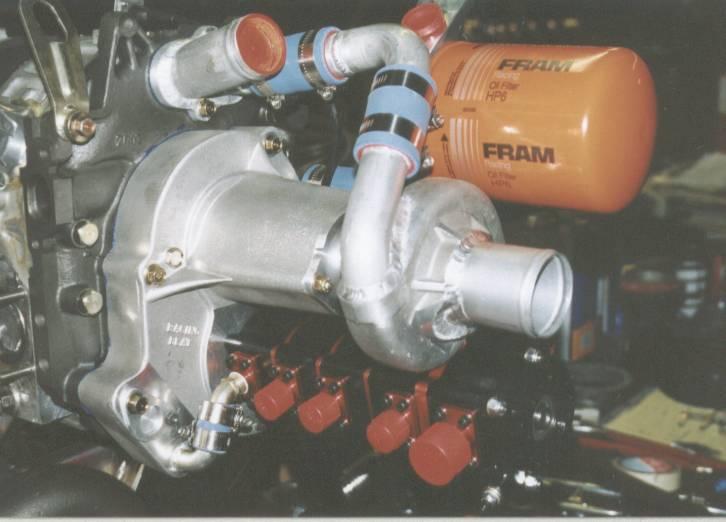
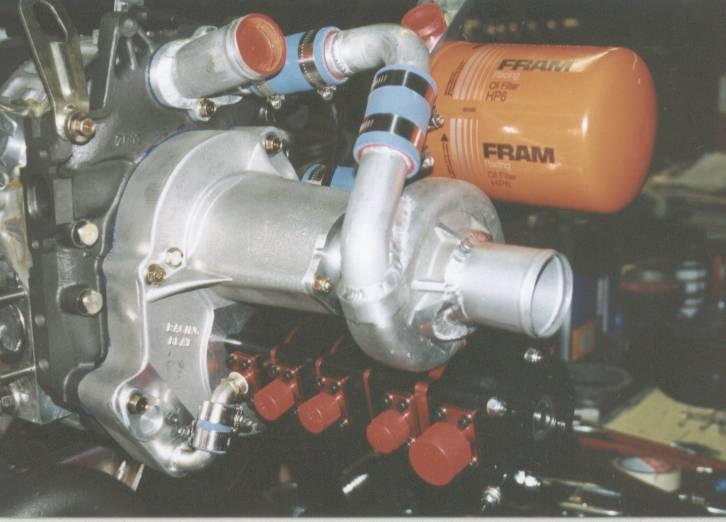
Here is a picture on Racing Beat's three rotor. The black thing
below the extended e-shaft is the dry sump pump.
Since there are several competing  manufactures of these pumps they
should be relatively low cost.

I think the Power Sport set up is mainly oriented towards road
racing so the plumbing may not be optimum for aerobatics.

A suitable electric driven one would suck down several HP. At 746 watts per HP
and 3 HP that is 2,338 watts. At 12 volts that would be 186 amps!!!
Got another alternator? :)

Paul Lamar

The AirCraft Rotary Engine NewsLetter.  Powered by Linux.
ACRE NL web site. http://home.earthlink.net/~rotaryeng/
Copyright 1998-2003 All world wide rights reserved.