"Brian D. Cain" wrote:
Hey guys, I just tore down a customer's engine out of a base model '91 coupe
that was experiencing no-starts and burning water.  The motor had only about
50 miles on it prior to being rebuilt w/ all new seals, springs, bearings,
and o-rings (TES inner water jacket o-rings).  The owner unfortunately
overheated it shortly thereafter and cooked the motor.  I am unsure how hot
the factory gauge in the vehicle reads scale-wise, but the needle was "all
the way to the top" according to the owner.

The rear rotor housing had large marks of varnish on the underside and the
rear rotor was completely covered in rust-like sludge.  I disassembled the
engine last night and found that both rear chamber TES o-rings were cooked.
One of them had some of the silicone core mysteriously missing.  The o-rings
I used for assembly were the McMaster-Carr part # 9319K239 o-rings.  I'm
unsure of what type of teflon jacketting they use or how the core is
constructed.  Based on what I could theorize, it appears that the teflon
jacketting baked enough to develop cracks and pores, allowing combustion
chamber gasses to enter the core and damage/destroy it.  Perhaps someone
with more of a chemical knowledge of teflon can chime in on this.  The
o-rings were both damaged on the combustion stroke portion of the centre and
rear iron housings, starting at about TDC and ending just after 90ATDC.  The
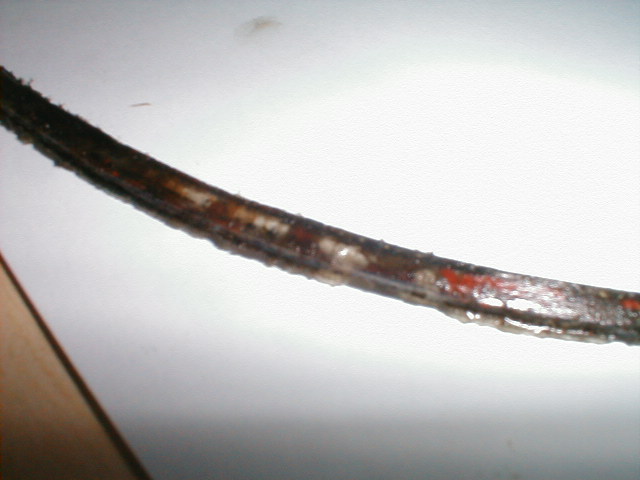
teflon was severly burned and was stuck to the o-ring land on the iron
housing (reminds me of cookware).  One of the o-rings I tried to remove came
apart in pieces much like burnt toast.  From what I could tell, a large
amount of the o-ring failed and allowed combustion gasses and coolant to
flip-flop positions.  The first symptom was the upper radiator hose
exploding.  The latter symptom, once the vehicle was shut off and stationary
for a time, was a large amount of contaminated coolant seeping into the
chamber, finding rest at the bottom of the housing.  The rotor housing was
also warped, and the rotor was deemed unusable per stuck side seals, so I
believe the teflon jacketting held up for quite some time prior to being
compromised.  What temperatures they withstood is unknown to me.  I have
used these same o-rings, from the same manufacturer, in engines that have
seen over 230F degree coolant temperatures and still not experiencing any
symptoms of blow-by.

I'm still a big fan of the teflon-encapsulated o-ring technology and believe
it will do wonders (I still build all of my engines using these atleast for
the inners) but am unsure as to how this all happened.  When I inquired w/
Jeff Chrysler about the TES o-rings they manufacture at Creavey Seals, he
said that there were two different types of teflon available -> FEP and PFA.
The PFA evidently is more robust and can handle higher temperatures.  For
what we're doing, that may be the type required.  Since these failed o-rings
were McMaster-Carr units, I'm unsure as to which kind they used.

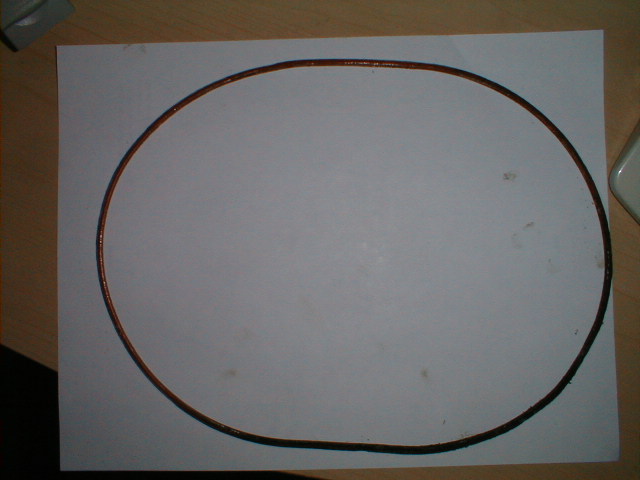
Hope this helps out some folks out there.  Attached are two pictures of one
of the failed o-rings (the one that stayed together upon removal from the
iron o-ring land).

B

Brian D. Cain -/- Grand Prairie, TX -/- bdc196@comcast.com
http://bdc.genxracing.com
http://groups.yahoo.com/group/fc3s_org
http://groups.yahoo.com/group/HaltechSupport
That is amazing Brain. The only time I have every seen anything like that
is when the thermostat in my industrial oven stuck and it went to
1000 F. Those teflon rings are good to at least 500 F. He must have driven
that engine way beyond the point where it should have been shut off.

Those McMaster 3/32 inner rings are not the right size. They are too big.
Silicone will expand with tremendous force and could have opened up a gap
between the rotor housing and the end housing to allow hot gases to
impinge on the  O rings.

Buy the proper size inner rings from Creavey direct.

Paul Lamar

The AirCraft Rotary Engine NewsLetter.  Powered by Linux.
ACRE NL web site. http://home.earthlink.net/~rotaryeng/
Copyright 1998-2003 All world wide rights reserved.
I will outline what we are talking about.
There are four coolant sealing O-rings per rotor housing.
Two outer and two inner.
There are also four oil sealing O-rings per rotor. Two on each side of
the rotor proper. These are located on the flanks of the rotor.
Two per side.

Teflon encapsulated silicone O-rings are the best there is for this
application. Teflon is about the most inert material you can
find and it is resistant to most known chemicals. Unfortunately
it is not rubber like and that is where the high temp silicone
rubber core comes into play.

http://www.creavey.com/
1.  Inner coolant oring -

    circumference  = 28.625
    diameter       =  9.111
    slot depth     =  0.062
    slot width     =  0.141
    section size   =  0.103
2.  outer coolant oring -

    diameter       = 11.340
    slot depth     =  0.062
    slot width     =  0.110
    section size   =  0.093
This is critical! The proper section size is .093. Not 3/32
as a 3/32 O-ring is bigger in section size than .093.

The TES O-rings are stiffer than the stock O-rings. It is harder
to get them to lie in the groove. Even with Vaseline.  When you buy
them they don't come flat. I found that using a plywood
form to pre set the slightly under size TES  O-rings for a few
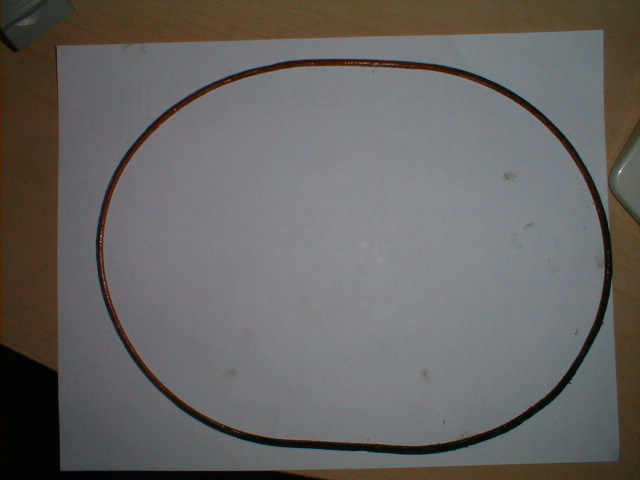
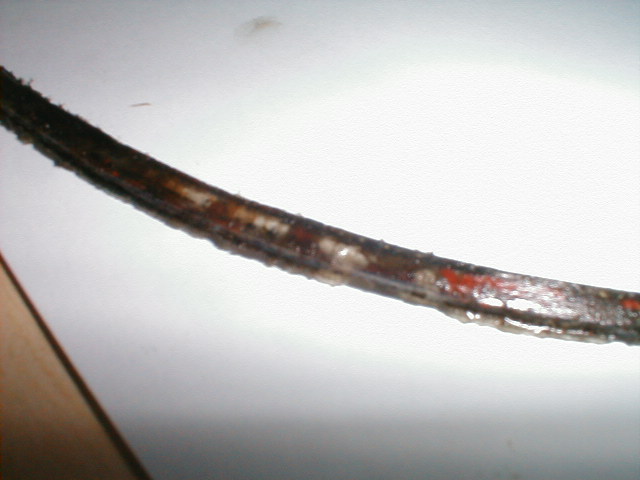
days  works well. Here is a picture.


--------------------------------------------------------------
Oil O-rings.

I checked the installation of the oil O-rings with the new
sizes I got from Creavey. They worked perfectly and were
very easy to install. You will need a little O-ring lube
and a 2 by 8 to install them. They were also easy to remove
with no signs of distortion.

One of the secrets is if you reuse the old oil scraper rings
they must be spotlessly clean inside and out. Soak them
in carb cleaner for a few days. If you use new scraper rings
this will not be a problem of course.
The second thing to watch out for is don't nick the
rotor wall between the two scraper rings when you remove them.
Very very important!!


These can be the same or just a little more than the
stock oil O-rings from Mazda.

The proper oil O-ring sizes are:

0.093" section 4.68 inch ID
0.118" section 4.33 inch ID

I can vouch for the quality of the Creavey O-rings but some
of those water TES o-rings from Mcmaster Carr I have seen
are not as good. This is not to say they won't work. They just
don't look as good around the joints as Creavey O-rings.

Viton is good only to 400 degrees F. The center of the rotor runs
as high as 500 degrees F. I think 400 degrees F leaves's too
little of a safety margin when 500 degrees F is available
in TES O-rings at the same price probably.