Also IMHO at the current time there are too many unknowns to use a
mathematical solution. It would help if more people would measure
the air and water pressure drop across their rad and the temperature
of the water going in and coming out of the rad. Another factor is the
temperature of the metal within 2 mm of the combustion chamber
in the area of the lower spark plug. The temperature of the water
is not the whole story.

Paul Lamar
Per your instructions, I drilled small holes in the webs (one per housing)
directly next to the leading plugs on the housings on my 20B for
thermocouples.  Now if I ever get off the ground...   BTW, what temps are
considered "within normal operation temps" at this location?

Mark S.
Something less than 500 degrees is considered safe for aluminum adjacent
to the combustion chamber. In the case of the Mazda rotor housings with its
mechanically bonded steel liner a higher temp could be acceptable.
This addresses the issue of transfer of heat between the metal
jacket and the coolant.

Here is some data from SAE Paper # 871042  Design and
Development of the Voyager 200/300 Liquid Cooled Aircraft Engine by
R.E. Wilkinson. Twenty pages. Published in 1987. This paper is about
the engine used in the Rutan Voyager around-the-world un-refueled
record holder.

The numbered thermocouples are within a few mm of the combustion
chamber surface.

Here also is some data from Mazda. 210 C is 410 F
I am not sure what the engine HP level was related to this data but I suspect
it is only around 160 HP.

Paul Lamar
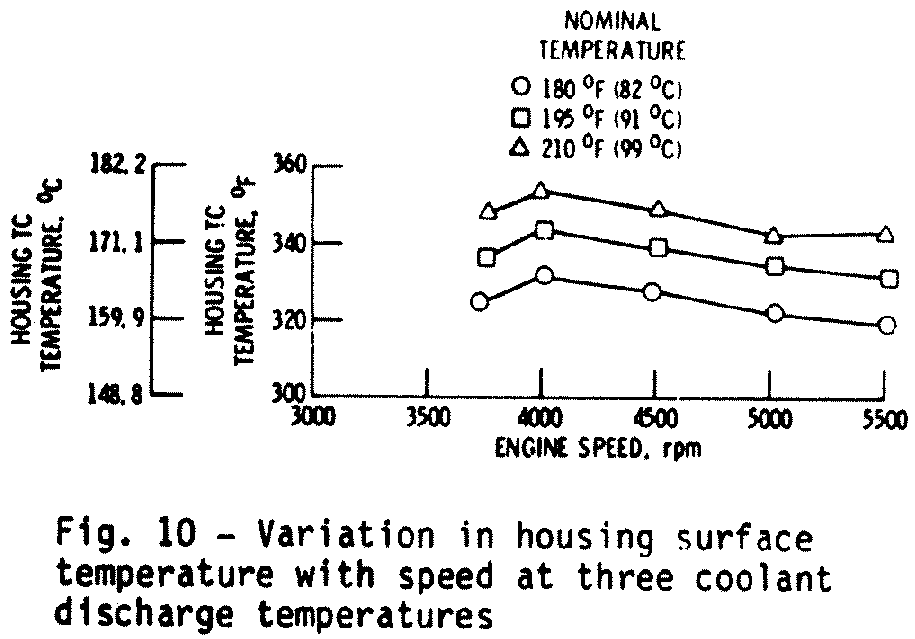
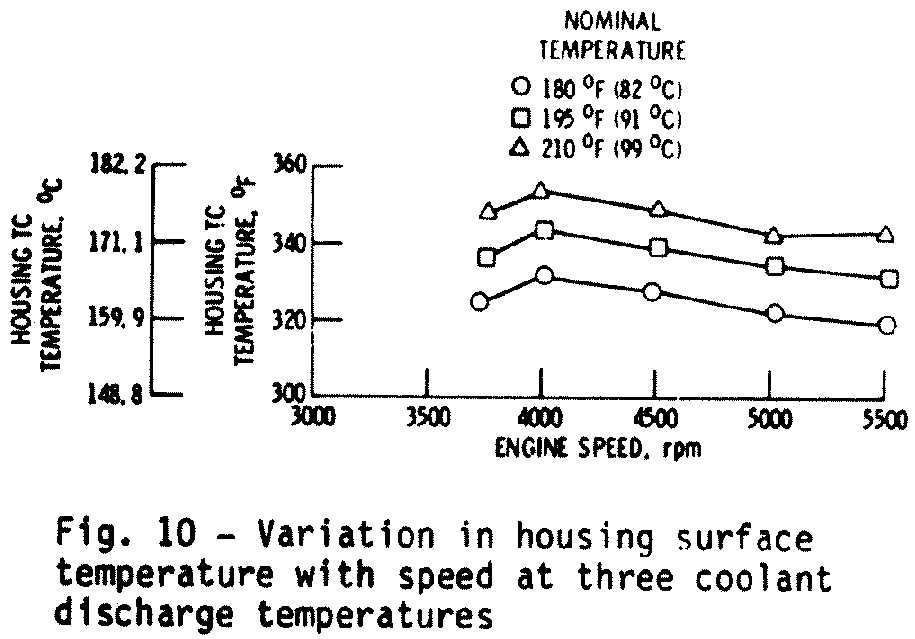
Here is some more interesting data from Mazda. Mazda did not say so but
I think the metal is cooled better at high RPM at a given coolant temp
despite the fact the engine is generating more HP and waste heat because
the water pump is putting out more water so the velocity of the
water passing through the rotor housings is increasing.
This causes more turbulence and a scrubbing action that more
quickly carries away the tiny bubbles formed by nucleate boiling.

When Mark gets his airplane flying we will have some very interesting
additional data on this issue.

IMHO we have just scratched the potential of the rotary engine as far
as the ability to generate high continuos HP. Cooling of the metal
is the bottom line.

Paul Lamar

The AirCraft Rotary Engine NewsLetter.  Powered by Linux.
ACRE NL web site. http://home.earthlink.net/~rotaryeng/
Copyright 1998-2003 All world wide rights reserved.