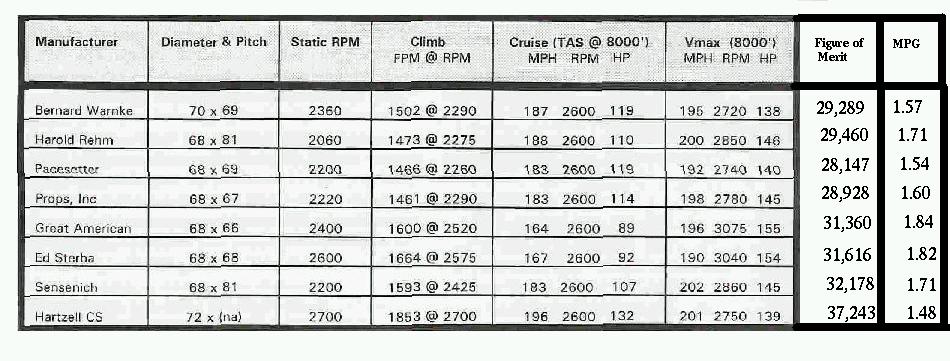
I don't know how I missed this back in 1990 but it was republished
in the RV Aviator book.

Something I never thought about was if you have a climb prop
on your airplane your engine is probably generating more
HP at top speed. Interesting. The rotary, just like a direct drive
aircraft engine, generates more HP in direct proportion to RPM.
This is because, like a direct drive aircraft engine, it is not
breathing limited. Most large displacement piston engines start
to become breathing limited about 5,000 RPM. Smaller piston engines
and the rotary to a lesser extent become breathing limited around
7,000 to 8,000. The main reason for this is the piston engine poppet valve.

A peripheral port rotary will keep generating more power right up to
the point the rotor bearing fails due to centrifugal force overcoming
oil pressure in the bearing. I digress too much. Getting back to
fixed pitch props.

I divided the climb rate by ten and multiplied the max speed and the
climb rate together. That is the first added column on the right.

The second added column is a number proportional to MPG at 2600 prop cruise RPM.
Cruise speed divided by HP.

What blew me away was the mediocre performance of the constant speed
prop in this regard. I suspect something is wrong with this data.
Either that or the CS blade twist was all wrong for 180 MPH or so.

Paul Lamar

The AirCraft Rotary Engine NewsLetter.  Powered by Linux.
ACRE NL web site. http://home.earthlink.net/~rotaryeng/
Copyright 1998-2003 All world wide rights reserved.