Paul Carey wrote:

Hi Paul

John Otter from Perth is my engine builder (I believe you have met him)
 and he mentioned you sell intake manifolds.

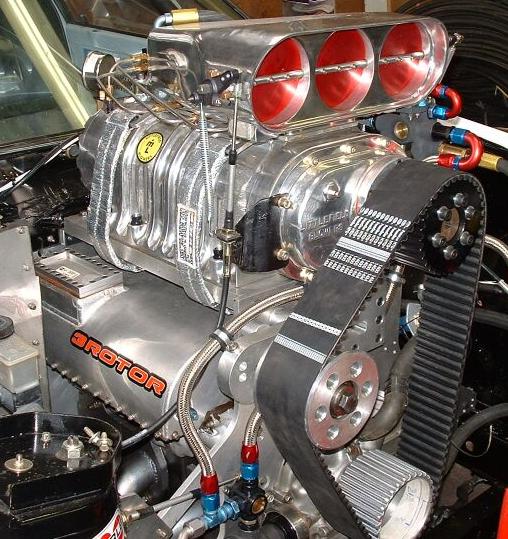
I hand made a manifold to suit our application, but we had a huge
intake explosion that totally destroyed it. Was wondering how
far along you are with yours?

I am in the process of designing a new manifold to withstand up to
50psi boost, and a 75psi intake bang without being destroyed.

Photos of mine below.

Regards

PC

Paul Carey LAME, MC
Aero Management - aviation consultants.
www.aeromanagement.com.au
(08) 9371 5205  0418 959 892
Wow! the explosive power of a tea spoon's worth of gasoline (nitro methane?).
How fast are/were you going before this happened?

I don't have a three rotor version of the intake manifold. You could
take two 13B versions and cut one down, weld the two parts together
and make a three rotor version.

Ours is only 90 degree. It is designed to be welded to round aluminum tubing
bends or pipe. That is the approach I suggest for your use as it keeps
any one runner's cross sectional area  at a minimum and hence the explosive
volume of each runner limited. Bring all runners to the blower adapter plate
and use bell mouths to gather the air. This will limit the volume of the
explosive power of the mixture everywhere but in the blower itself. There
is nothing you do about that. The drag racers have been blowing up
blowers for years :)

Archie on here may have a few tips along those lines as he builds
blown hemi fuel dragster engines. I think there may be some sort of pop off
valve you can use to keep the blower from departing the engine.

The plenum approach, as shown in these pictures, of course must be
very very strong indeed to withstand a back fire. Hense it becomes very
very heavy. Even 13 mm thick wall plate might not be strong enough.
Also the flat sections of plate have tremendous bending forces
on them tending to distort the plate as you have well demonstrated here.
A round tube or pipe will withstand much higher pressures.

BTW our manifold may not have enough meat to extensively port a three rotor.
You might look into having a 90 degree version (transition from oval port to
round tube) made by a four or more axis NC mill. Many of the V8 cylinder
heads here in the states are now ported by NC machine
tools. The Extreme Rotaries guys in Seaford Victorie tell me they
have an extensive NC machine shop. Once the NC program is written and
debugged additional items are much cheaper. There could be a market
for these in the states.

Paul Lamar

The AirCraft Rotary Engine NewsLetter.  Powered by Linux.
ACRE NL web site. http://home.earthlink.net/~rotaryeng/
Copyright 1998-2003 All world wide rights reserved.