Edward Klepeis wrote:

Dear Paul
     I have a question is there any reason  to have 4 tube  on the intake when
two tubes could do the same job.It makes a
simpler  set up and easyer to weld. please give some feed back you
 have worked on these eng way long than me i am starting out
and have a lot to learn. thanks for your help.

Regards

Ed

techwelding@comcast.net
Here is the long answer :)

Any time there is a discontinuity in the intake plumbing there is a disturbance
in the wave effect. Each section then becomes its own organ pipe.
Every rotary Mazda has made since about 1982 or so has had individual
pipes for each port. The actual affect of a short Y in one pipe feeding
two ports on the same rotor is unknown at this time. In theory short
legs would resonate at very high RPM's out of the range of the rotary.

Long legs of the Y's
are used in the 1982 and up RX7's and RX8's intake system. Particularly
the RX8 intake system as shown here. A Y with the proper length of the legs
connecting two rotors 180 degrees out of phase has two resonate frequencies.
A primary and a a secondary resonate frequency. One at the length of the
individual leg, the primary effect and one at half the RPM of the individual
leg, the secondary effect. The wave  travels from one port through the Y
over to the other port so the length of the path is twice as long.

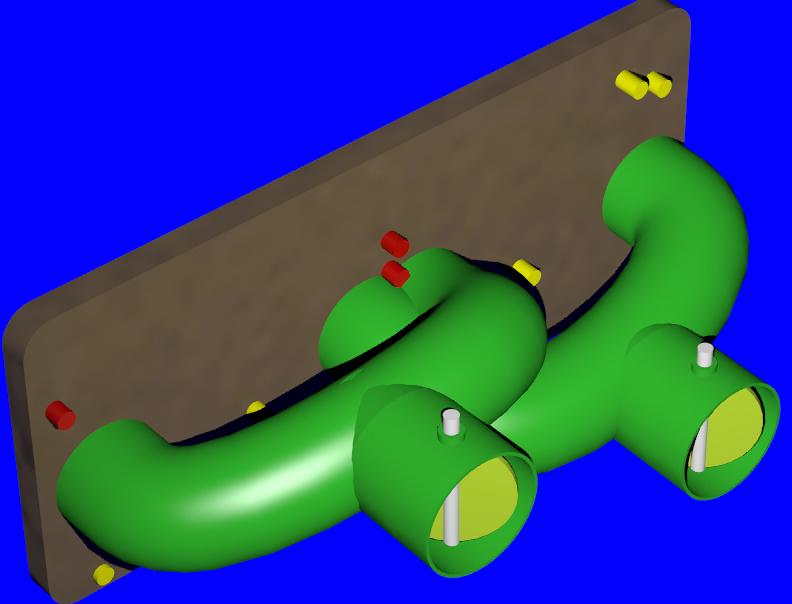
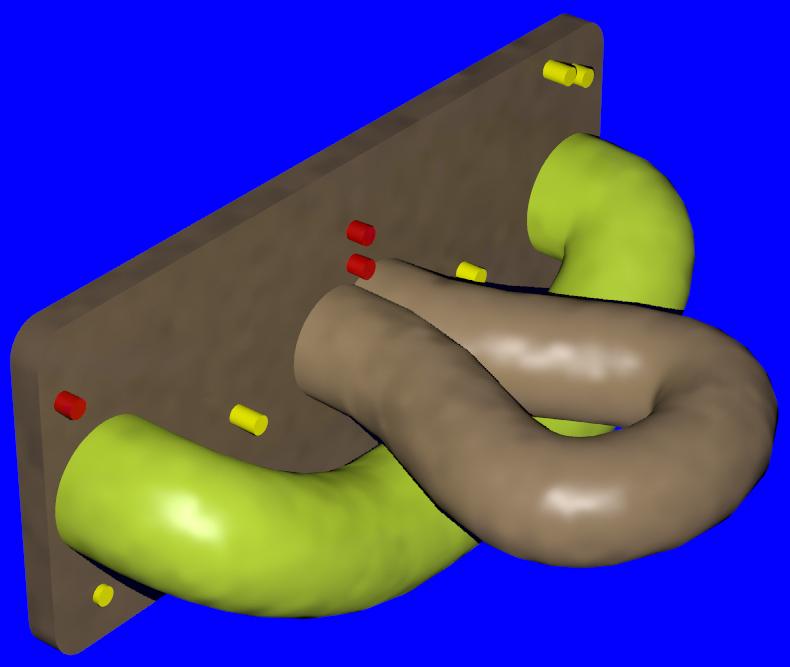
Here are some renderings of what such a strictly  secondary effect manifold might
look like. In this case the short primary resonant mode of the leg between
throttle and port is not used. Only the secondary effect between
ports of individual rotors is used.

This secondary effect is somewhat enhanced at lower RPM's by valve overlap but this
last minor effect goes away with the side exhaust port in the RX8 as all
valve overlap has been eliminated. The finite physical distance between
the rotors precludes using this  secondary effect at high RPM. In other
words it is very difficult indeed to connect two rotors together in such away to
take advantage of the secondary effect at six thousand RPM and above.

Never the less the RX8 generates more HP at any given RPM than any stock side
ported rotary built to date. Due mainly to a 30% increase in port area.
The purpose in the RX8 intake system is to broaden the torque curve at low
RPM  for automotive use. It does this by extensive use of the secondary
effect at lower RPMs. Not needed in an aircraft engine as prop load is at
least proportional to the cube of RPM. Over about 6000 RPM the RX8 uses
only the primary effect.

In that case the most HP will be generated at a specific RPM with all
pipes of the same length using only the primary effect. The out
and out record amount of HP per rotor generated by any rotary at any RPM
from 6000 up is held by a peripheral port engine with all pipes the same
length using the only primary effect. Namely the Lemans four rotor.

In an electronic analogy this is called a high Q parallel resonant system.

I hope to be able to test some of these ideas (built by others) on my new
dyno now nearing completion.

Paul Lamar

The AirCraft Rotary Engine NewsLetter.  Powered by Linux.
ACRE NL web site. http://home.earthlink.net/~rotaryeng/
Copyright 1998-2003 All world wide rights reserved.