This procedure is not recommended for a flight engine.

I started to make the oil system modification today without
disassembling the engine.

I used 3/8 dowels to seal the holes before I ground off the filter
mounting block. At this stage Vaseline will not work as it melts
when cutting or grinding. You can remove what is left of the dowels
by drilling a small hole in them and using a dry wall screw.

I used Vaseline to seal the rear part of the large horizontal gallery when
tapping the holes for 1/8 inch pipe plugs.

I also used Vaseline to seal the horizontal gallery when drilling up from
the bottom of the rear end housing using a 12 inch long 3/8 inch aircraft
drill. I used a pre drilled shorter dowel to seal the rear main bearing gallery.

I used another 3/8 wood dowel to seal the front main bearing gallery of this
turbo engine. I pre drilled the dowel and inserted it below the horizontal gallery
passage. This is a turbo engine so I had access to that gallery.

I used air pressure applied at the turbo oiling port on the top of
the front end housing to remove the Vaseline seal in the rear part of
the horizontal gallery. I used a magnet on the end of a SS telescopic
wand to remove the iron particles in all of the galleries and passages.
I also poured  quarts of cheap 10W 20 engine oil in the front end housing
and let it flow through the main gallery and down and out the vertical gallery
in the rear end housing to flush particles out. It helps if the magnet
is worked up and down in the vertical gallery as the oil is flowing.

Many many times I had to clean the magnet until I could not find any magnetic
particles.

It would be better to set up an electric pump and pump oil through
these two galleries starting at the front end housing and then through a
filter with a closed loop system to remove all the particles.

When done remove the front and rear main bearing gallery wood dowel plugs.

This is a tedious and time consuming project. Plan on two days.

If perhaps you feel you are getting particles in the rear main bearing gallery
it is possible to remove the rear main bearing without disassemble the rest of
the engine. First remove the flywheel or flex plate and then
the rear main-holder/stationary-gear will unbolt.

Do not try to remove just the rear end housing. This will result in
failure of the water O rings as the tension bolts are removed.

There is no question that this is safer and easier to do if the
engine is disassembled.

Paul Lamar
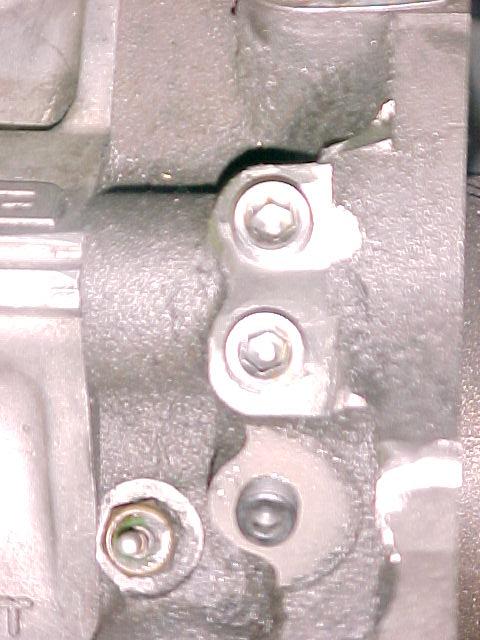
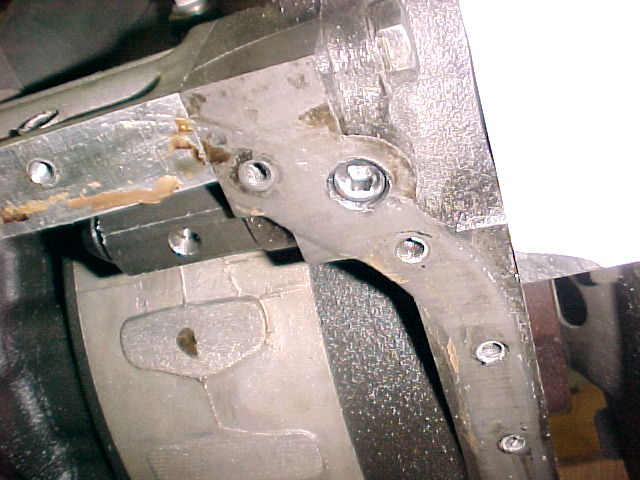
Here are some more shots. I used 1/4 NPT instead of 1/8 NPT as there is
really not enough meat left in a 10 mm [.3937"] hole. A 1/8 pipe tap
requires a 11/32 or .3438" hole. 10 mm is too big. So I drilled the oil
filter passages out to 7/16 .4375 and taped them for 1/4 inch NPT. Much
more secure. First picture.

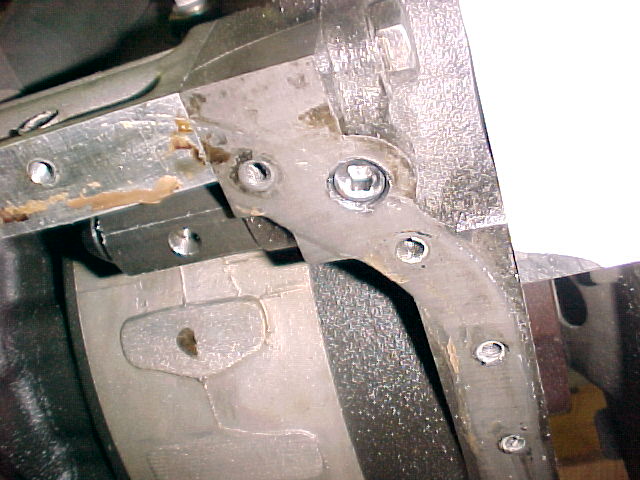
The aft end housing vertical gallery is drilled out from the bottom. That hole must
also be plugged and a 1/4 NPT is also the right size. The threads need to
go way up in there as the plug must be flush or above the oil pan
rail or you will get oil leaks in that area. Drill it out to 7/16 inch
and use a really big tap handle as it requires a lot of torque to
tap deep threads in cast iron. Second picture.

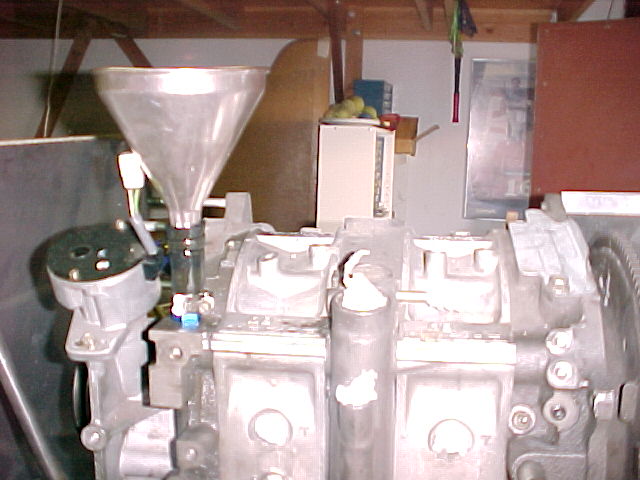
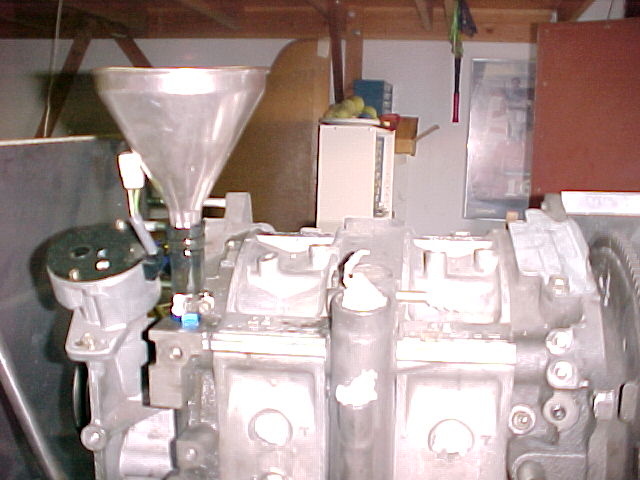
Here is the set up I used for flushing the galleries with cheap engine oil.
Don't forget to plug the front and rear main galleries with a 3/8 dowels
before you do this to prevent washing chips down into the main bearings.
Also don't forget to force the Vaseline out of the horizontal galley
with air pressure or the oil will not flow out of the funnel and into
the horizontal gallery. Don't forget to remove the dowels before
you run the engine as you will trash the main bearings if you don't.

All this is not necessary with the vast majority of airplanes as there is
usually plenty of room under the cowl for a remote filter adapter block.
My Kis Cruiser is one of the very tight ones as the distance from
the thrust line to the top of the cowl is not much. Only about 7 or 8 inches.
Also I need the space for the plenum or intercooler I will eventually integrate
with the intake manifold.

Bill Schertz, how did you handle this problem on your Kis Cruiser?

Paul Lamar

The AirCraft Rotary Engine NewsLetter.  Powered by Linux.
ACRE NL web site. http://home.earthlink.net/~rotaryeng/
Copyright 1998-2003 All world wide rights reserved.