Paul Carey wrote:
Hi Paul

I gave thought to a space frame originally, but opted against for a
couple
of reasons.
1 - in my car the chassis is the original RX-7 Series 1 - which twists
on
launch. I originally had a rear engine plate bolted to the engine and
upper
blower plates - but my drag racing experts soon had me change that. To
assume that the whole engine will not turn on launch was a mistake. So
all
engine hardware was transferred to the engine only - as then the
engine/gearbox has flexibility to turn under torque.
2 - the room around the engine is very tight, and must allow for access
to
exhausts, quick plug changing etc. A space frame design would be
compromised
in this particular installation.

If I build a full frame chassis, I will defenitely do the space frame
for
the engine - makes perfect sense.
snips..........
Regards PC
I would think any wind up in the drive train would cost
a slight delay at launch time. Drag races are won and lost on thousands
of a second.  Even street car manufactures are eliminating wind up.
Look at all the trouble Chevy with the Corvette and Mazda with
the RX7 and the RX8 went to tying the engine/transmission
and the rear axle together with a long beam to eliminate differential
housing twist.

What is the reasoning for allowing the engine to twist in the chassis?

Paul Lamar
Paul Carey wrote:
Hi Paul

When I say twist, I mean a small amount of movement on the dowels, or engine
plate holes elongating etc.
Having no twist is the ideal, but when trying to deal with between 1000 and
5000 horsepower, a small amount
of movement does occur. Engine and gearbox are dowelled together and solid
mounted, but the diff is floating (with it's own method of anti-torque).
The diff pinion angle needs to be adjustable, to fine tune launching. 1% can
be the difference between wheelstanding and tyre spin.

PC
When you say 5000 HP I am sure you are talking Nitro Methane fuel and not
alcohol :) It has always just amazed and dumbfounded me when I see the
huge amount of HP the Mazda rotary is capable of and still only weigh 190
pounds in the case of the two rotor and 260 pounds in the case of the three rotor.

It is no wonder they start coming apart at the seems :) Have you tried
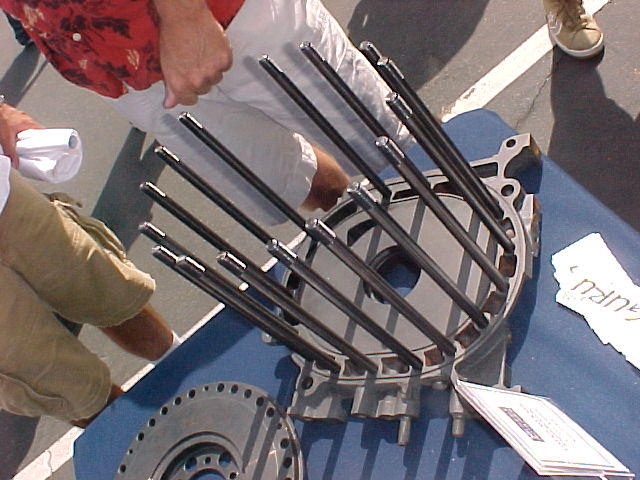
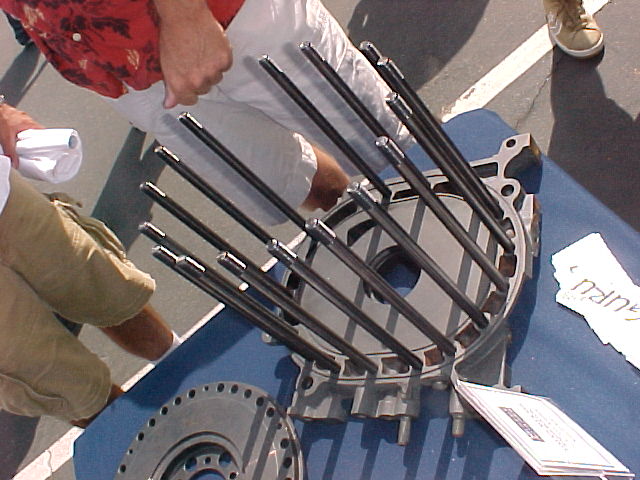
1/2 inch tension bolts rather than the stock 10 mm (.3937 inch) yet.

I won't get into chassis dynamics here as it is not directly related
to rotaries but the CG position both fore and aft and up and down has
a lot to do with whether the car wheel stands or not. Able Ibarra had to
use a bunch of weight at the front bumper of his short wheelbase high CG
Mzada R100. I think you want the pinion angle to be zero with the tx
output shaft and the drive shaft at all times for max efficiency.

An AA fuel rail will wheel stand if the CG is too far aft or too high
and the engine and TX are rigidly connected to the rear axle for whatever
coefficient of friction is present on the track you are running on.
The long wheel base is to keep the overall weight low by adding
the required small amount of ballast way out on the front axle.

BTW even the first gen RX7 chassis can be made very stiff with a few tubes
in the right places. Got any pictures of your chassis. Perhaps I can identify
places where missing tubes should go.

Paul Lamar

The AirCraft Rotary Engine NewsLetter.  Powered by Linux.
ACRE NL web site. http://home.earthlink.net/~rotaryeng/
Copyright 1998-2003 All world wide rights reserved.