Jerry wrote>
Don't forget that SS 253MA is available.  It will operate without
damage at 2000 degrees.  This is 300 degrees hotter than 321.    I
would build through the first bend with  .059 253MA and then switch
to
a thinner 321 for the rest of the system.  Jerry
Mark wrote>
Jerry, this is an oversimplification. No metal can operate in a
thermal
cycling, vibrating, acidic environment to 2000°F without damage. You
are
looking for an acceptable life. What the spec sheet shows is that the
material has better capablities than 321 under the controlled
conditions of
the test (whatever they were). In the environment of a IC engine
exhaust
header, material science is still quite empirical.

An example, the large commercial turbofan combustion has a feature
which was
eroding, limiting life between overhauls to about 20000 hours. A
material
change was made to turbine blade material, being the latest/greatest
in high
temp erosion resistance. The revised combustor feature is eroding at
about
twice the rate. You can bet the manufacturer's engineers had all the
material specs, design experience with the materials, CFD and FEM
models of
the stresses and environment, and likely did a combustor rig test and
possibly slotted the redesign into a full engine test.

What I am saying is, be conservative. 321 and inconel have known
characteristics for this environment. 253MA may be an improvment, but
taking
a pound out of the header was a bad deal if it cracks. The material
may be
"better" but what about the welds?  Broken Exhaust manifolds are so
far the
#1 danger in homebuilt 13B installations.

Regards,
Mark
Mark,   it is always good to be skeptical. All I have is the data
sheets from AvestaPolarit which describe in great detail the
characteristics of SS 253MA including workability and weldability.  It
is claimed that 253MA welds as well or even better than other
stainless steels.  If you are interested in finding out more about
this material  you can go AvestaPolasrit's web site and download a PDF
which deals with some of the issues you raised.  SS321 will not hold
up to rotary temperatures period.   Jim Mederer told me the same. It
is only "better" than other stainless steels such as 304 which are
completely inappropriate.  I think the appearance of 253MA will  be
very important to the aircraft rotary engine.  I was surprised it did
not get much of a response when I posted the original message about
it.       Jerry
I think what Mark is trying to say is the life of the exhaust part is not only determined
by its alloy but how thick it is. The weight is primarily determined by the
alloy used. We have one rotary that has been flying for four or more years
with RB Wagner cheap stainless steel pipe railing as an exhaust system.
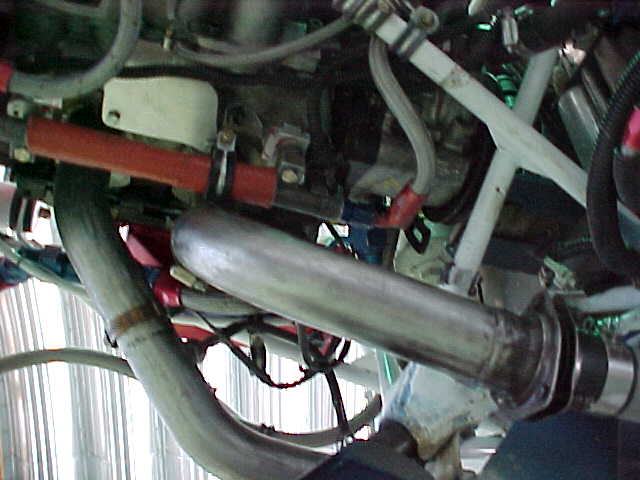
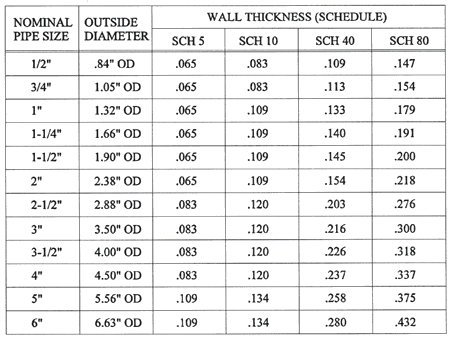
Sched 40 or .140" thick. Picture below. It took a few years of
use to make them discolor. http://www.rbwagner.com

Tracy had 650 hours on an .035 thick tangential muffler
made from 304 or 316 as I recall. Perry Mick has been flying for years
with the stock cast iron exhaust manifold.

The point is you can user lesser material if you are willing to take a slight
weight penalty. My guess is 321 .049 will live for a few years and
.065 321 will live past five years. Until we have some time on 253MA
we won't really know.

BTW Ed you can buy heavy mild steel exhaust flanges from Racing Beat and Mazdatrix.
It is best however if you make them square with four holes and let people
drill and tap their rotor housings for the square four hole flanges.
A drill jig and stop would come in handy for this purpose.

Paul Lamar

The AirCraft Rotary Engine NewsLetter.  Powered by Linux.
ACRE NL web site. http://home.earthlink.net/~rotaryeng/
Copyright 1998-2003 All world wide rights reserved.