The problem is neither per ignition or detonation, it is the flame front
arriving before the piston is after TDC.  In the situation Lynn is
describing this would be a function of the injection/ignition event
timing.
Not the fuel burn speed.
I think you are talking about pre ignition. The burning and expansion starts

about 20 degrees before TDC in the rotary. If it starts significantly
earlier
than that negative work is done on the e-shaft. Use of the words "flame
front" is
very specific and only applies to one aspect of the combustion process.
It defines only one dimension of the fire. What is far more important
is how the combustion pressure is distributed over the face of the rotor
as a function of the e-shaft position relative to TDC.
The BIG advantage of direct injection Gas engines is Low Octane fuel
giving
HUGE hp.in^3 as the octane rating is irrelevant.
Yes. That that is exactly what Wankel GMBH in Germany was after burning low
octane heavy fuel using spark assisted direct injection. AKA diesel fuel.
However again, it did not result in a significant reduction if fuel burned
per HP generated.

http://www.wankel-rotary.com/

Paul Lamar

Sorry Paul, I received this note after your second response.  I don?t want
to fracture this into to many conversations.
Your choice of "combustion pressure" is more appropriate I believe.  It is
my understanding that the ignition event creates a pressure wave that must
strike the piston after TDC.  How this effects the Rotary I am just getting
my head around, but I would guess it must be after TDC of the E shaft as
well.  Can you explain further regarding...
"What is far more important is how the combustion pressure is distributed
over the face of the rotor as a function of the e-shaft position relative to
TDC."  I do not understand that sentence.
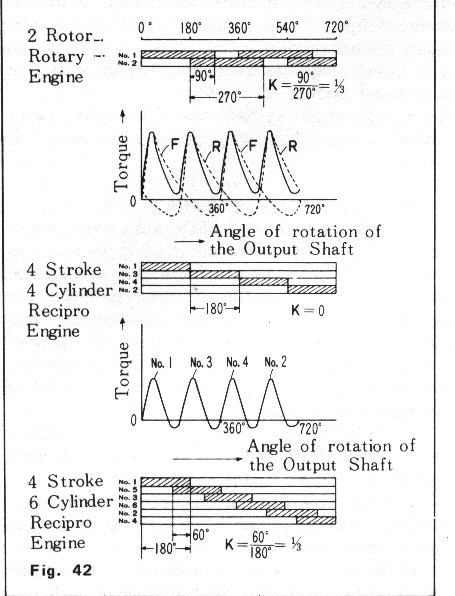
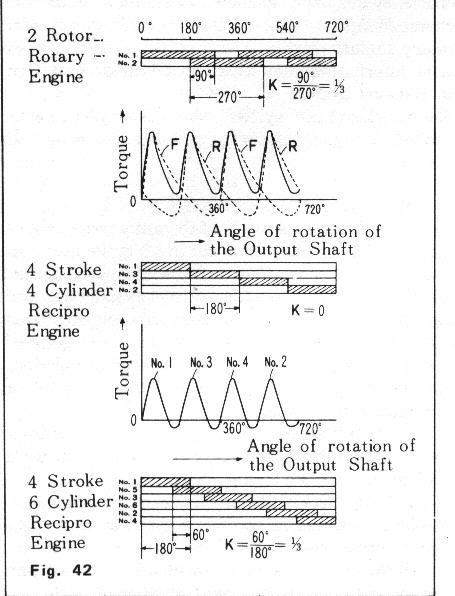
It is sort of like that. The pressure builds up rather slowly compared to
say an explosion or detonation. Here is the shape of a rotary torque pulse
compared to a piston engine torque pulse. This is at the crankshaft or
e-shaft so the geometry of the rotary and the piston/con rod/crankshaft has
an effect. The actual pressure distribution on the rotor would be nearly
impossible to measure directly so we can look at the torque
pulse to get a clue on how fast the average pressure is building
on the rotor face.

Unlike the rotary the force on the piston top is divided into two components.
One component acts down the con rod to turn the crank and the other
pushes the piston skirt against the cylinder wall. This causes a friction loss.
No such thing happens in the wankel as there is no connecting rod.
The rotor acts on the e-shaft directly. Note that the wankel torque pulses
rises faster and decays slower than the piston engine. The dotted line
is for one rotor. The area above the zero line and under the curve is
the net work done on the output shaft. The area under the zero line is
the work done compressing the mixture. If the ignition takes place too
soon negative work is done on the output shaft.

Paul Lamar

The AirCraft Rotary Engine NewsLetter.  Powered by Linux.
ACRE NL web site. http://home.earthlink.net/~rotaryeng/
Copyright 1998-2003 All world wide rights reserved.