Eric Ruttan wrote:
The problem is neither per ignition or detonation, it is the flame front
arriving before the piston is after TDC.  In the situation Lynn is
describing this would be a function of the injection/ignition event
timing.
Not the fuel burn speed.
I think you are talking about pre ignition. The burning and expansion
starts
about 20 degrees before TDC in the rotary. If it starts significantly
earlier
than that negative work is done on the e-shaft. Use of the words "flame
front" is
very specific and only applies to one aspect of the combustion process.
It defines only one dimension of the fire. What is far more important
is how the combustion pressure is distributed over the face of the rotor
as a function of the e-shaft position relative to TDC.
The BIG advantage of direct injection Gas engines is Low Octane fuel
giving
HUGE hp.in^3 as the octane rating is irrelevant.
Yes. That that is exactly what Wankel GMBH in Germany was after burning
low
octane heavy fuel using spark assisted direct injection. AKA diesel fuel.
However again, it did not result in a significant reduction if fuel burned
per HP generated.

http://www.wankel-rotary.com/

Paul Lamar
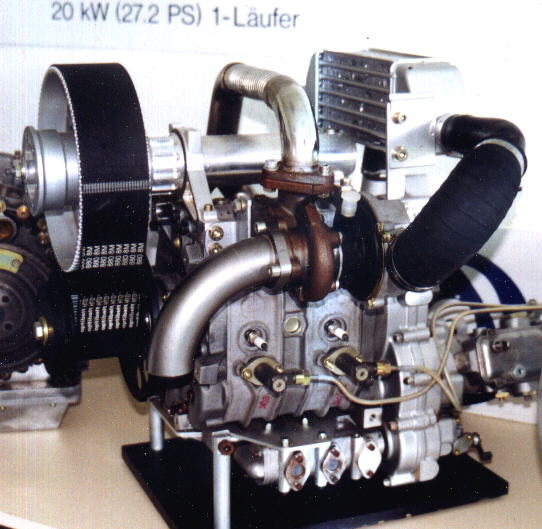
Ops I forgot. This did not result in any more HP per cubic inch. Actually
slightly less HP per cubic inch. Here is a picture I took in Germany
at Wankel GMBH in 1999 of the direct injection turbo charged Wankel
on the dyno.

Paul Lamar

Is this a compression ignition engine or a "stratified charge"?
It is neither. It is spark assisted compression ignition I suppose.
The compression ratio is not high enough to ignite the mixture.
One would think the use of an intercooler would hurt not help
yet an intercooler is used.
The potential is that with injectors capable of higher pressures, and a
turbo, more air/fuel can get in the cylinder, which will raise power
density.
If this is a direct injection engine then its power output is a function of
the injector capability, a problem that was too expensive to challenge until
recently, as I understand it.
Only a small amount of additional air will enter the combustion chamber if no
fuel is injected into the intake manifold. After all.... the ratio is about
12 to 14 pounds of air for every pound of fuel. 12 pounds of air is a
whole bunch of air. You will get no more power than the amount of air
you can get into the combustion chamber.

Paul Lamar

The AirCraft Rotary Engine NewsLetter.  Powered by Linux.
ACRE NL web site. http://home.earthlink.net/~rotaryeng/
Copyright 1998-2003 All world wide rights reserved.