Eric Ruttan wrote:
<snip>
I haven?t read anything on a high compression rotary combustion
chamber
shape.  What does it look like?  What is impractical about the higher
ratios?
As I understand it diesel BFSC's are a function of the BTU density AND
the
high compression ratio. At higher ratios we are able to extract more
energy
out of the burn.  This was figured out a long time ago by hot-rodders.

Wasn't there a few compression ignition rotary's?  How'd they work
without
a
high compression ratio?
As you make the rotor depression shallower and shallower the combustion
chamber
becomes a long rectangular flat volume. This quenches the fire due to
excess
heat loss to the rotor and rotor housing. The ideal combustion chamber
shape is a sphere.

Rolls Royce built a compression ignition rotary wherein two rotors were
used in a compound arrangement. One rotor pre compressed the air for the
second
rotor. I suspect it failed for the same reason a super charger or turbo
charger does not result in better BSFC. Too much heat loss.

Paul Lamar
Is there a reason a rectangular shape is necessary? Would not one
"well"
recessed in the rotor per injector be workable? This would mean two
wells
and two "combustion chambers" that would merge into one as the rotor
rotated.
If you recessed a well in the rotor housing it would leak mixture or hot
gases
from leading chamber to trailing chamber when the apex seal passed over
it. PL
VW's combustion chamber is a cylinder recessed in the piston directly
under
the injector. It seemed such a thing could be done for each injector on
the
rotary.
The shape we have now is a compromise.

Paul Lamar
"Dr. Kenneth R. Johnson" wrote:
I thinking of wells I was wondering what changing the entire shape of the
outside chamber wall would do?   What would be advantages or disadvantages
of an eliptical or half circle type outside chamber wall.  The rotors could
be designed the same way to fit.  Instead of a three piece seal, one
circular one could be placed.   How would the explanding gases burn in
comparison?
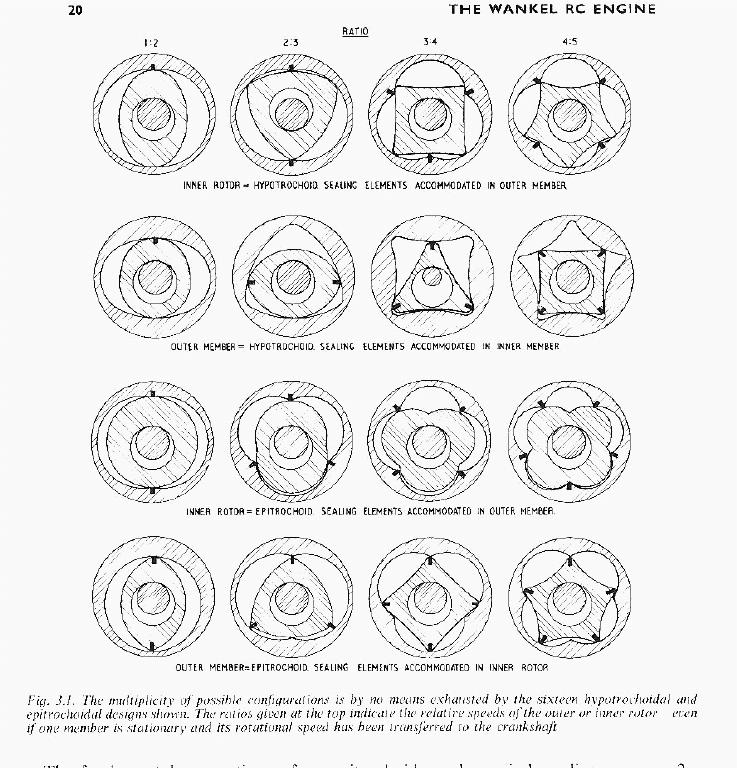
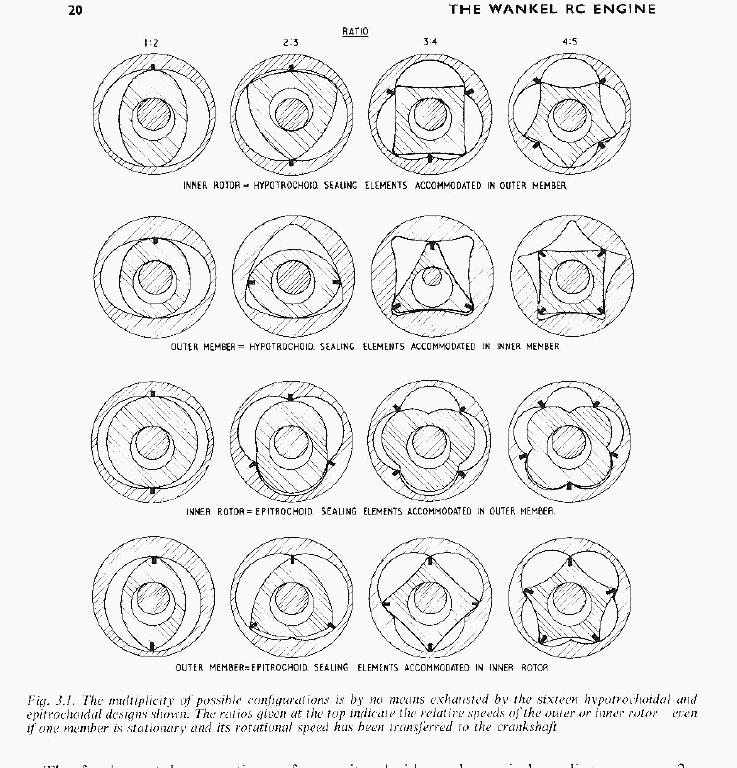
Would not come close to working. It must be the shape it is.
The exact shape is defined by the path of the apex seal.
You need to find Ansdale's book "The Wankel RC Engine."

Paul Lamar

The AirCraft Rotary Engine NewsLetter.  Powered by Linux.
ACRE NL web site. http://home.earthlink.net/~rotaryeng/
Copyright 1998-2003 All world wide rights reserved.
By Kenichi Yamamoto from his book "Rotary Engine" 1981

1.3     REQUIREMENTS FOR A PRACTICAL ROTARY ENGINE
        Although various types of rotary engines have been
developed to date, there are few that do not qualify as internal
combustion engines or do not qualify as a practical engine even
if they satisfy the qualifications of an internal combustion
engine.
        The requirements for a rotary engine to be qualified
as a practical internal combustion engine can be summed up in
the following five items. The practicality of various ideas on
rotary engines can be judged by evaluating them by these
criteria:

(1) Every moving part, including the timing mechanism, should
make a rotating motion. A mechanism having a reciprocating
inertia will increase mechanical noise and vibration, and will
work against high speed and high revolution.  Accordingly,
structures that require intake and exhaust valves and
mechanisms using the rotors oscillatory motion are not
desirable.

(2)     Gas seals or the working chamber should be three
dimensionally reliable.  The gas seal mechanism of a rotary
engine should be constituted by connecting the individual seals
three dimensionally. Among the many ideas we come across are
those that don't show such three dimensional thoughts.

(3)     Appropriate gas exchange of intake and exhaust should
take place. Together with having a mechanism that can correctly
open and close the ports, sufficient time for intake and exhaust
should be provided especially for high speed and high
revolution.  Among the ideas on rotary engines, there are some
that ignore this point.

(4)     Every component part should have the strength to endure
high speed and high pressure.  As the component parts are
exposed to high pressure, high sliding velocity and high heat
load, every part should have sufficient allowance in size and in
shape.

(5)     Sufficient cooling and lubrication should be provided.
In order to qualify as an internal combustion engine, although
this is related to above (4), durability against high heat load,
high sliding velocity, etc. are required. Therefore, the
structure should be simple, and the ideas on rotor cooling,
lubrication of seal parts, and oil seal structure should be
those that are given adequate thought.
        Also, it is desirable for a practical rotary engine to
have a simple and compact structure. When we evaluate the
various type's of rotary engines devised to date in view of the
above mentioned requirements, the NSU Wankel type rotary engine
is the engine that best satisfies the above mentioned
requirements.


The AirCraft Rotary Engine NewsLetter.              Powered by Linux.
ACRE NL web site.
http://home.earthlink.net/~rotaryeng/            http://www.linux.org