Thomas y Reina Jakits wrote:
Check out Kenne Bell,  http://www.kennebell.net/index.htm, and his twin
screw charger. Doesn't need any intercooling, at least at the pressures
mentioned here, and doesn't need that much power either, like the Centrifugal
ones and the roots blower. Although the newer Eaton (roots) blowers are
getting good from a heating and power consumption point of view.

Thomas J.
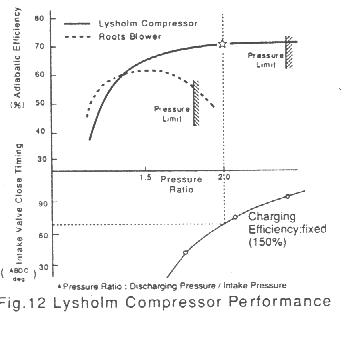
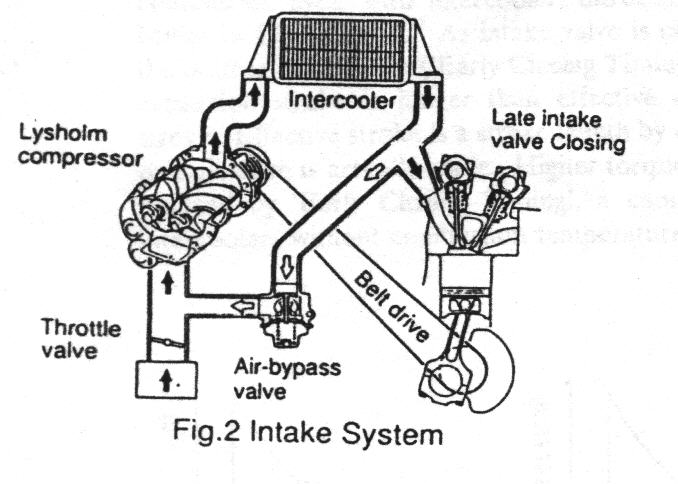
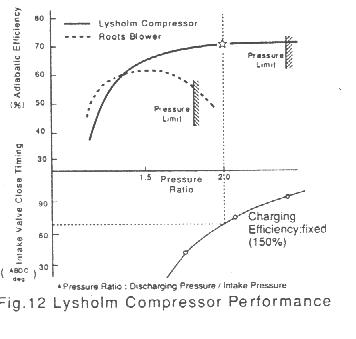
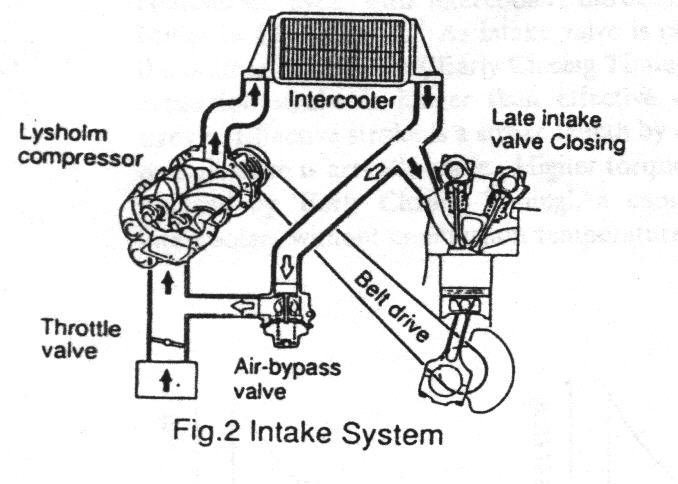
Yes the screw type (Lysholm) are more efficient than a roots blower but still not
as efficient as a centrifugal blower. Kind of a compromise half way between
the two. Mazda used one on the V6 Millennium. It is positive displacement however.
Historically it has been very expensive to machine but with newer NC
machine tools that may no longer be true.

If you compress air it heats up. That is a law of physics. How much it
heats up over and above the basic law determines the efficiency of the
compressor. At high boost you will never be able to do without
an intercooler regardless of the type of compressor used. It then
boils down to how much larger than the basic sized intercooler you
need and the HP required to compress the air. In the case of
the turbo, as Bill pointed out, uses otherwise wasted energy
in the exhaust.

another old message.
*******************************************************
Subject:         Mechanical supercharger, Lysholm etc.
   Date:         Thu, 24 Sep 1998 10:43:19 -0700
   From:         Paul <rotaryeng@earthlink.net>

Wankel-Rotary wrote:
PLease be informed that to judge a S/C of any type you have to consider:
size, weight, installation/packaging requirements, purchase price, maintanance
essentials (i.e. oil control etc.).
When it comes to EFFICIENCY you really want
to look first to your S/C map rather than to statements like 70% volumetric.
The key thing is whether or not this efficiency is reached at one specific best
point of your S/C map or that such efficiency is present in your specific
operating condition (rpm range).
In automototive applications you like to have
high efficiency in the low rev. area in order to increase engine torque in such
low engine rev. conditions. i.e to improve accelleration.
This is also important
for boats (for early planing) or for aircraft on floats (for early and
easier take off from the water). [with a fixed pitch prop] [P]
In a wheel landing aircraft you must consider your total power system, the type
and pitch of prop, the runway you usually take off from your usual (mean)
profile of flying and like.
Please remember: the larger your S/C efficiency map area, the easier you can be in
that area of the map for your specific S/C application.
The Lysholm S/C is good at efficiency only at high rpm. Eaton is worse in any
condition compared to Lysholm or WANKEL. [Our turbo compound concept has a
variable ratio belt drive for the s/c.] [P]
The WANKEL TX-type family of S/C are in the wide rpm range substancially better
than the Lysholm design.
Enclosed is a S/C map of our TX-20 (2 liters of air per rev.). It shows
a volumetric efficiency of 70% in a wide rpm range (2000 to 4300), the
65% volumetric efficiency ranges from 800 rpm up to 6300 S/C rpm.
Our TX-10 which
is compareable to Eaton's M-62. It  offers a volumetric efficiency of over 20%
higher in the same test. Our discharge temp. was 20°C lower and our S/C consumed
0.5 kW less power (lower inertia etc.) than the compareable Eaton.
[The Eaton is used in the MB SLK and the four cyl. CLK ][P]
Jürgen - World WANKEL Center in Korb/Germany

copy: Mr. Bosch/WANKEL
      Mr. Heimsch/WANKEL
      Dr. Klotz/WANKEL
      D. Eiermann/WANKEL
The Aircraft Rotary Engine Newsletter.              Powered by Linux.


The AirCraft Rotary Engine NewsLetter.  Powered by Linux.
ACRE NL web site. http://home.earthlink.net/~rotaryeng/
Copyright 1998-2003 All world wide rights reserved.