Are they doing something wrong or choosing the wrong blowers?

Phil, in answer to your questions, yes and yes. A belt or mechanically
driven supercharger (blower) should make boost from near idle. A
underdriven supercharger won't make boost until higher RPMS. A good
example of a well matched supercharger would be the Mercedes SLK
roadster. The old Ford Thunderbird SC V6 was another. The Ford was a
really fun engine, stuck in an outdated chassis.
Hey I represent that :) That chassi was not outdated. Other than
the Corvette, the Thunderbird, along with its brothers the Cougar and Lincoln
MK VIII were the only rear drive American cars with independent rear suspension.
I would also go as far to say it had one of the finest combinations
of ride and handling in the world. Lots of cars would handle better but
few came close to the ride at the same time. In this regard I would put it up
against anything of its era. To this day I  am still impressed by
the ride and handling combination when I get out of the RX8 and into
my 94 Cougar. It was a dumb thing for Ford to abandon that chassis.
Some of the rear suspension parts are still used in the Cobra and SUV's. PL
 Turbosuperchargers, i.e. exhaust driven superchargers almost always
start working at a higher RPM since there isn't enough exhaust energy
to spin the turbine until then. The turbo does really improve engine
efficiency though. The recovery of the wasted exhaust energy really
helps. Paul frequently mentions the turbocompound engines that
recover the exhaust energy directly and link it to the crank or output
shaft. The only real advantage of a mechanically driven supercharger
for aircraft use is that the plumbing is simpler. The engine won't be
as efficient as a turbo engine at any speed since you must waste
output to drive the blower. Bill Jepson
The exhaust plumbing is simpler but for the same amount of boost
you need a slightly larger intercooler as the roots blower is
less efficient. I think you are missing something here Bill. There are
two kinds of blowers on the market. Centrifugal belt or gear driven
blowers that don't make much boost from idle and roots or positive
displacement types that do. The problem is the centrifugal blower
adheres to the square law. If you gear it to not exceed max RPM there
is little or no boost at idle. Way back in the old days (30's) Paxton built
a variable speed belt drive centrifugal blower to overcome this problem.
Originally used on mining trucks in the Andes. It was sold up until
recently and may still be available.

Paul Lamar
Real old message on the subject.
****************************************************************
Subject:         Varible ratio turbines and blowers.
   Date:         Mon, 10 Aug 1998 08:14:33 -0700
   From:         Paul <rotaryeng@earthlink.net>


I went to a car show on Main Street in El Segundo last Saturday
and saw an old hot rod with dual Paxton Centrifugal superchargers.

I contacted a TWA mechanic co-worker of Robin's whom I knew
to be an expert on old hot rods. Turned out his father was a TWA station
manager and my expert had flown at the age of 12 on a twenty hour
non-stop flight to Paris from LA on one of the 1649 R3350TC Connies.

He also knew all about the Connies and the R3350TC.

He filled me in on the history of the Paxton supercharger. It was
originally designed by McColluck(s?) back in the thirties or forties to
supercharge trucks in high altitude mining operations in South America.
This is the same company that made the four cylinder horzontal opposed
two cycle drone engine. The VR version of the blower had a variable
ratio, ball bearing speed up  drive instead of gears.

No need to explain the altitude and turbo compounding significance of
this I take it.

The automotive portion of Paxton Products company was recently bought by
one of the sons of Andy Granatelli... J.R and David Adams Jr. and is
located at 1250 Calle Suerte Camarillo CA. (805) 987 8660. They still
overhaul the VR version.

I intend going out there and taking pictures. This product was way ahead
of its time and is now making a come back with the addition of
intercoolers.

Paul

The Aircraft Rotary Engine Newsletter.              Powered by Linux.

*******************************************************************
Subject:         Variable speed blowers and turbines
   Date:         Tue, 11 Aug 1998 22:50:55 -0700
   From:         Paul <rotaryeng@earthlink.net>


This is an excerpt from the book called Street Supercharging by Pat
Ganahl 1984 and
 1992 ISBN 0-931472-17-3 S-A Design Books North Branch Mn

There is much more about Paxton in the book and it is well worth the
$20.

Paul


The Aircraft Rotary Engine Newsletter.              Powered by Linux.


THE PAXTON SUPERCHARGER

        The Paxton centrifugal blower is almost as venerable as
the GMC roots. As we mentioned in the section on swap meet blowers,
Robert Paxton McCulloch developed his first centrifugal supercharger
for flathead Fords well before WW II. This early McCulloch blower
was entirely different from the current model. During the war,
McCulloch also developed some Roots-type blowers on government
contract for use in landing craft and other special vehicles. One or
two of these blowers appeared on race cars, but none was ever
produced for aftermarket automotive sale. The current
Paxton/McCulloch centrifugal blower was developed by the Paxton
Division of the McCulloch Corporation in 1952, and the first kits
were made for flathead Fords in 1953.

Although this blower has undergone a few changes in belt drive
mechanisms over the years, the basic design especially in terms of
impeller and scroll housing shape, and the unique planetary ball
drive system has remained virtually the same to the present The
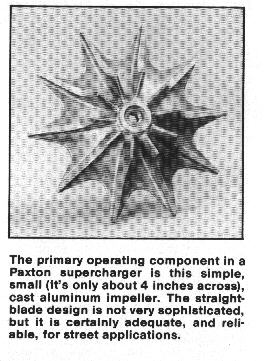
Paxton blower uses a plain radial blade impeller and a volute type
scroll housing. Actually only a small portion of the Paxton blower
unit is comprised of the impeller and scroll. Most of it houses the
impeller drive system, which is accomplished by five large diameter
steel balls which ride against two opposing "races." One race is
driven by the blower pulley (which is driven, via a belt, by the
crankshaft). A spring loaded clutch pack, much like that in the
engine's pressure plate, applies pressure to the back of the driven
race, which is directly connected to the impeller drive shaft Thus
the steel balls are sandwiched between the two races, and the clutch
pack applies enough force to maintain a friction drive from one
race, through the balls, to the other race. However, the rolling
action of the balls between the two races acts like the planetary
gears in an automatic transmission to step up impeller speed at
a 4.4 to 1 ratio over the blower pulley speed.


This unique design feature of the Paxton blower serves a few
important purposes. First of all, it is a consider- ably quieter
drive system than spur gears would be. Second, the ball bearing
drive system absorbs less energy to operate than step up spur gears
would. But most important, this planetary ball drive design
eliminates the major failure of previous centrifugal blowers for
high performance automotive engines the fact that rapid acceleration
or deceleration of the engine would strip the teeth off of
conventional drive gears in the blower housing, due to the extremely
high rotational velocity of the impeller and its consequent inertia.

In other words, a major asset of the Paxton blower is its nearly
fool proof drive mechanism. Another unique feature of the
Paxton/McCulloch blower introduced in 1953 was a variable speed
drive pulley. These blowers were known as the "VS" series (for
variable speed). The idea was to compensate for the "peaky" boost
curve inherent to the centrifugal blower design by driving the
impeller at a higher speed ratio at lower engine rpm, and then
"shifting" the blower drive to a lower ratio at higher engine
speeds. This feature would not only produce more blower boost at
lower engine rpm, or flatten the boost curve over the engine
operating range, but it would also limit maximum blower rotational
speed (to about 35,000 rpm) to safeguard against internal blower
damage.

        The VS blower shifted gears by means of a special V-belt
pulley, which had one fixed flange and one movable flange. The
blower was driven from the crank with a single large, wide V-belt At
low engine speeds, the blower pulley would be spread apart,
allowing the V-belt to drop down between the flanges to an effective
pulley diameter of 3.5 inches, giving a blower overdrive ratio of
1.61 to 1 (in most cases). As engine speed increased, so would
manifold boost An electric pressure switch inserted in the intake
manifold would trigger a solenoid in the blower tension of the idler
spring, the tension of the spring between the diaphragm and the
movable pulley flange, and the pressure in the manifold were all
balanced to each other so that the blower speed would vary with
engine speed and boost, rather than just shifting abruptly from
one speed to another at a given rpm.

The reason we are telling you all this is because there are lots of
these early McCulloch/Paxton VS blowers out there, and (as we
mentioned earlier) they can often turn out to be your best swap
meet blower buys. After the VS blower kit was introduced for
flathead Fords in 1953, similar kits were developed for nearly all
the engines of the mid 5O's, and one source states that "tens of
thousands were sold year after year." Paxton Products will still
make the VS-57 blower (on special order), and they can rebuild any
units going back to 1952. According to Paxton's Rick Gattennio,
"Unless a guy drops it and breaks it in half, we can fix it" Typical
rebuilding of a Paxton/McCulloch would consist of checking the
impeller for balance, replacing the ball drive element, replacing
bearings and seals, and a thorough cleaning and repainting. At the
time this was written, a complete rebuild cost about $450
(including parts cost for the ball drive element, of about $300).


The AirCraft Rotary Engine NewsLetter.  Powered by Linux.
ACRE NL web site. http://home.earthlink.net/~rotaryeng/
Copyright 1998-2003 All world wide rights reserved.