> Better under 220 tops on the coolant. And not over 170 for best power. The oil is
     > under 160 for best power.
     >
     > Lynn E. Hanover

     Are those the 12A front cast iron end housing? At what temp do they crack?

     If it boils over while in the air you are coming down very soon.
     You can run it cooler if you wish but raising the boiling temp gives
     that much more margin for error.

     Paul Lamar
Paul, Margin for error prior to destruction yes. Most ICEs have
problems running well hotter than the low 200s though. Hydrogen
will run ok a little hotter. Lynns' comment on power seems
correct though, most ICEs produce max power at lower
temperatures. Charge density falls quickly at the higher
temperatures, which is the rationale behind intercooling.
Bil Jepson
Well the rotary is not most ICE's. It is unique. As I said the problem is
combustion chamber wall temperature in most ICE's. Especially the area
between the exhaust valves and spark plug holes. The wankel rotary is
a rotating combustion chamber engine. Therefore the wall temperature
are much lower and they are lined with steel and cast iron.

Yes if you are using an aluminum intake manifold which I am sure
Lynn is. The 300 degree F engine was well researched in the early
1930's and again by Continental with the Voyager series.
The engine that took Dick Rutan and Jeana Yeager around the world
was designed to run at 250 F. That is how they got the BSFC so low.
In fact I don't think it would have made it if it was running at 180 F.

I highly recommend getting this SAE paper. In fact I highly recommend
everybody obtain the books and technical papers listed on the ACRE NL web site.
It would certainly make my job a lot easier.

I don't make this stuff up.

Paul Lamar

****************************************************************
* SAE Paper # 871042    0148-7191/87/0428-1042 $2.50 Design and
Development of the Voyager 200/300 Liquid Cooled Aircraft Engine by
R.E. Wilkinson. Twenty pages. Published in 1987. This paper is about
the engine used in the Rutan Voyager around-the-world un-refueled
record holder. If you never read anything else about any kind of
engine you must read this paper. It is by far the most informative
and up to date information on liquid cooled engines there is.

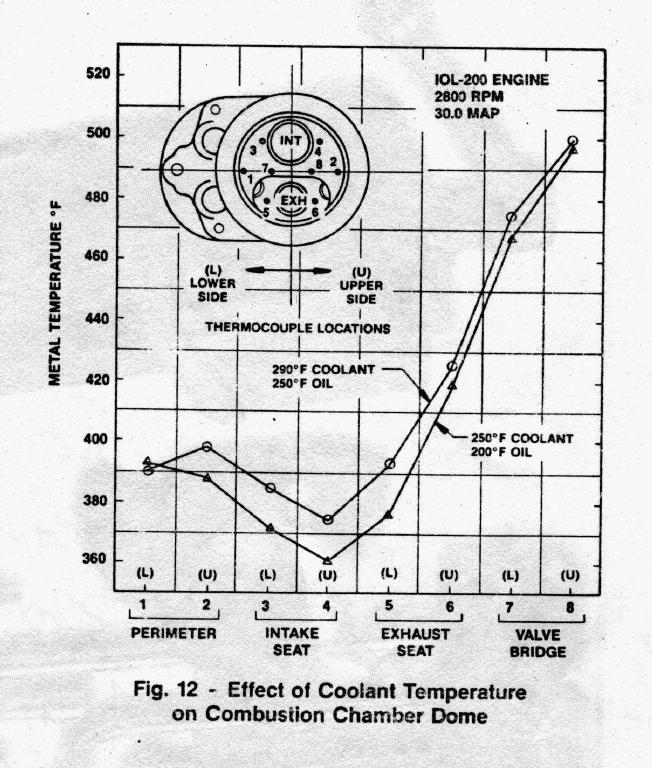
The real critical limitations of the aluminum head engine are
thoroughly explored. That is; the temperature of the metal
immediately adjacent to the combustion chamber. Aluminum loses half
of it's fatigue life when the temperature goes up from 250 degrees
to 500 degrees F. Therefor this temperature limits the amount of
continuous power obtainable from any engine whether air-cooled or
liquid cooled. Just because the coolant temp. is less than 220
degrees F does not mean the metal next to the combustion chamber is
anywhere near that at high power levels. The continuous HP
requirements are far higher for an aircraft engine than they are for
an auto engine or pickup truck engine.

The Automotive manufacturers rarely publish any real information
about engines in the SAE due to the highly competitive nature of the
automobile marketplace.  This paper is an outstanding exception for
the SAE. A must read bargain of real information.


The AirCraft Rotary Engine NewsLetter.  Powered by Linux.
ACRE NL web site. http://home.earthlink.net/~rotaryeng/
Copyright 1998-2003 All world wide rights reserved.