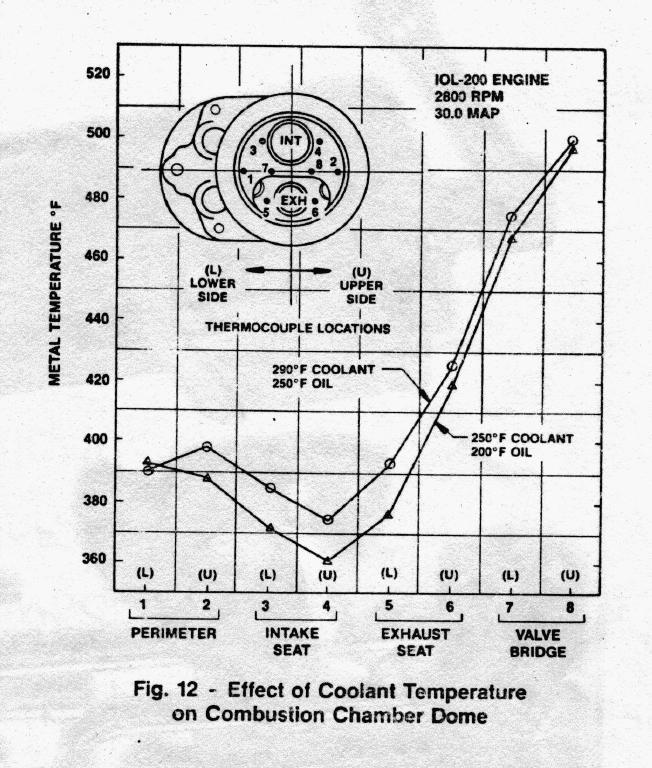
Here is what Allison and Rolls Royce found.

Paul Lamar
*************************************************************************

Engine Cooling Systems

Early in the development of liquid-cooled engines it was recognized that
water was the preferred coolant, due to its very high specific heat and
latent heat of evaporation. However, when coupled with the demand for low
radiator drag, i.e. a small radiator cross-sectional area, water at
atmospheric pressure was out of the question. Many attempts were made at
using some form of evaporative cooling, but this was quite troublesome and
was found to be totally impractical in a military aircraft. The feature was
demonstrated by some very innovative systems which were developed using a
large portion of the surface of the aircraft constructed to function as a
steam condenser. An excellent example being the upper wing-surface radiators
fitted to the Curtiss V-1400 powered Curtiss R3C-2 Schneider Cup racers of
1925.
In view of these limitations, in the 1920s Wright Field pursued use of
chemical coolants having high boiling points, and ethylene glycol was found
to be particularly ideal for the purpose. Not only could it remove large
quantities of heat by operating at high temperatures, but it operated at
comparatively low pressure, while also possessing inherent anti-freeze
capabilities. Consequently, the Allison V-171O and the contemporary
RollsRoyce Merlin, were both developed to operate on nearly pure ethylene
glycol, known by the trade name of "Prestone" in the U.S. Should the coolant
be diluted with water by more than about 5 percent, its cooling capabilities
at low pressure were greatly diminished.
From this work the Arrny had originally intended to operate its Prestone
cooled engines at 300 oF. Initial operation of the XV-171 0-1, which was
designed to accommodate both Prestone and the 300 of temperature, resulted
in an interesting finding. The high temperature was causing the amount of
heat absorbed by the engine oil to increase to the point where the oil
cooler would have to be as large as the radiator. When Allison took
everything into consideration it was found that 250 degrees was a more
realistic temperature, and all subsequent V-1710's operated at this
temperature. Even with its advantages, Prestone cooling was still not as
effective as water cooling, and it still caused numerous problems within the
entire aircraft cooling system due to its tendency to "creep" through joints
and other small passages. By comparison, water was easier to control.
With this knowledge, Rolls-Royce in 1938-39 began to advocate use of
pressurized water cooling." In such a system the pressure forces the water
to remain a liquid, preventing boiling and steam formation, even at
temperatures in the 250 to 300 degree range. They proposed adding 30 percent
ethylene glycol to the mixture, but only to function as an antifreeze. The
solution remains liquid down to -15 'C.
Rolls-Royce had originally switched their Merlin to chemical cooling after
finding out about its advantages, and its use in the Allison during a visit
to Wright Field in April 1935. They were then the first to switch to
pressurized water cooling for production installations, with Allison
following in 1942. Allison also specified a similar 70 percent water, 30
percent ethylene glycol mixture, and both manufactures requiring something
less than one percent corrosion inhibitors in the mixture as well. With the
institution of pressurized water cooling it was again possible to allow
increasing the power output of the V-171O, as the water was particularly
effective in increasing cooling of the hot spots in the cylinder heads
around the valves. This can be seen in tables of engine model versus type of
cooling.
Another difference in the cooling concepts between Allison and RollsRoyce
was Allison's practice of reliance on liquid-phase convective heat transfer
while Rolls used predominantly vapor-phase cooling, meaning that local
boiling would be allowed at hot-spots. The result was believed to provide a
lighter and perhaps more effective cooling system for the Rolls engines49
Changing from one type of coolant to the other was not a simple matter of
draining one and filling with the other. The plumbing itself had to be
changed to accommodate the relative amounts of vapor being produced and the
proper location of system components such as the radiator, expansion tank,
vapor separator and connections to the coolant pump.
Collaboration of the effectiveness of Allison's switch to pressurized
water in its coolant system, was provided by the NACA-LMAL laboratory at
Langley Field, Virginia, in 1944.50 In the course of their work on
investigating the cooling requirements of the V-3420, they found that in
general, the reduction in engine-head temperatures in changing from 100
percent glycol, or 80-20 glycol-water mixtures to either 30-70 or 0-100
Prestone water mixtures were preferable in the V-171O.
Allison identified two locations within the engine for which cooling was
of critical importance. These were the piston crown and between the
exhaust valves in the cylinder head. They successfully limited the
pistoncrown temperature by controlling the amount of coolant provided to the
cylinder barrels. The switch to water based mixtures was effective for
improved cooling of the cylinder head, as some vapor production was then
allowed. The nature of vapor production in pressurized water is that the
temperature remains constant as long as liquid is present, a very desirable
feature within the heads.
With the one-time "standard" 97 -3 glycol-water mixture, between the
exhaust valve temperatures in the V-1710 were about 512"F.51 With the change
to 30-70 mixtures the this temperature was reduced to about 456'F.
Pure water, the best coolant, only offered a reduction to about 444'F, all
of this using 35 psig at the cylinder block outlet." It should be clear why
the change in coolant mixtures was adopted, for it provided a wider margin
to detonation for engines being operated at very high Military and WER power
ratings.
******************************************