Jon, your
     > radiator comments show that you were not quite
     > getting what Paul was intending. The INTENTION
     > was to run a typical temperature of around 250°
     > with protection up to 300°+. At the elevated
     > temperatures the delta T would be higher therefore
     > requiring a smaller radiator. If the delta
     > difference would improve the overall rejection
     > or just get it back down to normal with pure EG
     > is the question.

No, I think I understand that. The relationship of radiator size as
a function of fluid thermal characteristics and delta T should be
readily calculable (by someone else!!!) My gut feel is that you will
"meet yourself coming back..." the inferior thermal properties of
the fluid will more than negate the benefits of the increased delta
T and the radiator will end up being the same size or larger. I
could certainly be wrong.

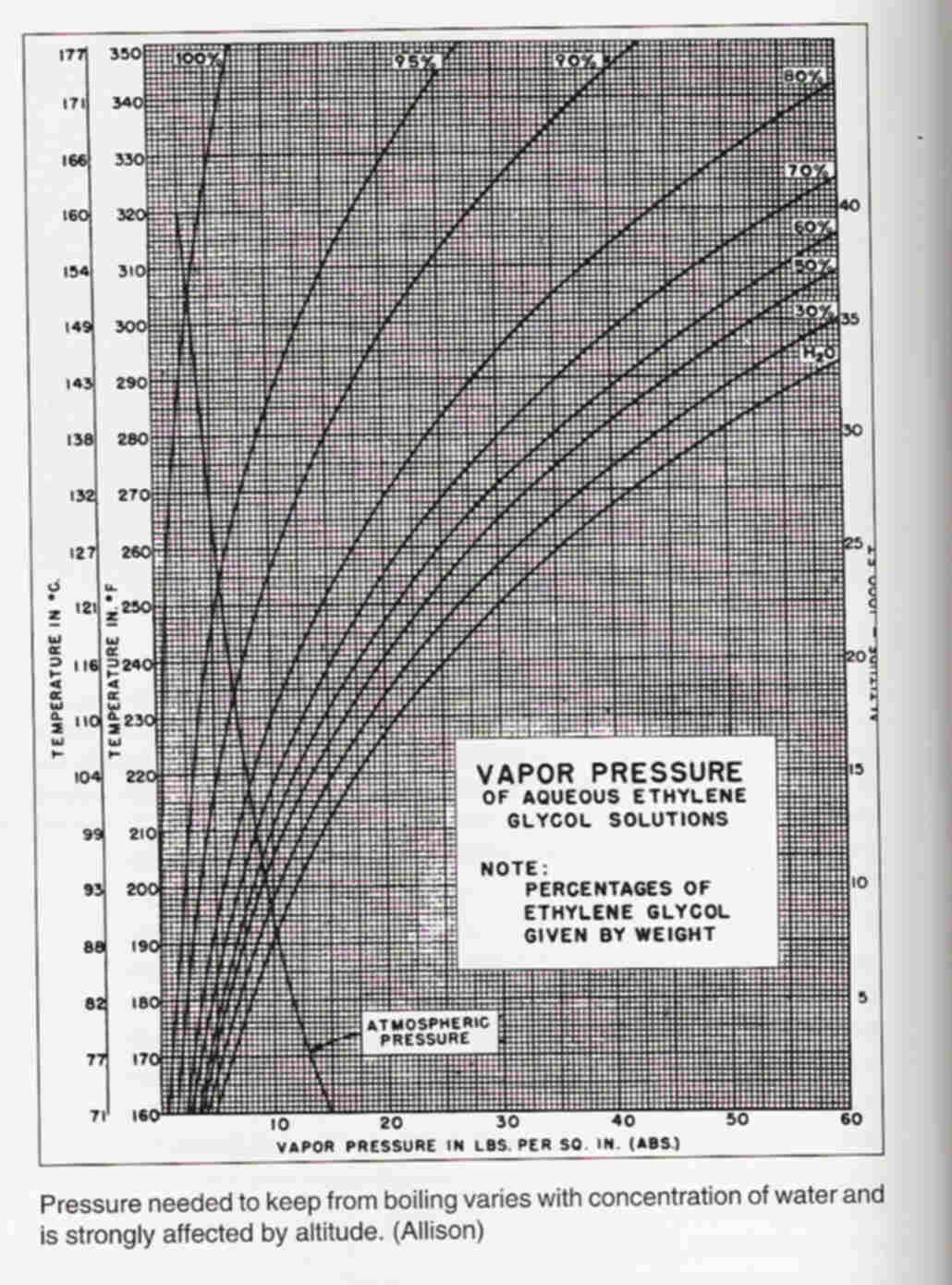
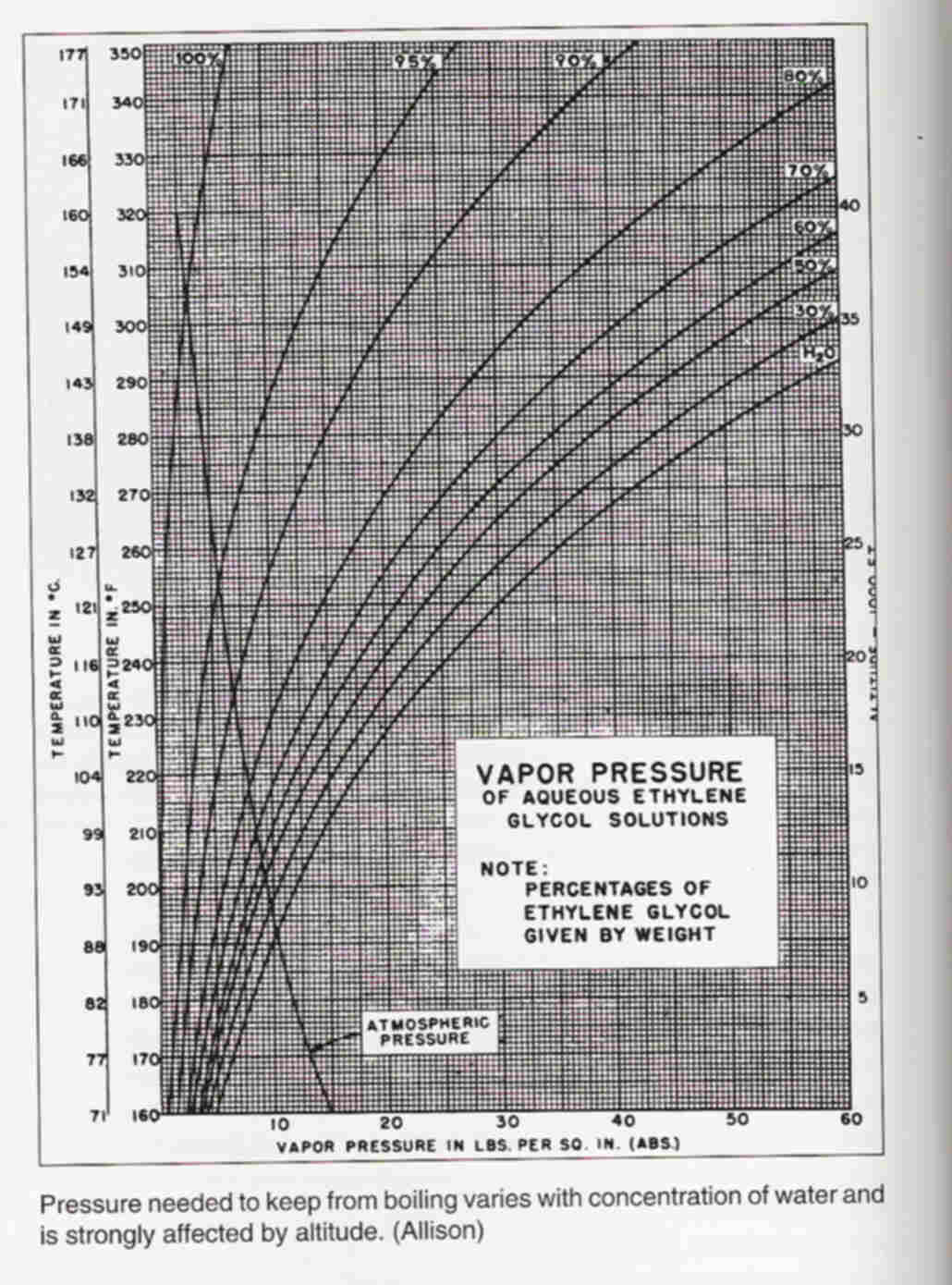
50-50 EG with a 14 PSI pressure cap will boil at 257F if memory
serves correctly. If the "normal" cooling system design point is,
say, 205F, there is a 50 degree margin to boiling. With the
alternate fluid and a higher design operating point, there may be a
slightly higher margin to boiling. Not really significant in my
view. And there can be NO ARGUMENT that the inferior fluid
properties will cause an increase in rotor housing temperature...
the maginitude of the increase is at least a degree for every degree
of increase in bulk fluid temperature, possibly much more if
nucleate boiling is the dominant heat transfer mechanism -- which is
dependent on the power level of the engine. (Which reminds me, and
this is VERY SIGNIFICANT when it comes to a comparison with
automotive piston engine cooling systems... automotive piston
engines are NOT designed to operate with nucleate boiling. The heat
flux isn't high enough. Thus, they can PROBABLY operate more safely
at higher bulk temperatures without causing metal temperatures to
rise more than a degree for a degree.) So, again, I come to the
point of "why bother?" A straightforward analysis can determine if
the radiator size can be reduced by running a higher boiling point
fluid at a higher bulk temperature... the effect on engine
durability can't be determined so easily. And it still comes down to
the fact that there are precious few "soft" failures of the cooling
system that will cause boiling with 50-50 EG that wouldn't also
cause boiling (or engine failure without boiling) using a different
fluid. I am assuming that in an aircraft, the cooling system will be
properly designed for all reasonable ambient conditions, and that
the system will be maintained to avoid failures.

I was the chief engineer on a military project to design a liquid
cooled heavy fuel rotary engine for an unmanned air vehicle.
Radiator size and weight was absolutely critical for this
application, which had a requirement for full power operation on a
125F day. We looked at all the options VERY carefully, and concluded
that EG-Water was the best cooling medium. Don't recall the
proportion, I think it may have been slightly different from 50-50
to optimize things to the last possible degree... I no longer recall
most of the details on the cooling system design, but that
experience is what has guided my comments on this thread.

Jon
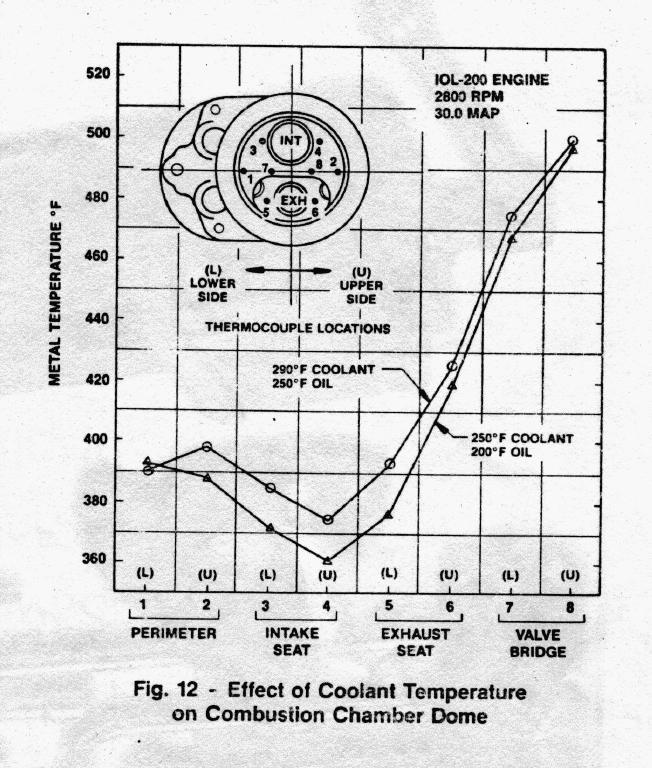
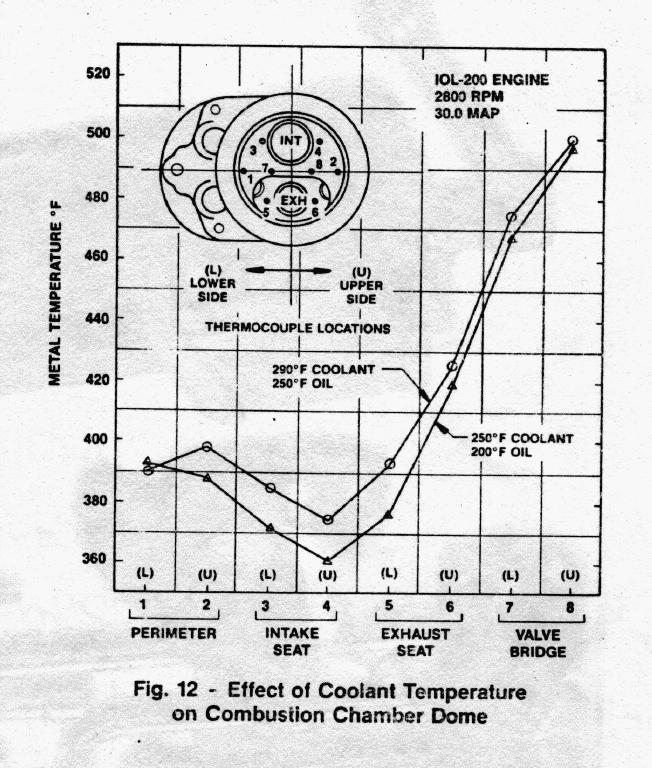
Here is the Allison data again on boiling at various pressures and
EG/water mixtures. Also the Continental data showing no increase in
critical metal
temperature going from 250 F to 290 F coolant temperature.

That is what the Allison and Continental  experiments were all about.
They felt the  disadvantages of the cooling properties of EG were
outweighed by the advantages of the  higher delta T. My contention is
the rotary combustion chamber is more robust than an aluminum
combustion chamber. More tolerant of higher temps.
Obviously there are no exhaust valves to cool.   Furthermore the
synthetic lubricants and high temp O-rings available today justify
another look.

I intend to do that on the dyno engine by simply tracking coolant temp
with rotor housing temp. Way back I stated we needed to do this when
people were advocating pure Evans PG as a coolant. It never happened.

Paul Lamar

****************************************************************
Subject:         High boiling point coolant.
   Date:         Thu, 07 May 1998 17:07:02 -0700
   From:         paul-lamar-la@worldnet.att.net

Some more info on Evans propylene glycol coolant (no water).
(EGW is eth. glycol water mix.)

-------------------------------- Water --- 50/50 EGW --- Evans
-------------------------------- @16 psi -- @16 psi ---- @0 psi
Boiling Point ---------- F ----- 252 ------ 268 --------- 369
Viscosity 212 F ------- cp ----- 0.28 ----- 0.7 --------- 2.35
Density 77 F --------- lbs/gal - 8.34 ----- 8.84 -------- 8.59
Specific Heat 212 F -- cal/g.K - 1.0 ------ 0.88 -------- 0.71
Heat of Vapor. ------- cal/mol - 9.7K ----- 9.8K ------- 12.5K
Vapor Press. 176 F ---- hPa ---- 490 ------ 400 --------- 11
Surface Tension 77 F --dyn/cm --- 72 ------- 56 --------- 36

Jack Evans also recommends upping the flow to 90 gal/min in a
small block running at 7,000 to 8,000 RPM because of the lower
specific heat. (This alone may be the main benefit.)

Special rads are needed to flow 90 gal per minute. He sells a
27.5 by 15 inch, two rows, 1.25 inch tubes with #14 AN fittings.
All rads have 18 fins per inch. Looks pretty good for an
aircraft. He also sells a 22 by 13 inch, two rows, one inch tubes
with auto hose fittings.

He claims his system and pumps pay off in terms of increased
gross HP out verses increased pump HP in.

He also calims that 220 to 240 F oil temp is optimum. (What
weight oil?)

They will send you reprints of a couple of articles including the
one I mentioned in High Tech Performance magazine if you ask.
Don't tell him you are going to run it in an aircraft.

http://www.evanscooling.com

***********************************************************

The AirCraft Rotary Engine NewsLetter.  Powered by Linux.
ACRE NL web site. http://home.earthlink.net/~rotaryeng/
Copyright 1998-2003 All world wide rights reserved.